
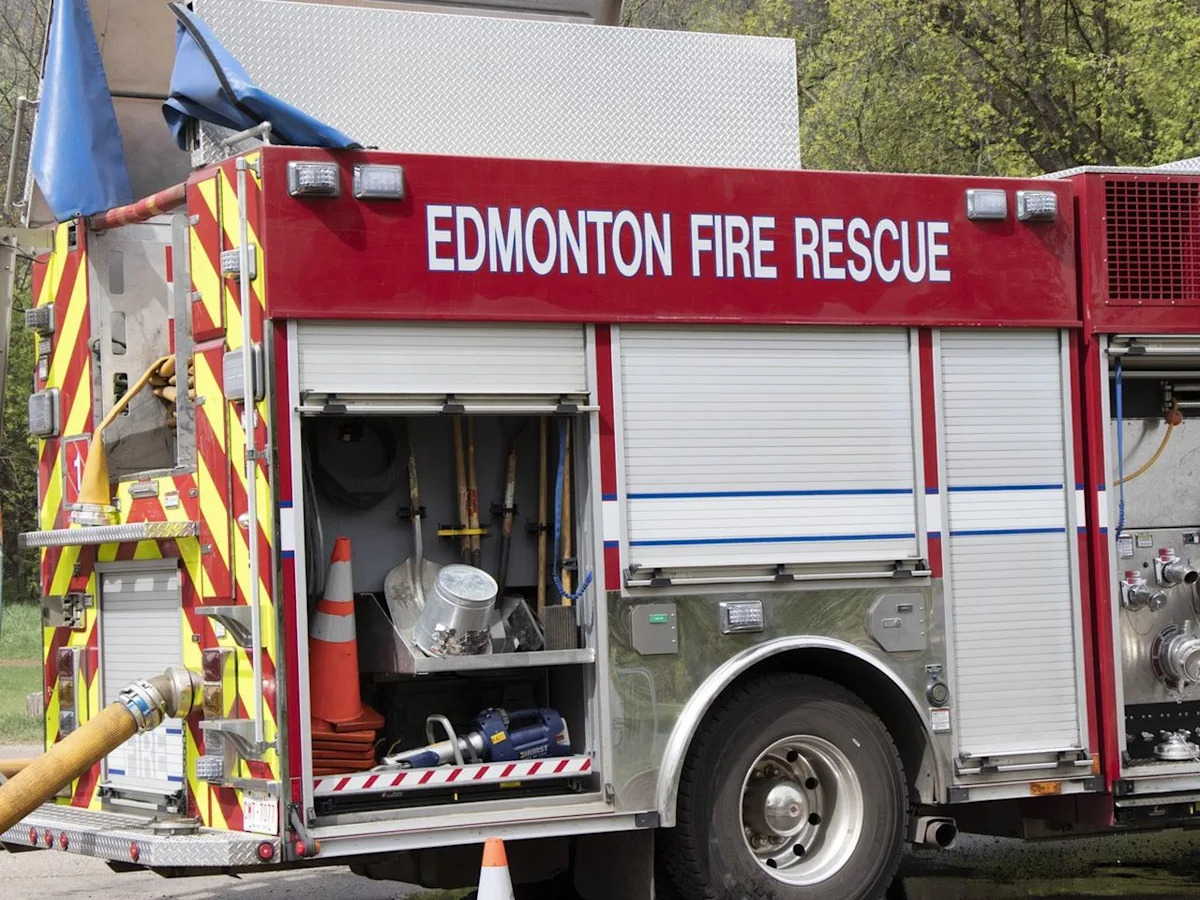
The City of Edmonton is scheduled to replace 37 fire trucks over the next budget cycle.
But, with an already strapped budget and a maintenance shortfall that’s in the billions of dollars, the fire truck issue is already sounding alarm bells with councillors.
Why? Because fire truck prices have doubled since COVID, and show no signs of slowing down. And that means replacing 37 trucks will cost the city millions more than it would have just a couple of years ago.
The Canadian Association of Fire Chiefs pins the cost of a new fire truck at between $2 million and $3 million.
The pricing issue is bad enough that Ward papastew Coun. Michael Janz believes that the federal government needs to step in and make fire security part of its national defence strategy. This might be a way to provide some cost relief to municipalities across the country that are experiencing fire-truck sticker shock.
“This is putting excessive profit-seeking ahead of public safety,” said Janz. “There’s no reason under the sun why fire trucks should be this expensive, especially as one of the greatest threats to our city and to our country is wildfires right now. This is an area where Mark Carney should absolutely be stepping in, because fire trucks are part of our critical national defence strategy, whether it’s the Fort McMurray fire, the Jasper fire, whether it’s risks to the Industrial Heartland, you can’t have a safe country, you can’t have a true north, strong and free unless you can protect us from from fires.
“Edmonton taxpayers should not be on the hook because of our country’s failure to break up the monopolies.”
Janz believes Ottawa need to step in and nationalize fire truck manufacturing. He believes the vehicles need to be categorized as “critical.”

Edmonton Ward papastew Coun. Michael Janz in council chambers on Jan. 27, 2026. Photo by Shaughn Butts/Postmedia
Sure, some might roll their eyes when Janz, who sits on the progressive side of the city council table, suggests nationalizing or placing price controls on an industry. But, in the United States, both Democratrs and Republicans have decried what has happened to the emergency-vehicle industry.
In 2025, Indiana senator Jim Banks, a Republican, and Democrat Massachusetts senator Elizabeth Warren, began an inquiry into how fire trucks became so expensive, so fast.
Banks issued this statement, “While CEOs and shareholders pad their pockets, consolidation in the industry impedes firefighters’ ability to do their jobs safely and effectively, squeezes fire departments’ budgets, and forces taxpayers to bear the consequences.
“We have heard from dozens of fire departments in Massachusetts, Indiana, and elsewhere about difficulties they have faced related to serial roll-ups of fire truck manufacturers, including delivery delays, defective parts, and price increases. Private equity consolidation of fire truck manufacturers has led to higher costs and a nationwide shortage of fire trucks.”
Floating prices
Warren said that communities that order fire trucks face “floating” prices. That is, a price is agreed upon, but it could change before delivery. And the truck won’t be delivered unless the municipality makes up the difference on the new, increased price.
There are also stories of long delays between the ordering of the trucks and deliveries.
Well, go back in time, and you’ll find that most of the major manufacturers made fire trucks. GMC was in the business. So was Ford.
But hedge funds got involved in the business, and now there are three major American manufacturers left. REV, which was created through the roll-up of a number of manufacturers, is by far the largest. Oshkosh and Rosenbauer are the other players. But, they control the market. Because there isn’t a lot of choice, the buyers can’t find price relief. And the manufacturers know they have a captive market, because municipalities can’t really cut back on ambulances and firefighting equipment.
While Janz calls out the problem, so do hardcore Republicans in America.
Mayor Andrew Knack said the city is already facing a “renewal deficit” of $1.5 billion over the next four years. That’s what’s needed for regular replacement and maintenance of city property, from vehicles to buildings. Right now, the city doesn’t have enough money to even meet that need.
And the fire-truck question burns. These are must-haves. Knack acknowledges the city has to continue to invest in fire safety, but where’s the money? The mayor said the city can’t go on without more funding from other levels of government.
“It’s also why we’ll continue to work with the provincial and federal governments to talk about municipal funding,” said Knack. “You know, we’re responsible for about 60 per cent of the infrastructure, and we receive about eight cents of every tax dollar, all at a time where we are seeing a lot of renewal. And this isn’t just an Edmonton problem. This is a Calgary challenge. This is a challenge in every summer village, village, town, small city, midsize city. How we fund infrastructure needs to be very thoughtful going forward, and we’ll continue to work with all the partners in government on this.”
The Canadian Association of Fire Chiefs has issued a policy statement urging the federal government to include firefighting equipment in its national defence budget. In 2025, the federal Liberals pledged that 1.5 per cent of GDP would be dedicated to defence spending. The association said that new fire trucks should be part of that plan.
“National security is impacted when local communities are vulnerable to emergencies,” reads the statement from the association. “The longer we delay the restoration of local equipment, the more expensive it becomes due to supply chain lead times, tariffs and surtaxes.”
A 2025 Canadian Association of Fire Chiefs report found that 1,500 fire departments across Canada need new fire trucks, and the cost to replace them all would be around $2 billion. Edmonton’s 37 fire trucks are part of a national problem.
The squeeze is on
Janz said the fire department is already trying to stretch the lives of old vehicles.
“Guys are trying to duct-tape trucks together and figure out what they can do,” he said. “We’re already trying to do anything we can to squeeze more kilometres out of these trucks. But, at the end of the day, you don’t want to be gambling with faulty equipment or a faulty truck. I know of a ladder truck that was out of commission, and that means some other ladder has to come from somewhere else, farther away, and that means a slower response time. And when you’re in the fire business, seconds matter.”
As well, the city needs new fire halls to service many of the new neighbhourhoods outside of Anthony Henday Drive. Knack said that the city will need to build them, but hopes to work with developers.
“We’re working with the development community to say, is this something that they can build in order to help make sure we get the six fire halls that we need in the city as soon as possible?” said Knack. “Because if we’re building all six ourselves, then that puts the renewal at risk. And so that’s why we’re engaging the development industry around how we can come up with creative solutions for this.”
But guess what those fire halls need? New fire trucks. And that’s more to add to the city’s order over the next few years.
Related
.Bookmark our website and support our journalism: Don’t miss the news you need to know — add EdmontonJournal.com and EdmontonSun.com to your bookmarks and sign up for our newsletters here.
You can also support our journalism by becoming a digital subscriber. Subscribers gain unlimited access to The Edmonton Journal, Edmonton Sun, National Post and 13 other Canadian news sites. Support us by subscribing today: The Edmonton Journal | The Edmonton Sun.