
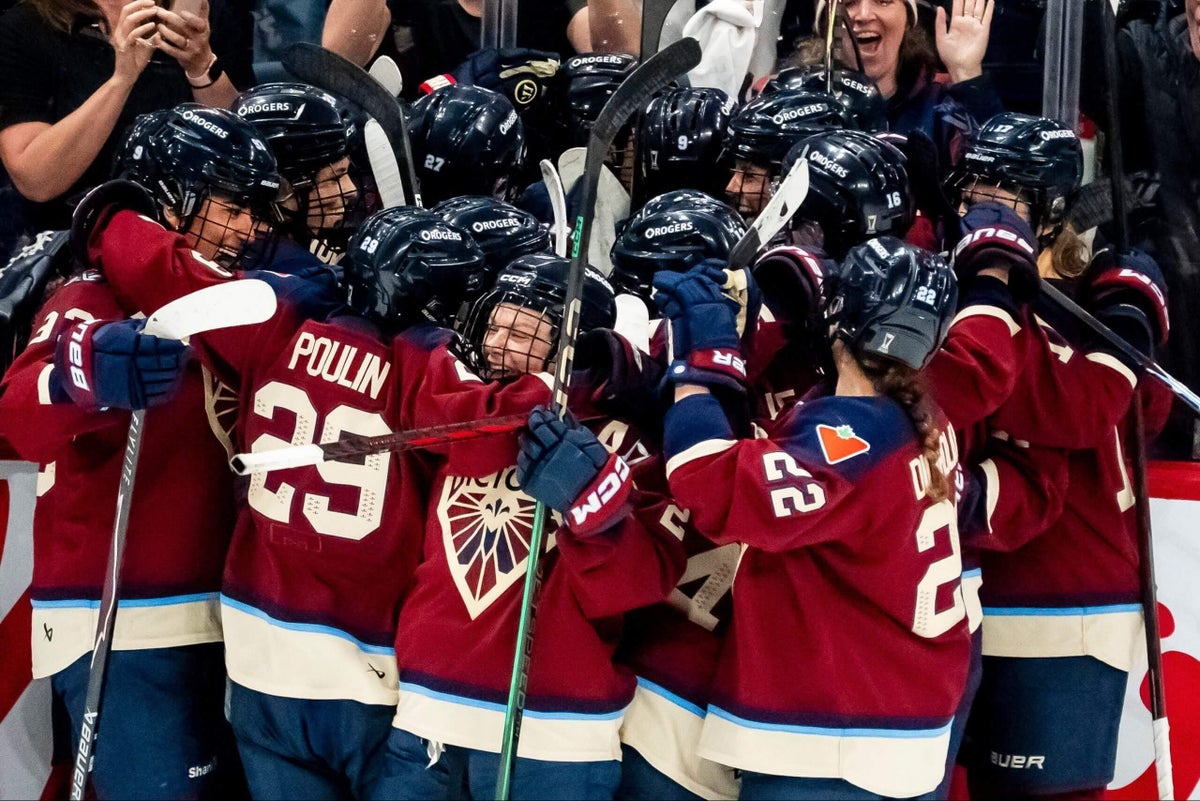
LAVAL, Que. — After 74 minutes spent limiting Montreal’s opportunities, the Ottawa Charge saw the puck end up exactly where they didn’t want it: on Marie-Philip Poulin’s stick in overtime.
Despite an injury, Poulin, the greatest clutch player in the history of the sport, had already scored two game-winning goals in the 2026 PWHL postseason. So, naturally, when she got the puck deep in the offensive zone, nearly every Ottawa Charge skater converged into the corner, hoping to keep Poulin from netting a third.
The problem with that plan?
Maggie Flaherty was left wide open — and screaming for the puck — alone in front of Gwyneth Philips. And somehow, through a crowd of five white jerseys, Poulin made a perfect pass to Flaherty, who scored the game winner to give Montreal a 2-0 series lead in the best-of-five Walter Cup Finals.
“I don’t know how many players get the kind of coverage that she gets,” Montreal coach Kori Cheverie said postgame. “Luckily everybody tried to take Pou, and luckily Maggie screamed for that puck and it was right on her tape.”
Poulin, of course, refused to take credit for the play. Instead, she called it a “great team effort.” She shouted out Ann-Renée Desbien’s “amazing” save on Alexa Vasko to send the puck the other way, Kaitlin Willoughby’s “very smart” rim around the boards, Abby Roque’s pass and Flaherty’s ability to find the open space.
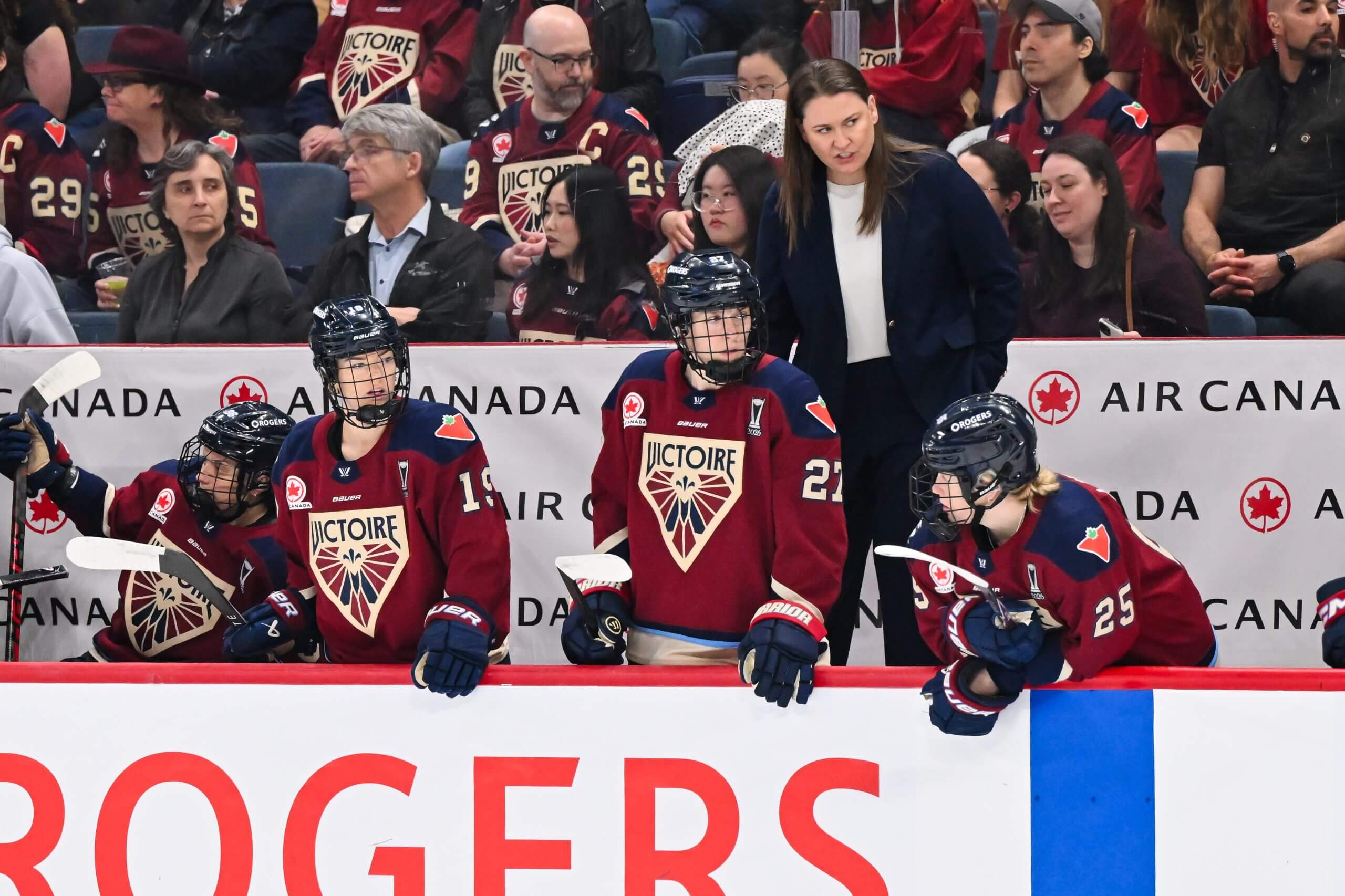
Coach Kori Cheverie and the Montreal Victoire have gone to overtime in four of their seven postseason games in 2026, winning three. (Minas Panagiotakis / Getty Images)
Montreal defender Kati Tabin, who scored her first goal of the playoffs in the second period, offered her own explanation.
“She’s got eyes on the back of her head,” Tabin said.
“All around her head,” Flaherty added.
Poulin’s assessment of the team effort might be true, but you also can’t deny the way she’s been able to step up in the biggest moments time and time again. Those around Poulin — such as Cheverie, who has been an assistant coach for Team Canada since 2020-21 — aren’t even surprised anymore.
“It just happens so regularly that you (almost) expect it of her,” Cheverie said. “We don’t put that pressure on her, either. We just know that she’s going to play her game, she’s going to make everybody else better, and she’s going to be able to execute on plays like that.”
Poulin now has a league-leading 7 points in seven playoff games, all scored while clearly not 100 percent.
The fact Ottawa defender Emma Greco was tripped up on the play — with no whistle — certainly did not help Ottawa’s D-zone coverage. Even Charge coach Carla MacLeod, ever the optimist, expressed frustration with the non-call.
“Obviously we probably put too many players in towards the puck,” she said. “Our net-front D has got to be net front, but if she gets her feet wiped out from her from behind right before that play, it’s pretty hard to get back to where you need to be.”
The result was Flaherty wide open for her second goal of the postseason. And now, the Victoire are just one win away from hoisting their first Walter Cup. With their season on the brink, the Charge will host Game 3 on Monday night (6 p.m. ET) at the Canadian Tire Centre.
Ottawa strikes first (again)
Heading into the Finals, the Ottawa Charge knew beating Desbiens would be a challenge. She set league records for wins (19), save percentage (.955) and goals-against average (1.11) this season, and in the final four games of the semifinals against Minnesota allowed four goals on 122 shots (a .967 save percentage).
But the Charge also found a winning recipe against U.S. Olympic gold medallist Aerin Frankel in the semifinals, beating her nine times on just 93 shots. That .903 save percentage is far worse than Frankel’s previous career low, a .921 save percentage in the 2024-25 season.
“The recipe doesn’t change,” Ottawa captain Brianne Jenner said. “It’s (about) how hard are you going to work to get in front of her, to get on those loose pucks around the net just to make her life as difficult as possible, because we know she’s a great player.”
In a first period with more dump-ins and play along the walls than zone time for either team, Ottawa created the exact kind of chaos it needed to best Desbiens.
Rookie forward Peyton Hemp won a puck battle below the goal line and sent the puck into the slot for Gabbie Hughes, whose shot snuck by Desbiens and hit the crossbar. As Desbiens turned to find the loose puck, Poulin and Flaherty jumped into the blue paint as Ottawa forwards crashed the net.
Eventually, rookie Sarah Wozniewicz took a final whack at the puck to beat Desbiens (and Poulin, who was standing in the crease).
“I don’t think it’s going to be a pretty goal (against Desbiens),” Wozniewicz said on the broadcast at the end of the period. “We gotta go to the net and get the rebounds and I think that’s how we’ll score.”
Wozniewicz, Ottawa’s third-round draft pick, was among the highest-scoring rookies in the PWHL this season with seven goals and 13 points while playing mostly on the Charge’s top line with Jenner and Rebecca Leslie. Wozniewicz joined the Charge after four years at the University of Wisconsin, where she established herself as one of the best checking forwards in college hockey.
Her game has translated well to the PWHL — and in the playoffs, as Wozniewicz is now riding a three-game point streak dating to Ottawa’s semifinals clincher against Boston.
“(Sarah) has had an amazing rookie season,” Jenner said Saturday. “She’s been so great for us, playing so many minutes. She’s got an awesome shot, obviously super fast. She’s been great for this whole stretch.”
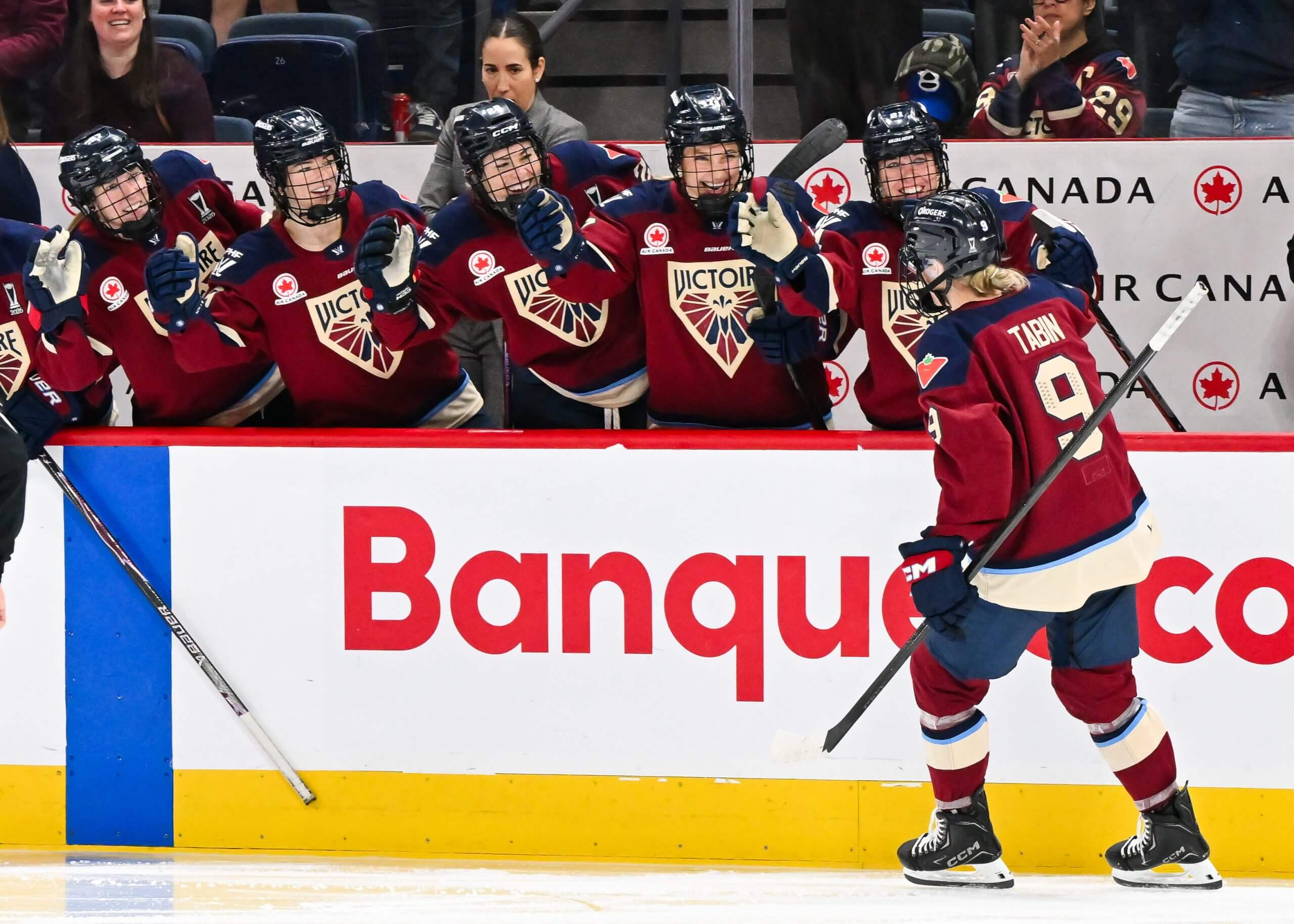
Kati Tabin scored the tying goal for Montreal in Game 2. (Minas Panagiotakis / Getty Images)
Tabin turns the tide
Tabin’s tying goal — 32 seconds into the second period — was huge, and provided the kind of depth scoring Montreal has lacked in previous playoff attempts.
In three years with the Victoire, Tabin has established herself as a steady shutdown defender — and an absolute pain to play against. But on her first career playoff goal, Tabin flashed some impressive skill.
On an offensive zone faceoff for Montreal, with the teams playing four-on-four, Poulin directed Tabin to slide down to the middle of the circle. The puck dropped to a bit of a broken play, but Tabin was able to jump on it in the middle of the ice and wound up one-on-one against Philips. Tabin pulled the puck to her backhand and elevated it blocker side for a stunning finish.
“We know she has that ability to do that and I’m so happy for her that she was able to pull that out tonight,” Cheverie said. “I think that that should boost her confidence even more with how valuable she’s been to our team.”
When asked after the game if players knew Tabin had a backhand finish like that, Flaherty laughed and Poulin nearly spit out her water.
“I have seen it in practice a couple of times,” Flaherty said, noting that there have been a couple of whiffs over the course of the season. “That was the best executed one.”
That goal wasn’t the first time Poulin has dictated where she wants her teammates on an O-zone draw. In Game 5 of the semifinals against Minnesota, she had Catherine Dubois move a few steps to the right. Poulin won the draw clean to a waiting Dubois, who scored a massive opening goal in Montreal’s eventual win against the back-to-back champs.
A low-scoring affair
After 60 minutes, Ottawa and Montreal combined for two goals — the second-lowest score at the end of regulation in this year’s playoffs — due to low shot volume and strong goalie play.
Saturday’s game was a tight and physical contest with almost as many hits (22) as shots (26) in the first two periods.
“When you’re playing for a championship, the physicality is going to be there,” Ottawa’s MacLeod said on the PWHL’s broadcast ahead of the final frame. “Both these teams are passionate, both these teams are great — it’s playoff hockey.”
By the end of the third, Desbiens (16) and Philips (23) had both faced their lowest shot totals of the playoffs and turned aside all but one goal each. Philips was a bit busier in the first period (11 shots against) and the third (eight shots against) and made big saves on two breakaway attempts by Laura Stacey. Desbiens, meanwhile, never faced more than six shots in a period.
“I think the game and the stats speak for (themselves),” Ottawa forward Emily Clark said. “We’re two great hockey teams and both want it really bad. Both teams are laying it all out there.
“This league is physical. This league has great goalies. You’ve got to get a lot of shots. I think we have some tight competition out there obviously.”
Flaherty’s winner
Like Tabin, Flaherty is known more for her physical presence and defensive game. But, she’s also incredibly opportunistic when it comes to her offensive opportunities.
In Game 1 on Thursday, Flaherty’s first shot attempt deflected off Stacey’s stick and Roque’s face to find the back of the net for the overtime winner. On Saturday, her first shot of the game beat Philips clean.
The 25-year-old won back-to-back Walter Cup titles with the Minnesota Frost before signing with Montreal in the offseason — one of the many moves by general manager Daniele Sauvageau that is paying off in the postseason.
“Every time we played against them, I always noticed Maggie,” Cheverie said. “I thought she had one of the best shots on their team from the point. (She’s) physical, mean, but also always had a smile on her face, which is really important for our group, too.
“She was definitely someone that we were looking to go after in free agency. We knew what she was able to bring, and tonight we saw it.”