
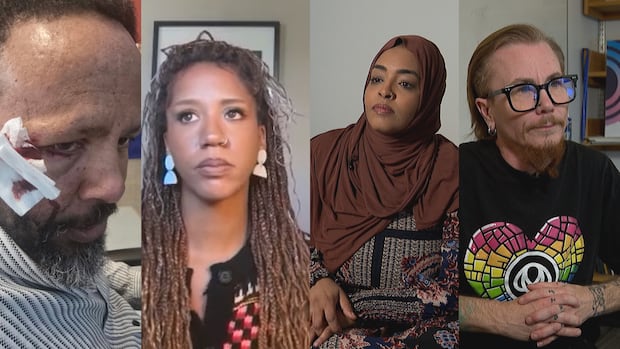
As reports of hate violence increase across Alberta, CBC News spoke with members of marginalized communities that have first-hand experiences of hate on how damaging and prevalent the violence is in the province.
Ali Wahed Noor is one of those people.
The 56-year-old Black man was assaulted as he was driving home with his family from a Muslim centre northwest of Edmonton in early May.
Noor stood solemn as he provided an update on his conditions during a news conference on Friday, surrounded by members of his community, elected officials and RCMP.
“It was painful, traumatic and frightening. No person should ever be targeted because of their faith, race or identity,” Noor said.
 Ali Wahed Noor, left, was attacked in St. Albert on May 1, while driving home from prayer with his family. He provided an update on how the attack has impacted him during a news conference with community on May 8. (Nathan Gross/CBC)
“This attack has deeply affected me and my family. It has taken away our sense of safety and peace. I’m speaking today because I don’t want anyone else to experience this kind of hate — Islamophobic racism or violence should never be accepted in our community.”
RCMP said a 40-year-old St. Albert man has been charged with aggravated assault and uttering threats in the incident.
Police said additional hate crime charges could be considered in court. Evidence will be provided to the Crown prosecutor’s office and may be considered an aggravating factor in determining the final outcome of the case.
WATCH | ‘It has taken away our sense of safety,’ says St. Albert man after attack: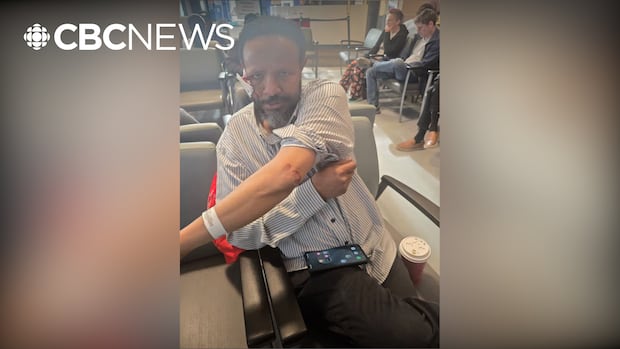
St. Albert assault victim says he was called racial slurs [GRAPHIC CONTENT]
A man who was assaulted last week, just northwest of Edmonton, says his family’s sense of safety is gone. As CBC’s Nicole Healey reports, now the Muslim Association of St. Albert is calling for justice. Warning: some viewers may find this story disturbing.Increase in hate violence
Noor’s case isn’t an isolated one.
During April’s Edmonton Police Commission meeting, officials said they recorded an increase in reported hate violence in the city in 2025.
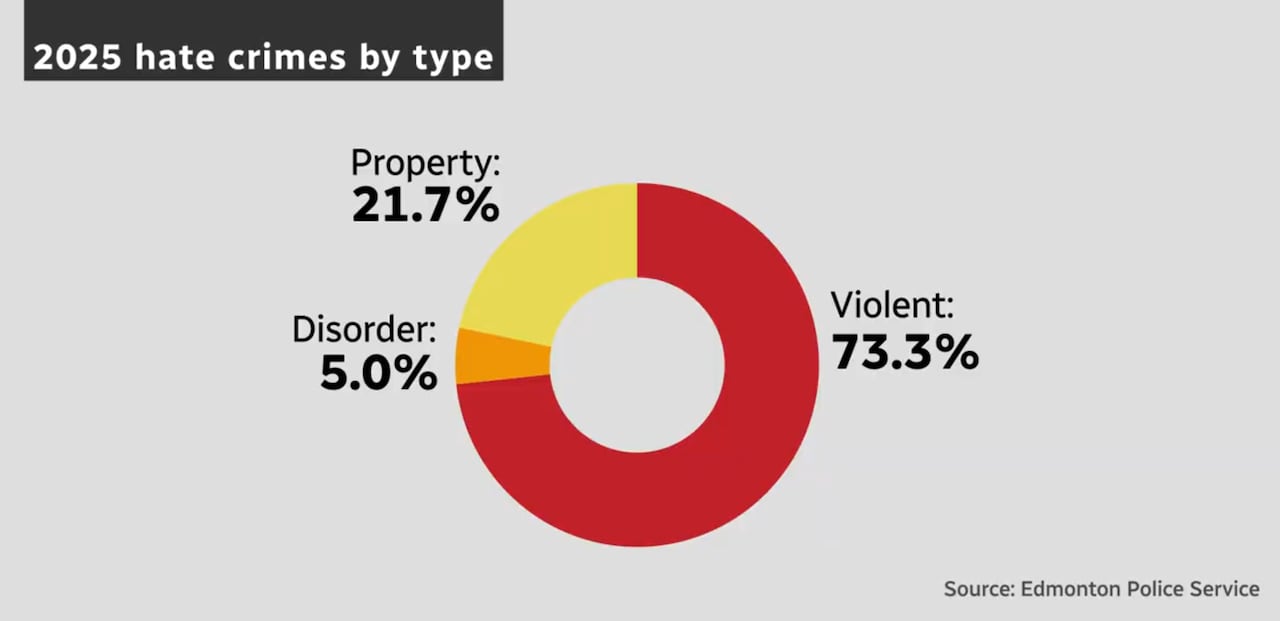
While 2025 had fewer total reports of hate crimes than the past few years, significantly more of them involved violence.
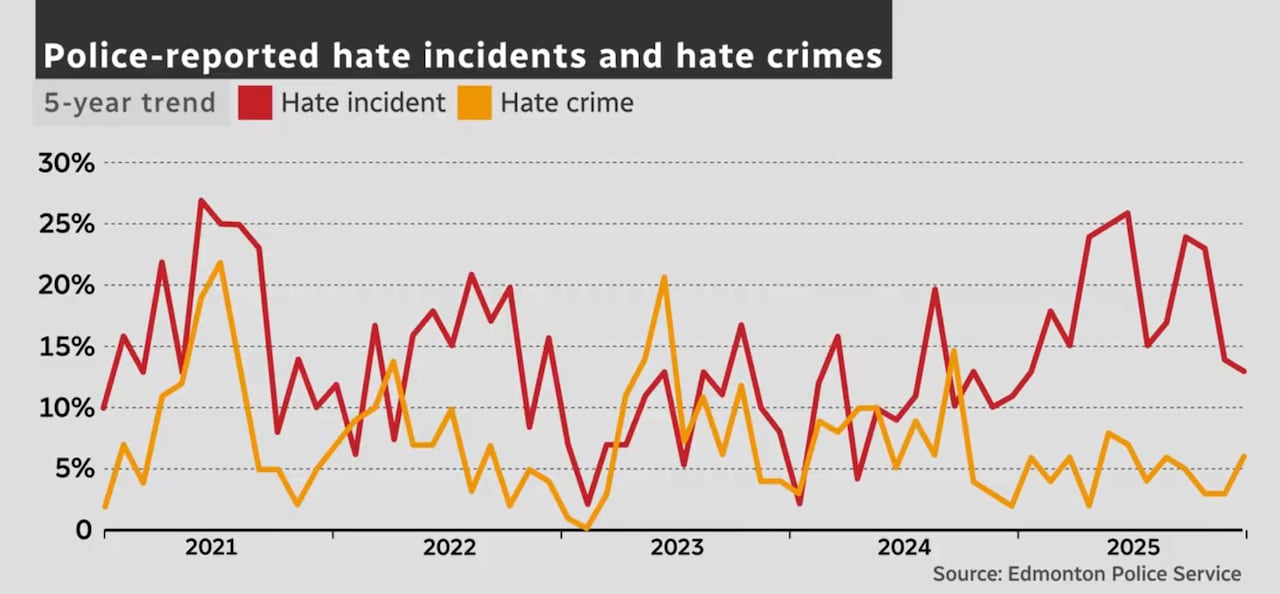 While 2025 had fewer total reports of hate crimes than the past few years, significantly more of them involved violence. (Edmonton Police Service/CBC)
The Edmonton Police Service defines a hate-motivated crime as a criminal offence committed against a person or property that is motivated in whole or in part by the suspect’s bias, prejudice- or hate-based.
Examples of hate crimes include violence, threats of violence, acts of mischief or graffiti, distribution of hate propaganda, threatening phone calls, and destruction of religious property or symbols.
According to EPS, a hate incident is a non-criminal action committed against a person or property and could include racial comments or slurs and offensive symbols.
“I want to recognize that hate crime reporting is one of the most underreported crimes for a variety of reasons,” Sgt. Amanda Ross said during her presentation to the police commission last month.
WATCH | Hate incidents increasing in our province: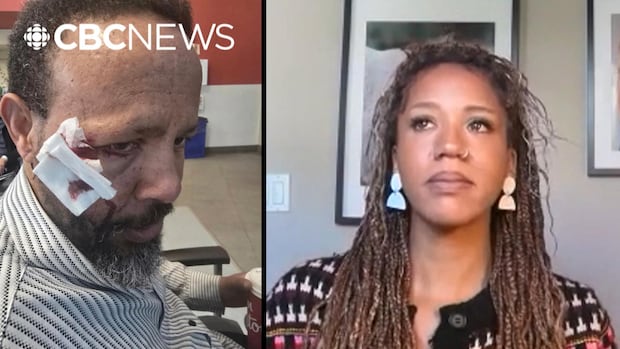
Here is the human impact of hate violence in Alberta
As reports of hate violence increase across Alberta, CBC News spoke with members of marginalized communities that have first-hand experiences of hate on how damaging and prevalent the violence is in the province.
“This includes normalization of hate in online spaces and in the community, lack of trust in the community or in the criminal justice system, fear of retribution or revictimization, and many other barriers that may prevent someone from coming forward to make a report to police.”
Ross said data from Statistics Canada shows only one in five hate crimes are reported to police.
“So we know that the real number of hate crimes and incidents are actually much higher.”
StatsCan data also shows that the rise in police-reported hate crimes isn’t limited to Edmonton, it’s risen across the province from 2020 to 2024.
 Examples of hate crimes include violence, threats of violence, acts of mischief or graffiti, distribution of hate propaganda, threatening phone calls, and destruction of religious property or symbols. (Edmonton Police Service/CBC)
Of the 60 hate crimes reported to EPS in 2025, 73 per cent of those were violent in nature.
This contrasts with the period between 2022-2024, which saw property hate crimes dominating reports.
There were 227 hate incidents reported in Edmonton in 2025, a number police said was double the amount it received in 2024. The majority of those reports fell under the category of disorder.
While there was a nearly 25 per cent decrease in hate crime reports from 2024 to 2025, hate incident reports saw about a 78 per cent increase over the same time period.
The 2SLGBTQ+ community reported the most hate crimes, police data shows.
EPS data also shows a rise in hate crimes against Black, South Asian and Arab people. Ross said part of this can be credited to geopolitics.
Factors surrounding hate
Const. Cydney Ross, who was also presenting findings on hate violence to the police commission last month, said there are ebbs and flows in how these types of events happen.
“Incidents and crimes may increase from what we call trigger events, which is an event that happens and then causes subsequent events to occur.”
She said examples of trigger events can include new legislation, military conflicts and political decisions.
Stacey Leavitt-Wright, CEO of the Jewish Federation of Edmonton, told CBC News that the Jewish community is one of the most targeted groups, and that the threat is disproportionately high when considering the size of the community in Edmonton.
“We’re a small minority, and yet we are on the receiving end of quite a bit of hate-motivated incidents,” she said.
“I think with social media, it almost gives a bit of cover that people feel a little more free to express themselves.”
Mousa Qasqas, spokesperson for the Canada Palestine Cultural Association, told CBC News that he believes there needs to be greater consideration and acknowledgement of anti-Palestinian racism in Edmonton.
“We, as a community, especially the Palestinian community, after … the last two and a half years of genocide in Gaza. We feel like even here on the streets … there’s not a nuanced enough discussion about anti-Palestinian racism,” he said.
“It’s often thrown in a bag with Islamophobia or some other type of racism, but it’s extremely nuanced.”
Israel’s current assault on Gaza began in retaliation for the Hamas-led attacks on the country on Oct. 7, 2023.
The Gaza death toll has been bitterly disputed since Israel’s assault began. Gaza health authorities, whose figures the United Nations has long deemed reliable, report more than 72,000 have been killed in the 28 months since October 2023, and estimate thousands more remain uncounted beneath destroyed buildings.
Israel has rejected allegations it is committing genocide in Gaza in the war with Hamas and has questioned those tallies.
Star Oldring is the rural program co-ordinator at the Fyrefly Institute, a hub for scholarly and community work related to sexual and gender diversity.
They advise RCMP officers in rural Alberta communities on 2SLGBTQ+ hate crime procedures, documentation and followup. Oldring also works with EPS’ hate crimes division.
Oldring points to the Alberta government’s passing of Bill 26, Bill 27, Bill 29 and Bill 9. They said they believe these pieces of legislation have created a vitriolic environment for queer communities.
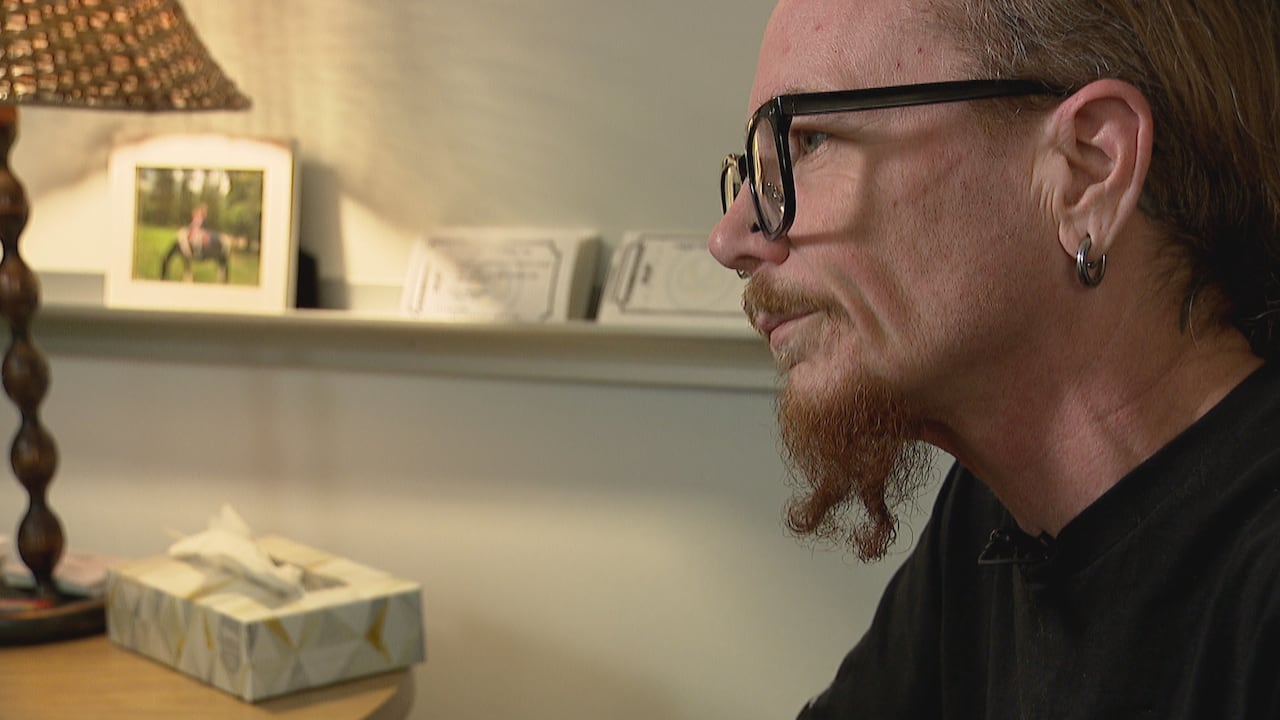 Star Oldring with the Fyrefly Institute points to the Alberta government’s passing of Bill 26, Bill 27, Bill 29 and Bill 9 . They said they believe these pieces of legislation have created a vitriolic environment for queer communities. (Nathan Gross/CBC)
“We are putting lives at risk by what we’re doing,” Oldring said pointing to research done by the Trevor Project, a U.S. non-profit suicide prevention organization.
CBC News requested further comment from the Alberta government on the concerns being brought forward by community advocates.
“These pieces of legislation preserve the choices of children and youth, strengthens the role of parents as a child’s primary caregiver, and ensures fairness and safety in amateur competitive sports,” said Minister of Justice Mickey Amery in a statement to CBC News.
“Alberta’s United Conservative government will be unapologetic in our commitment to these principles.”
Long-term impact of hate violence
Omnia Hassan is program director for Sisters Dialogue, a grassroots organization that works to support Muslim women in Edmonton.
Hassan told CBC News she has experienced hate violence, as a Black Muslim woman, and being part of Sisters Dialogue.
This past January, the organization held an event to mark the National Day of Remembrance of the Quebec City Mosque Attack and Action Against Islamophobia.
Hassan said the social media event post became the target of hateful comments that were Islamphobic and misogynistic.
“I have tough skin because I’ve been in the social work realm for a long time. But it’s always hurtful, no matter how many times you hear it,” Hassan said.
“We don’t become numb to it.”
The threats were concerning for the organization who ended up co-ordinating security around the threats to ensure safety.
Sisters Dialogue reported the incident to EPS who recorded the posts as a hate incident but it did not result in any criminal charges.
In early May, Hassan was also targeted in a hateful road rage incident whereby a driver harassed her at a red light and hurled xenophobic comments and slurs at Hassan, demanding “she go back to her country.”
“It was coming from someone who was a settler, just like me, right? It wasn’t someone native to this country. So it was very hurtful, but I rolled up my window because I prioritized safety at that moment, because my kids were in the car with me,” said Hassan.
“I did not report the incident to the police. At the time, I did not feel that reporting it would lead to much action, other than stats. I also think many people who experience these kinds of incidents choose not to report them for a variety of personal reasons,” Hassan said.
 Sisters Dialogue program manager Omnia Hassan says the organization reported hateful social media comments to EPS who recorded the comments as a hate incident but it did not result in any criminal charges. (Craig Ryan/CBC)‘Beyond the police’
Larissa Crawford, a Métis and Jamaican community advocate who founded grassroots organization Future Ancestors Services, experienced hate violence in Edmonton when she was in the city attending a conference in January.
Crawford went to pick up food from a downtown restaurant in Edmonton and upon entering the restaurant she was confronted with an older white man berating the staff.
Before Crawford had time to fully apprise the situation, the man’s attention landed on her and he began to verbally assault her by calling her the N-word.
Before she was able to disengage from the encounter, the man proceeded to punch and spit on her.
Crawford said the attacks only stopped once an employee said there was a security camera after which the attacker left.
What stays with Crawford is the physical and emotional hurt from that day.
Months after the attack, she still struggles with neck pain that requires ongoing medical attention and hinders her ability to show up for community and her loved ones.
“As the attack was happening and no one was doing anything, I had to look around and think, Is this actually happening? Is this as bad as I feel it is? Because no one’s doing anything,” Crawford told CBC News.
“And that experience of gaslighting myself and the internalization of the message it’s not that bad as a result of looking around and seeing in action. That’s something I’m still actively working through.”
Crawford said it felt futile to go to police directly after experiencing a traumatic event and expend the energy and time for an uncertain outcome.
“This issue goes beyond the police,” Crawford said.
During April’s police commission meeting, EPS said it was making progress in having more incidents reported to police. Const. Cydney Ross, who spoke at the meeting, pointed to the EPS Hate Incident Online Reporting Portal, which was brought into effect in June 2023.
“We’ve actually seen a huge increase in the reporting of incidents since that time.”
The power of community
Advocates that CBC spoke with said that combatting hate is a collective responsibility that requires building trust across communities.
Crawford spoke publicly about her experience at the Power of Voice Youth Conference in March that celebrated and uplifted newcomer youth.
“I shared about what happened to me, and it was so heartbreaking to witness and to experience the number of youth who came to me with similar experiences,” Crawford said.
“It’s a significant disadvantage that not all youth are experiencing right now, but in sharing my story, they also saw validation in what they were feeling, and they saw a connection.”
 Larissa Crawford with her two children, nine-year-old Zyra (left) and 16-month Ātea (right). (Submitted by Larissa Crawford)