
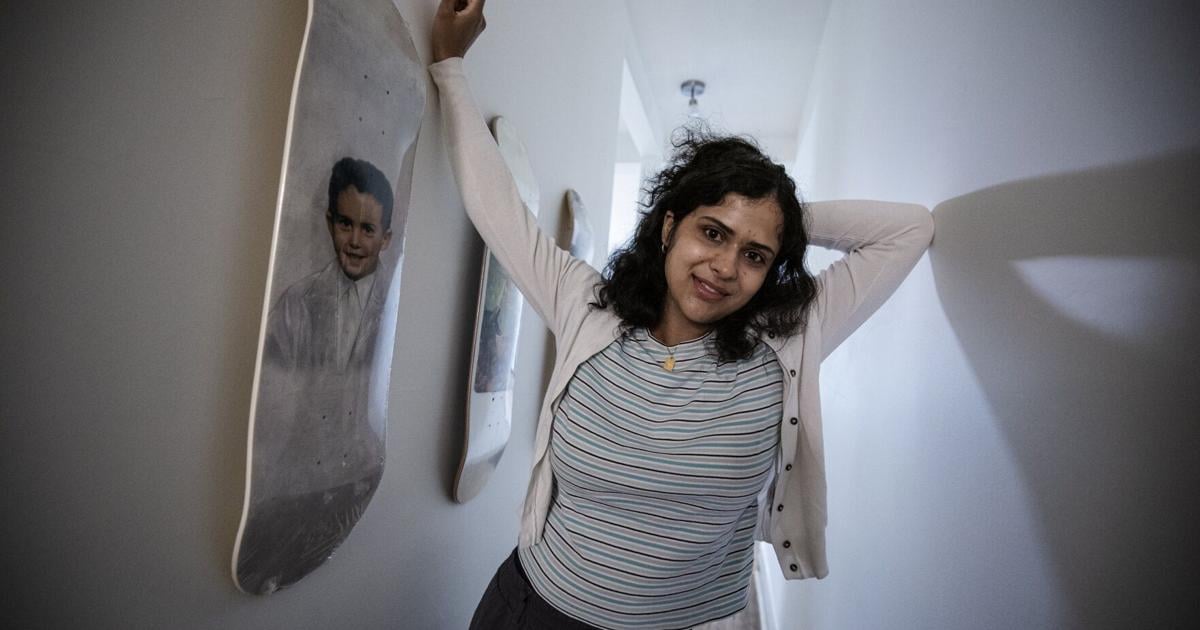
By the time Lienke Abdeen graduated from Toronto Metropolitan University’s prestigious fashion design program in 2019, she had no interest in working in the industry.
“I was over it,” she said. “I’m a terrible designer. If you asked my teachers they’d agree.”
So she logged onto the job board Indeed and got a paid internship in advertising. She stayed in that industry, and was working at WPP Media when the company started to lay off staff and replace their roles with AI.
She decided to go back to school when she suspected her role would soon be eliminated. She considered an MBA or project management certification, but worried skills she’d learn in those programs would also soon be overtaken by AI.
So she enrolled in comedy school.
“You cannot get AI to be funny,” said Abdeen, who is now taking classes in writing and performing comedy at Humber College.
Canadian post-secondary students who started their degrees in 2022 — the year ChatGPT launched — are nearing graduation. They’ve seen the good and the bad from the widespread adoption of artificial intelligence in the last few years. And students in nearly every career path are now considering how AI will affect the roles they’re seeking.
AI has already upended the job market, especially entry-level roles. Jobs for those in their early careers are being slashed across sectors as more employers favour AI over interns.
When she graduates, Abdeen, who grew up in Ottawa, wants to launch her own content creation and consulting business. She also wants to perform stand-up and host her own events.
“If you want to be a content creator, being funny is kind of the one thing that will set you apart from an AI content creator,” she said. “It’s not about being good-looking, it’s not about being aspirational anymore.”
Traditional office jobs, once thought of as stable, are now risky because of AI, said Abdeen.
“So my thing was: let me just take a risk and go the more entrepreneurial path.”
Abdeen’s specific path may not be easy for others to follow. She will likely be one of the Humber program’s last graduates. First introduced in 1999, the one-year diploma program was recently suspended following a decline in international student enrolment and an increase in operational costs.
But she’s among many students saying AI is causing them to pivot.
The Star spoke with students nearing graduation who have decided to change plans. Some decided to follow their passions rather than a career path that they initially perceived as stable. Others decided to focus on finding a way to work with AI. Here’s what they have to say about changing their minds.
Computer science to music
Leif Hill just finished his second year studying computer science at Queen’s University but won’t be going back this fall. The 20-year-old said he will take a year off, move to Toronto, get a job in the service industry and pursue his dreams of making hyperpop music.
For Hill, pursuing computer science was supposed to lead to stability.
“Now AI has come in, and it’s not that I believe that jobs are necessarily being replaced, but more so that there’s this major instability as to what these kinds of jobs will even look like in the future.”
There are fewer entry-level jobs and apprenticeships in the field available, and he’s seeing his peers split into two categories: people who feel they can keep up with AI, and those who feel “everything is completely cooked.”
With the industry roiled by confusion, Hill said he plans to explore his more creative side.
“I’m not here thinking I’m going to be famous or anything,” he said. “I think it’s going to help my growth in my career, you know, when I inevitably do come back (to school), if that is what I decided to do.”
Computer science is in an uncertain place, but the field is cyclical, said Troy Vasiga, associate professor and associate dean of undergraduate admissions and outreach at the University of Waterloo. Enrolment shot up during the dot-com boom, then dropped when it burst. But computer science isn’t going anywhere, he said.
“AI has often popped its head up and been seen as, ‘Oh, this is radically going to change everything.’ And then people realize that, in fact, it didn’t fulfill all the promises that it was going to make,” he said.
This happens roughly once every 15 years, he said, comparing this latest AI explosion to when IBM supercomputer Deep Blue beat Russian chess grandmaster Garry Kasparov in 1997, the first world champion to lose a chess match to a computer.
“People thought that was the end of humanity as we knew it, but people still love to play chess against other people,” he said.
“So I think AI will change how we do things, but I don’t think it’s going to actually remove some of the fundamental concepts.”

Akil Huang works at home on his computer using AI. Huang has decided to focus on learning how to use the technology to his advantage in his career.
R.J. Johnston/Toronto Star
Going all in on AI
When Akil Huang started university, he thought he would become a lawyer. But as his studies progressed, he said he felt more and more fretful about how jobs he would compete for in the legal landscape would be overtaken by AI. He got more interested in math, eventually enrolling in a Master of Science Mathematics and Statistics at the University of Ottawa. He’s set to graduate next year.
Huang currently works on contract with the Bank of Canada, where he said he is excited about how internal coding processes have been simplified for all staff by incorporating AI tools like Claude and Copilot. At the same time, he’s nervous about competing for jobs once he graduates.
“It’s very clear that companies, even in Canada, are very, very quick to adopt this, and are happy to let people go if it proves to be good enough,” Huang said.
So he decided to try and get ahead of AI’s curve.
Huang said he has learned how to automate what he can and found what AI can’t do: decide.
For example, AI is good at bringing up different ways to solve problems, but it won’t make the call of which one to go with. His current plan is to pursue work in AI advisory services, and work with mid-sized companies as they adopt AI usage into their workflows.
“I am trying to go as deep as I can into areas that still require some level of human thinking or some level of human trust.”
Applications to computer science
Broadly, less students are applying to computer science programs at Ontario universities.
Applications to Computer and Information Systems undergrad programs in Ontario fell 27.1 per cent between 2024 and 2025. Since 2025, applications have dropped another 21.2 per cent, according to Ontario Universities’ Application Centre.
But at Waterloo, which had a drop in applications in computer and software engineering, there was an all-time high of applications to civil and mechanical engineering, according to Mary Wells, dean of engineering. She said she has observed students adjusting their goals with the evolution of AI technology to make themselves more competitive and productive in the workplace. Though these advances are happening fast, Wells said she remains optimistic.
“We are at a moment in time where people have great opportunity to reinvent the world as we see it today,” she said.
The calculations for future students
Parents of university student applicants are feeling even more uncertain about their children’s future than the students themselves, Vasiga said.
“I think what AI will offer will certainly change the world,” he said, “but I don’t know if we can actually figure out exactly how it’s going to do that yet. I think it’s a bit early to kind of jump to doomsday, apocalyptic sort of conclusions.”
Babith Bhoopalan, a Seattle-based former Microsoft director who worked on AI initiatives, said instead of focusing on a perspective of “everything is over,” the AI boom is an opportunity to prepare for the future.
He said his teenage daughter, Thea, initially wanted to pursue a career in finance, but Bhoopalan, concerned about how AI would affect her, researched roles and found the early career positions she would eventually compete for were being slashed in favour of AI that can perform tasks faster and cheaper than a person.
He used his research to create a free website, “Future-Proof Careers in the Age of AI,” for families to help parents and children navigate how AI will change the job market and help young people map their careers. Users can search for their desired job and see salary estimates, how AI may affect the role and how resilient the role may be to AI.
But not everyone has a proactive father, let alone a father with foresight to ensure his child’s hireability while she is still a teen.
For those interested in AI as an academic discipline, now is a good time to be studying it, because it’s at the forefront of all kinds of conversations, and uses and limits are still being determined. That said, it’s not for everyone, Bhoopalan said.
“I think every student needs to make the right choice for them.”