
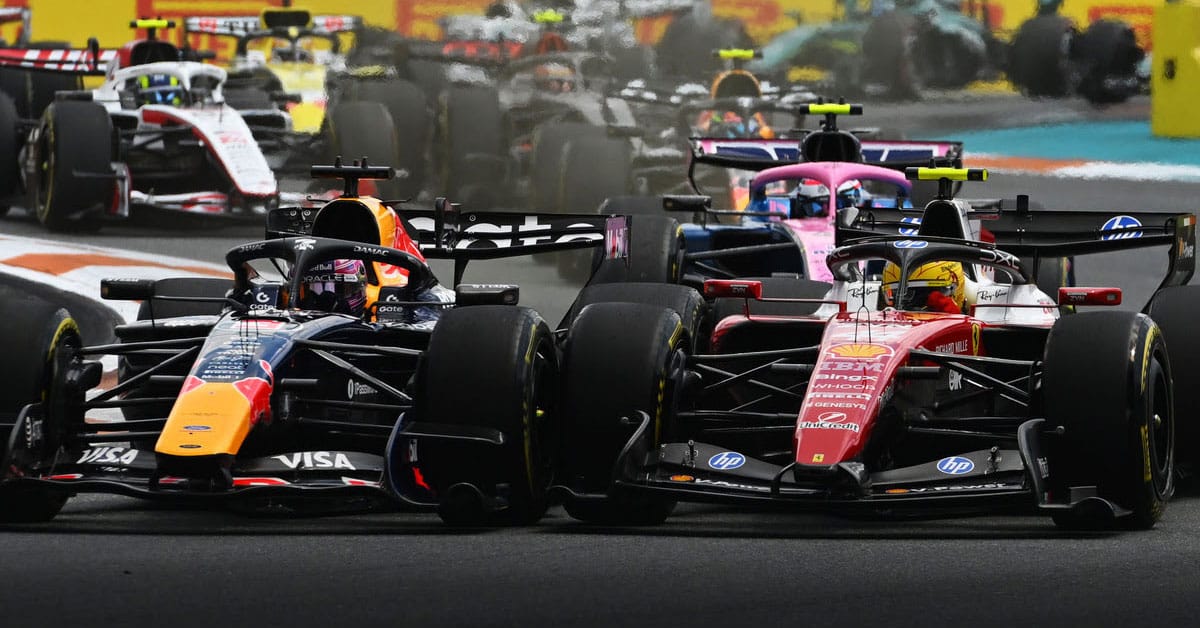
If Formula 1 fans have been noticing something unusual in the 2026 season’s speed trap data, they are not imagining it. Despite the arrival of the new technical regulations and major power unit changes, Formula 1 cars are repeatedly reaching similar top-speed figures across very different circuits, with many cars appearing to plateau in the 345–352 km/h range.
At first glance, that might seem counterintuitive. Formula 1’s latest generation of cars features reduced drag concepts, active aerodynamics and significantly revised hybrid systems designed to create a new competitive balance between internal combustion power and electrical deployment. Yet the numbers suggest a surprisingly consistent speed ceiling.
The explanation lies in a fascinating technical phenomenon that some analysts have started describing as Formula 1’s “invisible wall” at approximately 352 km/h.
Why 2026 F1 cars stop accelerating around 350 km/h
The answer comes down to how Formula 1’s new power units deliver energy at extreme speed.

Under the 2026 Formula 1 regulations, electrical deployment from the ERS system plays a much larger role in acceleration and straight-line performance than in previous years. When drivers activate maximum deployment or overtaking modes, the hybrid system can provide a major performance boost, helping cars approach roughly 1,000 horsepower in combined output.
That is why acceleration in the early and middle phases of a straight remains extremely aggressive. Combined internal combustion engine power, electric deployment and active aerodynamic efficiency allow cars to build speed rapidly, even on circuits that historically were not pure top-speed venues. However, the crucial limitation comes at very high speed.

Telemetry analysis suggests that full electrical deployment remains highly effective up to approximately 337 km/h. Beyond that point, the available electric power begins to taper off significantly. Instead of maintaining maximum assistance, ERS contribution reduces progressively until disappearing altogether at around 352 km/h.
Once that happens, the Formula 1 car is effectively relying only on the internal combustion engine.
The brutal physics behind Formula 1’s speed limit
That is where aerodynamics become decisive.
Air resistance does not increase in a simple linear way as speed rises. The power required to overcome aerodynamic drag grows exponentially—more specifically, roughly with the cube of speed. That means every additional kilometre per hour near 350 km/h demands dramatically more energy than it did at 300 km/h.
So while the hybrid system is removing power exactly when aerodynamic resistance becomes most punishing, the internal combustion engine alone is left trying to push the car through an enormous wall of drag.
And that appears to be the defining limitation.
Without hybrid support, the combustion engine’s standalone output is no longer sufficient to generate meaningful additional acceleration in most real-world race conditions. The result is the visual effect many fans have already noticed: the car simply stops gaining speed.
Why Monza may no longer be unique
One of the more intriguing consequences of this technical shift is how it changes the meaning of traditional top-speed circuits.
Historically, Monza has stood apart as Formula 1’s benchmark for outright straight-line velocity. But in 2026, that distinction may become far less dramatic. Because many circuits now allow cars to briefly exploit peak hybrid deployment before hitting the same high-speed limitation, Monza-style top-speed numbers could become increasingly common elsewhere on the calendar. That does not necessarily mean Monza will become slow—far from it. Instead, it suggests Formula 1’s new regulations are compressing top-speed performance into a narrower operational window.
In practical terms, fans may continue seeing speed trap figures clustered around 350 km/h whether Formula 1 is racing in Monza, Shanghai, Miami or other power-sensitive venues.
A new Formula 1 era with different performance trade-offs
The 2026 Formula 1 rules were designed to create a new balance between sustainability, hybrid efficiency and racing spectacle. But as teams continue to unlock performance, unexpected technical characteristics are beginning to emerge.
This apparent 352 km/h ceiling may become one of the defining engineering signatures of the new era—unless teams discover innovative ways to manage deployment, reduce drag further, or optimise power delivery differently.
For now, however, Formula 1 seems to have found a fascinating modern speed barrier—one created not by regulation directly, but by the complex interaction between hybrid energy strategy, aerodynamics and pure physics.
May 17, 2026Alex Marino
Let other Scuderia Fans know about us


