
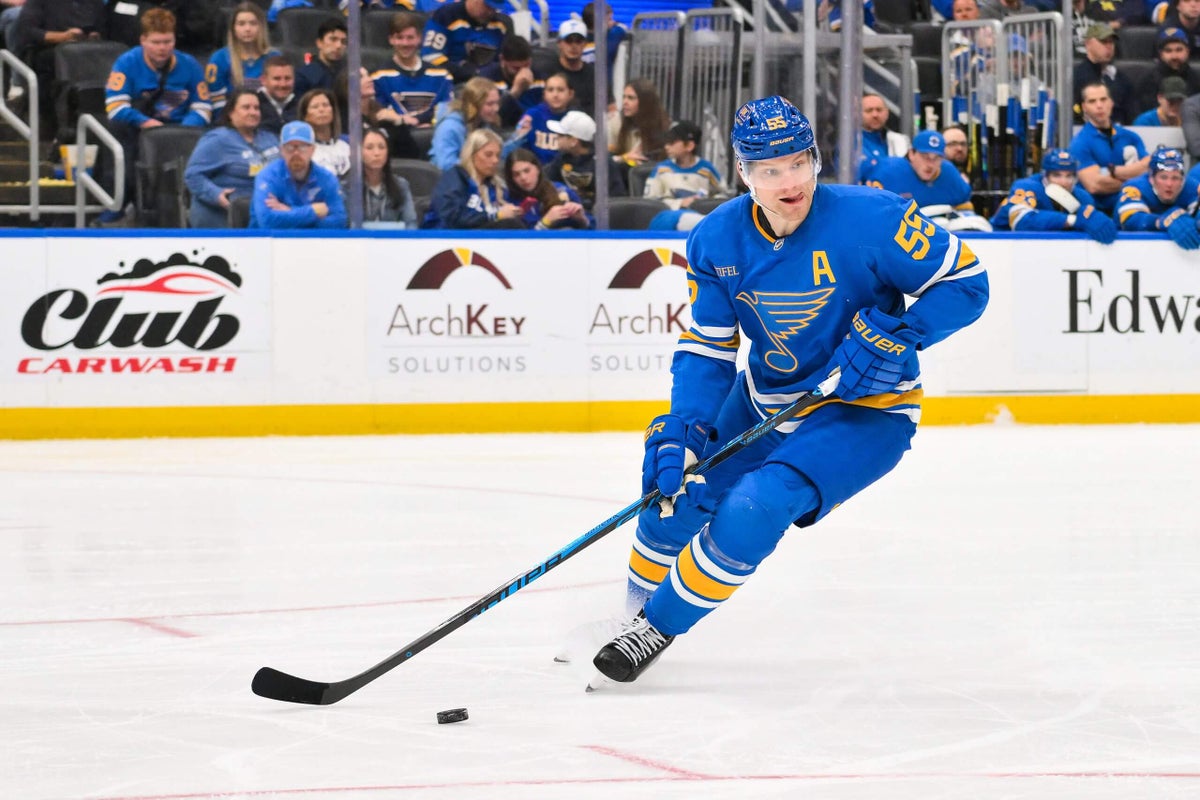
ST. LOUIS — As seen in the 2025-26 NHL regular season, the St. Louis Blues have a handful of NHL-ready prospects. As seen in the American Hockey League playoffs, they have plenty more in the Springfield Thunderbirds’ lineup.
Meanwhile, the Blues’ 12 selections in the NHL Draft June 26-27 are tied with the Calgary Flames and Nashville Predators for the most in the league. That includes three first-rounders, which is the most of any club.
They can’t all play in St. Louis.
Which prompts the question: With a prospect pool that The Athletic’s Scott Wheeler ranked No. 10 in March, would the Blues try to trade up in this year’s draft?
As Wheeler wrote, “The Blues’ pool is missing a truly elite prospect.”
The Blues have the Nos. 11 and 15 picks in the first round and will find out where their other first-rounder slots in when the Colorado Avalanche’s season ends. They also have three picks in the third round, two in the fourth, two in the fifth, and one in each of the sixth and seventh.
Could general manager Doug Armstrong and incoming general manager Alexander Steen come up with a package that includes current roster players, young prospects or picks to climb up in the order?
True, there’s not a projected generational talent in this draft, but there are highly regarded prospects. In mock drafts by Wheeler and The Athletic’s Corey Pronman, the Blues can still find a solid player if they keep their picks at Nos. 11 and 15. Think of it this way: In 2023, they took Dalibor Dvorsky at No. 10, Otto Stenberg at No. 25 and Theo Lindstein at No. 29, and are thrilled with how each turned out.
But would it make sense to trade up this summer? I asked Armstrong that in March, and though I’ve already reported this response, it’s worth reposting:
“Yes, we would — we can use the picks, we can use prospects, we can use players,” Armstrong said. “We’ll give it our best chance. But you also have to have someone that wants to move out of that pick, and that’s where the fly in the ointment sometimes comes in.”
The “fly in the ointment” is the clubs ahead of the Blues in the draft and what they’d be asking for. The one that sticks out is the San Jose Sharks, who have the No. 2 pick, which would give them an opportunity to choose Gavin McKenna and Ivar Stenberg, the younger brother of the Blues’ Otto Stenberg.
“I’m always open to listening to what’s out there,” Sharks general manager Mike Grier told reporters after the NHL Draft Lottery on May 5.
What would it take? To better analyze that situation, I’ve brought in Wheeler and The Athletic’s Eric Stephens, who covers the Sharks. We’ll also look at other options in the top 10.
Wheeler: What’s the value of the Blues’ first-rounders?
Moving up to the very top of the draft is so rare and unprecedented that it’s hard to gauge what the price would even look like.
If you use the Perri pick value calculator, Nos. 11, 15 and 32 have a total combined value of 67.3, and No. 2 has a total individual value of 72.7, so you still don’t get there. If the Avalanche lose in the conference finals and the Blues’ third first-round pick becomes No. 30, you’re still only at 68.3. And then there’s always a premium placed on top of that for moving up, and if I’m the Sharks, I’m setting that price at a significant roster piece (Jordan Kyrou) over another prospect (Adam Jiricek, Dalibor Dvorsky, etc.). — Scott Wheeler
Stephens: What would the Sharks want?
The No. 2 pick is a premium asset, and that’s how Grier must look at it. Though it’s worth listening to offers, the mindset should be it will take a lot to part with that pick, even if San Jose is already stacked with young talent on its roster and in its system.
Colton Parayko would fit as an upgrade to San Jose’s blue line, especially with his size and right-hand shot. Parayko is cost controlled, but he’s 33 years old with five more seasons on his contract. That’s not an ideal fit in terms of age and the level of ability at this stage of his career that will improve the Sharks defense. For instance, I don’t think he and the Blues’ pick at No. 11 get it done.
Nor do I see Kyrou or Pavel Buchnevich as desirable possibilities. Robert Thomas would be enticing, for sure, but the Sharks have seen enough in Michael Misa’s growth in his rookie year to believe he will be their long-term No. 2 center behind Macklin Celebrini. If I were Grier, I’d ask for Jimmy Snuggerud, knowing full well that conversation won’t get far. But you’ve got to ask, right?
What might be more realistic to move off the No. 2 pick is a combination of the No. 11 selection, Adam Jiricek and one of the three St. Louis third-round choices. Jiricek isn’t ready now, but the Sharks’ next period of consistent playoff contention probably starts a year from now. He would fit more with the Sharks’ long-term outlook.
But my guess is there might be better offers for Grier to consider. And he could address his defense in free agency, or make the pick at No. 2, and use one of his young wingers with upside in a trade package. — Eric Stephens, Sharks beat reporter
Does any of it make sense for the Blues?
If the Blues were able to interest the Sharks in a package of Kyrou or Parayko, there might be foundation for a deal. But that likely still wouldn’t be enough.
Everyone has to keep in mind, like Wheeler wrote, moving up to the top of the draft is rare. The reason is because the clubs that own those picks aren’t seriously looking to move out of those spots, and if they are, the cost will be exorbitant.
The reason I suggested Kyrou or Parayko is not only because that’s who the Blues would be willing to part with, but also because the Sharks are on the verge of being competitive, and with a prospect pool that was No. 2 in Wheeler’s rankings in April, perhaps they’d be eyeing established roster players who can jump in right away.
If not, then you move on if you’re the Blues.
I’m not undervaluing the No. 2 pick — the Sharks should get a haul — but Snuggerud and Jiricek should never enter the conversation. Yeah, Ivar Stenberg would be great to have on the roster, but I’ve seen enough in Snuggerud and seen/heard enough of Jiricek that the risk is just not worth it.
If the Sharks aren’t keen on Kyrou or Parayko, or even Jordan Binnington, perhaps the Blues could gauge them on a package that starts with Nos. 11 and 15 and includes more. But as Wheeler illustrated with the Perri calculator, those two picks plus No. 32 won’t get you there.
What other clubs would be options?
If you evaluate the teams ahead of the Blues in the top 10, there’s only a handful that might trade out of their spot:
Toronto (No. 1), but it would take a lot.
San Jose (No. 2), which we’ve addressed.
Chicago (No. 3), but if Stenberg is somehow still available, the Chicago Blackhawks aren’t budging.
Winnipeg (No. 8), and the Winnipeg Jets might want established players such as Kyrou or Parayko.
Florida (No. 9), but the Florida Panthers need young talent, and the Blues might not be interested because they wouldn’t be moving up far.
Of those, Winnipeg would arguably be the strongest possibility. But does moving up a few spots help the Blues if they could still get a center at No. 11? Well, it would if the Jets were interested in Kyrou or Parayko because it would allow them to move Parayko, an aging veteran with a lot of term left on his contract, or Kyrou, who might not be part of their plan.
Ates: What would the Jets want?
Winnipeg portrays itself as a win-now team, despite its failure to make the playoffs this season. The Jets have gaping holes on the second line and could use a right-shot defenseman, and franchise goaltender Connor Hellebuyck has ramped up the pressure on management to make a move.
That’s a long list of reasons the No. 8 pick could be available.
It could be sensible for Winnipeg to ask for Parayko and the Blues’ late first-round pick in return. It would be more appealing to package the No. 8 pick, along with two more first-round assets — Brayden Yager and Brad Lambert — for Robert Thomas.
But no-trade clauses abound: Winnipeg might look to turn the No. 8 into the Blues’ No. 15 and late first-round pick to do its shopping elsewhere. — Murat Ates, Jets beat reporter
Would that make sense for the Blues?
I am not discarding Parayko whatsoever. I think he had a huge impact on rookie Theo Lindstein’s performance at the end of the 2025-26 season and could continue to do so next season. If Parayko remains on the roster next season, there is no harm in that.
However, if the Blues can move Parayko and the remaining four years left on his contract ($6.5 million AAV) and move up in the draft, then I don’t know how they don’t do it.
The answer is obviously no on Thomas, but whether it’s Parayko, Kyrou or Thomas, they all have full no-trade clauses, which, as my colleague wrote, would play a part in the decision.
Conclusion
As we said from the onset of this exercise, it’s just difficult to find middle ground on a trade for a top draft pick.
The Sharks are thrilled to have leapfrogged so many teams to No. 2, and they’re going to take advantage of that. And though they might want to compete next season, and players such as Parayko or Kyrou could help, it won’t be at the expense of Stenberg or someone who can be in their lineup for the next 10-12 years.
With all of the Blues’ prospects and picks, they could probably afford to overpay a bit if they really liked Stenberg or one of the defensemen. But with players such as Jiricek and Justin Carbonneau showing a lot of promise, why take the risk? It would be nice to have one of the top picks in this year’s draft, but it’s not going to make them exponentially better, and watching one of those other players turn into a star in teal, or another color, would be a lot to take.