
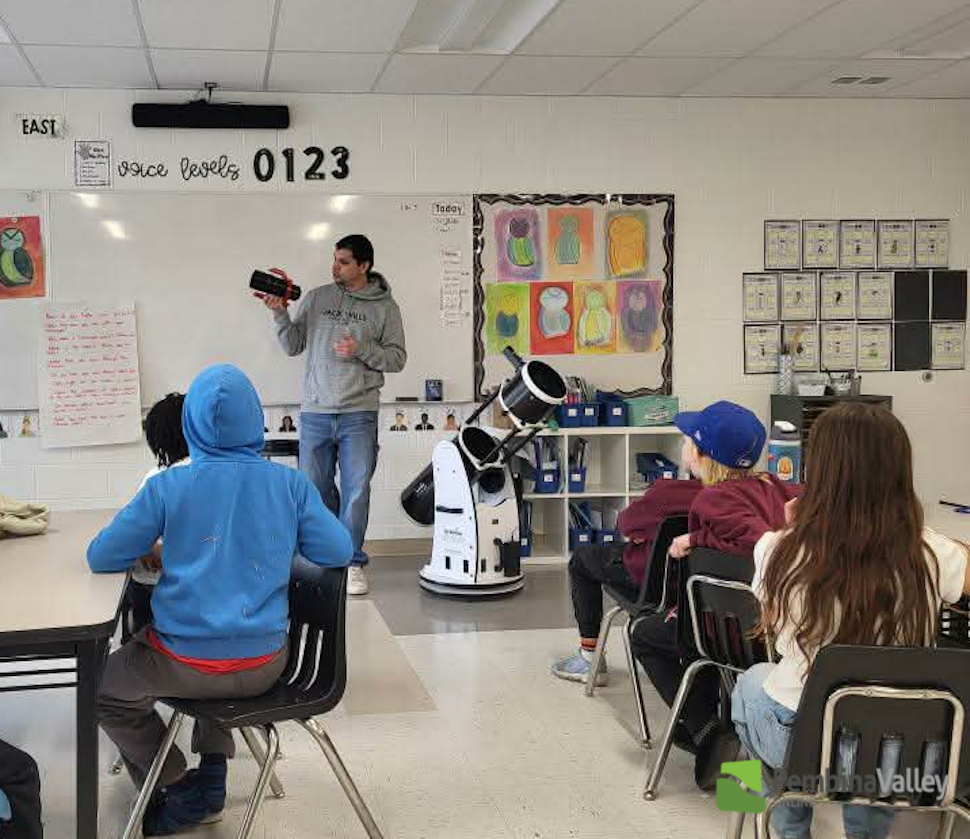
Although spring’s longer days can make telescope viewing “hit and miss,” Kenton Dyck of the Pembina Valley Astro Club said the group has been involved in a number of events and partnerships recently — all in the name of making astronomy accessible to everyone in the community.
More technology, more possibilities
In addition to its full schedule of events, Astro Club has been adding to its equipment arsenal.
Dyck is in the final stages of constructing an Allsky camera, which will record astronomical and meteorological events above the Pembina Valley.
“I got everything, powered it up, got the software on it, and I was running it, and then it turns out in order for me to put it at the site that I want, I have to rearrange the power requirements a little bit more,” he said of the project.
Related stories:
As Dyck puts the finishing touches on the Allsky project, the club has also recently acquired an SVBONY SV555 Astrograph Telescope from a community sponsor.
The new piece of equipment will expand the group’s astrophotography capabilities.
“[It] is a telescope that is specifically designed to be hooked up to a camera,” Dyck explained.
“You can look through it optically — it’s more than capable of doing that — but what this is specifically designed to do is astrophotography, so now Astro Club has the bones, or the framework, of a serious astrophotography rig.”
A five-element Petzval optical system
While the telescope may at first resemble a camera lens, Dyck explained that what makes it “fancy” is its five-element Petzval design, which allows for sharper images.
“[With astrophotography], you have to take light from a rounded kind of element, which is a 3D shape, and project that onto a 2D sensor plate, so you have to basically stretch the image flat before it hits that camera sensor,” he said.
He explained that when light travels through glass, it can cause chromatic aberration, which appears at the edges of a captured image.
“You’ll see the colours starting to separate, and that’s what this thing is specifically designed to get around. The five elements inside are designed to take that away, giving us perfectly sharp stars in our corners, as well as accurate colour gradients throughout the whole thing.”
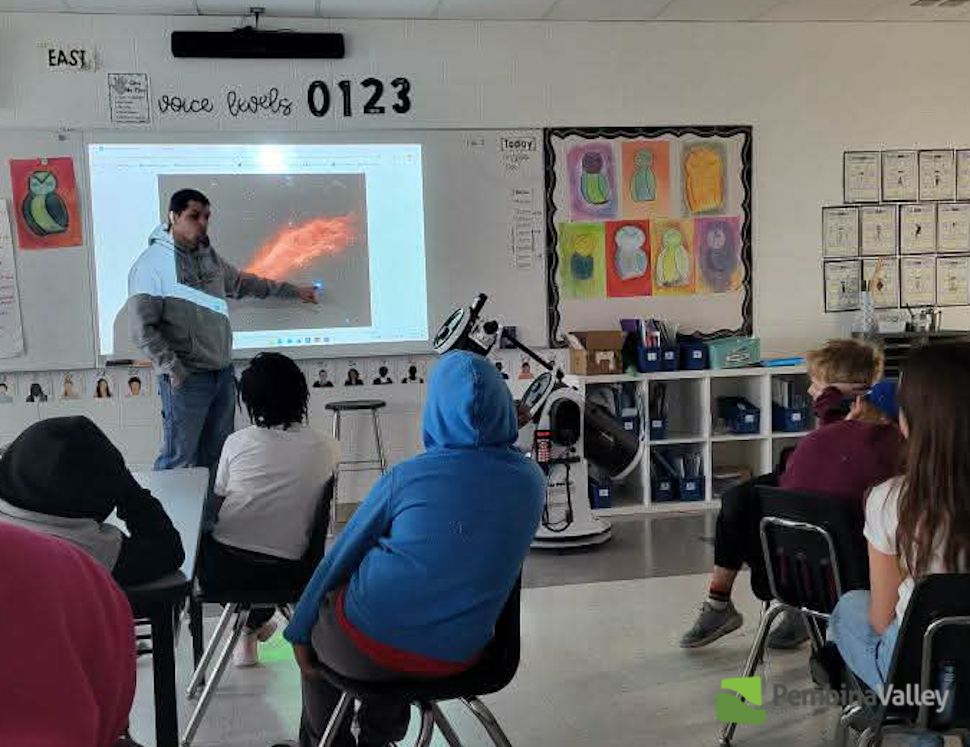 Kenton Dyck’s outreach includes going to local classrooms to present on astronomy topics. Submitted photo.
Dyck said that an important component of the astrophotography setup is a high-quality camera designed specifically for that purpose, which he may look into acquiring in the future.
Before that, though, a mount is next on the list.
“This is a telescope that … will give us an entirely new vehicle for getting people extremely interested in [astronomy],” he said.
“The plan is to get an equatorial mount, which will then allow the telescope to track the stars down to a milliarcsecond — so with tremendous degrees of accuracy.”
‘There are very few things that grab people’s attention more than a huge, wide projected photograph of a supernova’
Dyck said he is “extremely excited” about Astro Club branching into astrophotography, which he was inspired to do by a Winkler photographer (jenkashots on Instagram).
“I met him at an event that we had, and he had his very nice camera there, and he took a shot of the Milky Way and sent it to me,” he said.
“That was the instant that I was like, ‘Oh, I want to do this.’”
He added that astrophotography, which helps connect the astronomy and photography communities, is also an effective form of outreach — especially with children.
.jpg) Hand-drawn thank-you cards for Kenton Dyck from students he visited while sharing about astronomy. Submitted photo.
“What I didn’t realize would be the impact that astrophotography has, particularly when I go on school visits,” he said.
“There are very few things that grab people’s attention more than a huge, wide projected photograph of a supernova.”
Dyck said he hopes the setup is complete for the fall astronomy season, when shorter days bring even more opportunity to see what’s above.
With files from Ty Hildebrand and Jayme Giesbrecht