
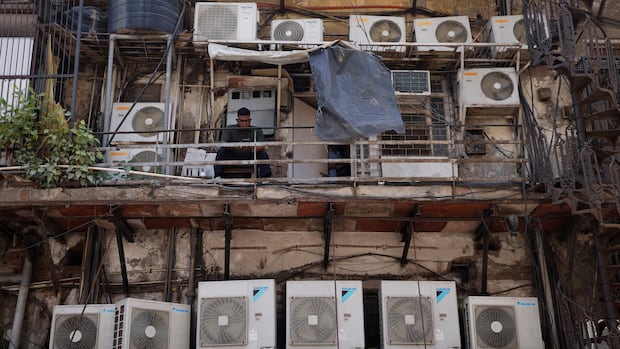
Buildings spew nearly 40 per cent of the world’s planet-warming emissions and the amount is growing, says a new UN report. That’s partly because fossil fuels still dominate heating and cooling. The good news is that solutions exist, and some countries are already successfully using them.
From homes to schools to offices, “buildings can either lock in climate risks or deliver safer, healthier and more affordable living conditions,” said Inger Andersen, executive director of the United Nations Environment Program at an embargoed media conference ahead of the release Tuesday of this year’s annual Global Status Report for Buildings and Construction.
The report found nearly half the materials extracted from the Earth are now used for buildings and construction, which are also the source of 37 per cent of global emissions and 28 per cent of global energy consumption.
The problem is we’re building more — floor space grew 20 per cent in the past decade, to 273 billion square metres in 2024.
And while building efficiency has increased, it hasn’t kept up — building emissions increased 6.5 per cent in that period. In fact, the report says progress has actually slowed since 2020.
Another problem is that burning fossil fuels still “dominate” for heating, cooling and cooking. The report highlighted some solutions, including passive cooling such as shading; rooftop and balcony solar; and technologies such as district heating and cooling that can tap into other renewable energy sources and boost energy efficiency.
 This mosque at the Hikma Community Centre in Dandaji, Niger, contains many passive cooling features, including windows and doors positioned for natural ventilation and vaulted ceilings designed to pull air upwards and radiate heat out of the building. (James Wang/UN)
The need for cooling is growing as the planet warms and air conditioning consumes massive amounts of energy from electricity grids, including many powered by fossil fuels, with its fast-moving fans and compressors. It also worsens global warming by releasing refrigerants that are powerful greenhouse gases.
But there are also ways to keep a building cool while effectively using no energy and doing nothing — called “passive cooling.”
Ian Hamilton, co-lead author of the new UN report, said that includes shading, reflective surfaces, insulation and natural ventilation that stop buildings from getting hot in the first place, reducing the need to cool them.
Passive cooling is “critically underrepresented” in building codes around the world, the report found.
Pushing builders on passive cooling
But countries such as Kenya and Pakistan and the state of California are pushing builders to use it more.
Kenya adopted a new building energy code in 2025 that mandates passive cooling.
Hamilton, a Canadian who is now professor of planetary health at Imperial College London, said that means when a new building is constructed, builders need to consider shading, natural ventilation, roof insulation and where vegetation is placed to keep the building cool.
Similarly, Pakistan makes builders consider which way a building faces relative to the sun and how to employ things like external shading. “Those aren’t necessarily super costly to add,” Hamilton said.

PREVIEW | CBC Investigates urban heat across Canada
CBC News has installed temperature and humidity sensors to test exactly how hot it gets in dozens of homes across five major cities in an unprecedented journalistic project Urban Heat. Participants are sharing how they’re handling the heat — and how worried they are about staying safe.
Closer to home, the report highlights California’s cool roof policy, which requires most new roofs to be cool roofs with light colours and materials that reflect the sun’s energy back into the atmosphere and radiate heat they’ve absorbed away from the house.
Hamilton said that doesn’t just keep individual homes cooler, but reduces the urban heat island effect that heats up entire neighbourhoods.
More solar-powered buildings
When that’s not enough, switching from fossil fuels to renewables can reduce reliance on fossil fuel-powered electricity grids to power things like heat pumps and air conditioning.
One way to do that is to add rooftop or balcony solar to buildings
“On-site and local generation, especially rooftop solar, is critical for both decarbonization and energy affordability,” the report found. “Yet its share has stagnated.”
There are some countries that have seen huge growth in rooftop and balcony solar, including Australia, India, Pakistan, Sri Lanka and Germany, the report found.
Hamilton said this was driven by a lack of access to high-quality electricity in countries in South Asia that are still building out their infrastructure and grid instability in Australia.
WATCH | Meeting demands for electricity: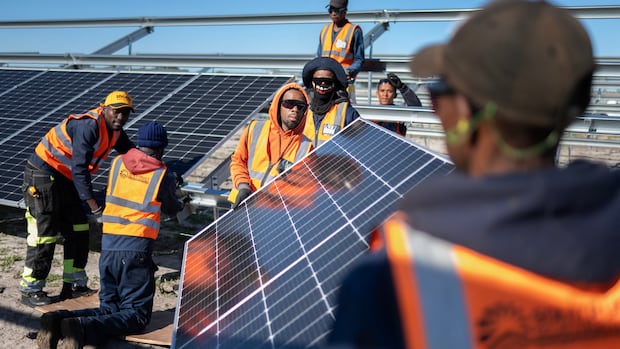
Renewable energy met all new demand for electricity in 2025: report
A new report by international energy research organization Ember says that while electricity from solar and wind increased in 2025, there was no change to the amount of electricity made by burning fossil fuels.
But he thinks Germany is a great example for Canada. There, adoption has relied on incentives and awareness of the technology and its benefits, such as reducing costs and improving resilience.
He thinks it’s something Canadian utilities should think about as data centres multiply and more people adopt heat pumps and EVs.
“Grid operators ideally would be looking at this and saying, ‘Yes, we do want you to have more local generation because for us to build a new power plant, it is prohibitively expensive.'”
Ankit Kalanki leads programs related to cooling at RMI, a think-tank focused on clean energy. He said pairing solar with batteries can make cooling less stressful for the power grid everywhere, but the up-front cost can be a big barrier, especially in many parts of the world with subsidized electricity rates.
Sharing renewable heating and cooling
Switching away from fossil fuels for heating and cooling is also important.
At a news conference on the report, co-lead author Oliver Rapf said renewable heating and cooling such as geothermal or solar thermal are still “not sufficiently mainstream.”
One technology that can help is district heating and cooling, which allows heating and cooling to be shared among many buildings.
Hamilton said that allows a completely different scale of technology to be used. “That main benefit is it’s more efficient, and that can be pretty significant,” he added.
Such systems allow heat discarded by some buildings to be used by others.
And they can provide access to renewable sources that individual buildings can’t use — for example, he pointed to Toronto’s deep lake cooling that uses cold water from Lake Ontario to provide air conditioning to downtown buildings.
The UN report highlighted the fact that Colombia is now integrating district cooling into urban planning for larger developments such as multiple apartment towers or commercial districts.
WATCH | Going deep into the lake to cool more buildings downtown:
Enwave to expand deep lake water system to cool more downtown buildings
Enwave Energy has commissioned the expansion of its deep lake water cooling system. The system has been in place for 20 years and uses cold water from Lake Ontario to heat and cool downtown buildings. Now it could cool even more. As CBC’s Dale Manucdoc reports, it’s a big step in helping the city achieve its climate goals.
Kalanki said it was “sobering” to read the report and see the work that remains to be done in decarbonizing buildings.
He thinks the upfront costs of the greener solutions are the biggest barrier and policymakers need to do a better job of emphasizing costs and emissions of such solutions over the lifetime of a building.
“I think that’s going to be very critical if you want to scale the passive solutions and the active solutions and make them more affordable for people.”