
For ultra-high-net-worth families navigating an increasingly complex global landscape, the traditional advisory model, built around products, transactions, and jurisdictional arbitrage, is showing its limitations. A new generation of wealth managers is emerging with a fundamentally different proposition: start with what the client actually wants from life, and work backwards from there.
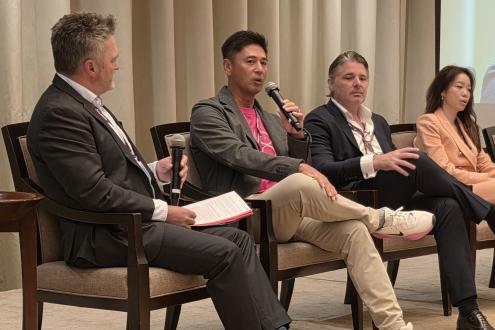
At the recent Hubbis Independent Wealth Management Forum in Singapore, a panel discussion on Singapore’s evolving role as a global wealth hub surfaced a range of perspectives on booking centres, geopolitical risk, and multi-jurisdictional structuring. Among the panellists, Garett Lim, Partner and CMO of MOIQ Capital, offered a distinctive and at times contrarian view, arguing that the industry’s preoccupation with jurisdictional competition and structural complexity misses the point entirely. For Lim, the real differentiator is not where you bank, but how deeply you understand the client sitting in front of you.
Key Takeaways
Client outcomes, not product sales, should drive the advisory model: MOIQ Capital positions itself as an outcome-oriented firm that does not sell products, instead spending the first months of any engagement simplifying a client’s existing arrangements.
Jurisdictional competition is a false framing: Rather than viewing Singapore, Hong Kong, and the UAE as rivals, Lim argued that clients are seeking advisers who share their mindset and understand their priorities, not those who pitch one jurisdiction over another.
Time is the most valuable asset for UHNW clients: The families MOIQ serves pay a significant premium not for outperformance but for the reclamation of their time, with fees of 150 to 200 basis points reflecting the value placed on that exchange.
Simplification is the first step, not an afterthought: New client onboardings typically involve a six-month period focused on reducing the number of structures, instruments, and costs before any forward-looking strategy is implemented.
Next-generation disengagement is a real and growing risk: Wealth transferred to heirs who have no passion for managing it becomes a burden, not an enabler, and the industry must adapt its approach accordingly.
AI and systematic rebalancing are being used to reduce volatility: MOIQ rebalances portfolios monthly using artificial intelligence, prioritising stability over the pursuit of higher returns.
Starting With the Person, Not the Portfolio
From his opening remarks, Lim made clear that MOIQ Capital operates from a different starting point than many of its peers. Where the conventional advisory conversation begins with asset allocation, risk profiling, or jurisdictional selection, MOIQ begins with the client as a person.
“The way that we look at it is really not in terms of the structure of where we think is best for us, but really where the clients want to be and what makes it easy for them,” Lim explained. “We don’t sell any products. We want to ensure that we go on a journey with them. And all the other technical stuff comes later.”
This is not merely a positioning statement. Lim described a deliberate onboarding process in which the first six months of any new client relationship are spent stripping back complexity rather than adding to it. The objective is fewer structures, fewer instruments, and lower costs, creating a cleaner foundation from which to build.
“When we onboard clients, we spend probably the first six months trying to simplify things,” he said. “We want to have less structures. We want to have less instruments. We want to lower the costs. We don’t really have to be in that transaction game.”
The implication is that many UHNW families arrive at MOIQ with arrangements that have accumulated over years, often across multiple advisers and jurisdictions, without a unifying logic. Before any value can be added, the existing architecture must be rationalised.
The Price of Time
Central to Lim’s philosophy is a recognition that the clients MOIQ serves are not primarily seeking alpha. They are seeking time.
“It’s always the same thing,” Lim said of what clients ultimately want. “It’s just, I need my time back. I want you to give me my time back. That’s why I can pay you 150 to 200 basis points. And that’s very, very valuable for them.”
This framing redefines the value exchange in wealth management. Rather than justifying fees through investment performance or access to exclusive products, MOIQ positions its fee as the cost of liberating the client from the operational and cognitive burden of managing complex wealth. Every individual, Lim suggested, has a different price for time, and the families MOIQ works with are willing to pay a substantial premium for it.
To deliver on that promise, the firm employs a systematic approach to portfolio management, using artificial intelligence to rebalance once a month and remove volatility from the client experience. Lim was explicit that MOIQ does not promise outperformance.
“We’re never going to promise anybody a higher return,” he said. “We’re not asset managers. We are looking to really amplify their lives and really trying to understand what it is that they want to do with their family, and more importantly, how do we get there.”
Rejecting Jurisdictional Competition
When the panel discussion turned to the relative merits of Singapore, Hong Kong, and the UAE as booking centres, Lim pushed back against the framing itself. In his view, the question of which jurisdiction is “best” is largely irrelevant to the clients he serves.
“I don’t think it’s really a competition between jurisdictions,” he said. “The clients that we deal with, they’re looking for people with the same mindset. They understand what they’re trying to achieve. We’re never going to say Hong Kong or UAE.”
For Lim, the strength of Singapore lies not in its competitive positioning against other financial centres but in the robustness of its regulatory environment and the depth of its professional ecosystem. These qualities make it an effective base from which to serve clients, but they are secondary to the quality of the advisory relationship itself.
“Singapore is a fantastic jurisdiction. Very robust, great licensing and oversight. And we can do everything that we need to do in Singapore,” he said. “I don’t see Hong Kong or anywhere else as competition.”
This stance sets MOIQ apart from firms that lead with jurisdictional advantages or structural innovation. Lim’s argument is that where you bank is a byproduct of what you are trying to achieve, not the starting point of the conversation.
The Next-Generation Problem
One of the more candid moments in the discussion came when Lim addressed the challenge of intergenerational wealth transfer, a topic that has gained urgency as Singapore’s family office ecosystem matures.
The pattern, as Lim described it, is a familiar one. A patriarch establishes a family office, often prompted by favourable regulatory conditions, and designates the next generation to manage it. But the children, in many cases, have no interest in doing so.
“What we’re seeing is that the kids have just got no interest in running that family money at all,” Lim said. “They are not passionate about it, and that’s a problem. That money being transferred to them becomes a massive problem. It’s a burden to them.”
This observation connected to a broader point raised by other panellists about the high number of dormant CMS licences in Singapore, many of which were established during the COVID era and have since gone unfunded or inactive. Lim suggested that part of the solution lies in reframing the role of wealth for the next generation, positioning it as an enabler of personal ambition rather than an obligation to be managed.
“What we want to do is help these people to say, look, that money should be an enabler to help you do what you want to do,” he said. The opportunity for the industry, he argued, is to approach disengaged heirs with a different proposition: let a professional firm manage the capital, freeing the next generation to pursue what genuinely motivates them.
Alignment as a Commercial Model
Underlying all of Lim’s remarks was a consistent thread: the importance of alignment between adviser and client. MOIQ’s commercial model, as he described it, is designed to eliminate the conflicts of interest that arise when advisers are incentivised to transact.
“We can have that complete alignment with the client,” he said. By removing product sales from the equation and anchoring the relationship around outcomes, MOIQ is able to occupy a different position in the client’s life, one that is closer to a strategic partner than a financial intermediary.
This model is not without its commercial implications. Charging 150 to 200 basis points requires a client base that values the proposition highly enough to pay for it, and that in turn demands a level of service and understanding that goes well beyond portfolio construction.
Simplicity as Strategy
Lim’s contributions to the panel painted a picture of a firm, and an advisory philosophy, that runs counter to much of the industry’s instinct toward complexity. Where many wealth managers add layers of structure, product, and jurisdiction, MOIQ seeks to subtract. Where others compete on performance or access, MOIQ competes on understanding and time.
Whether this model can scale across a broader client base remains an open question. But for the UHNW families it serves, the proposition is clear: wealth management is not about the architecture. It is about the life the architecture is designed to support. And in an environment defined by fragmentation, volatility, and jurisdictional uncertainty, that clarity of purpose may prove to be the most durable competitive advantage of all.