
In San Francisco, the artificial intelligence boom has driven up housing prices, boosted tourism and fueled the emergence of an entirely new sport: robot fighting.
On a recent evening at a South of Market nightclub, more than 100 people paid $50 apiece to watch humanoid robots in neon wigs throw clumsy punches. Some milled around the bar at Temple, work bags slung over their shoulders, while others stood ringside.
“This is a San Francisco happy hour,” said Victoria Ye Kai, who works in operations for a tech company she declined to name. “Robots and vodka.”
A boxing robot sits with patrons before its fight during the “Ultimate Bots: Fight x Dance” event at Temple nightclub in San Francisco on Thursday.
Minh Connors/For the S.F. Chronicle
The match was marketed by Ultimate Fighting Bots, or UFB, a “humanoid sports league” that began hosting underground robot fight nights last July. Since then, it’s graduated to larger events in San Francisco and Las Vegas.
Article continues below this ad
Vitaly Bulatov, who co-founded the company with his wife, Xenia, sees one-on-one combat as the first in a long list of sports that could soon be played by robots.
San Francisco Chronicle Logo
Make us a Preferred Source to get more of our news when you search.
Add Preferred Source
“The decision to introduce that first was because it’s visceral and people want to watch that, but also because that’s technically what was possible.” Bulatov said. “Throwing punches is one of the easier things we could be doing in robotics.”
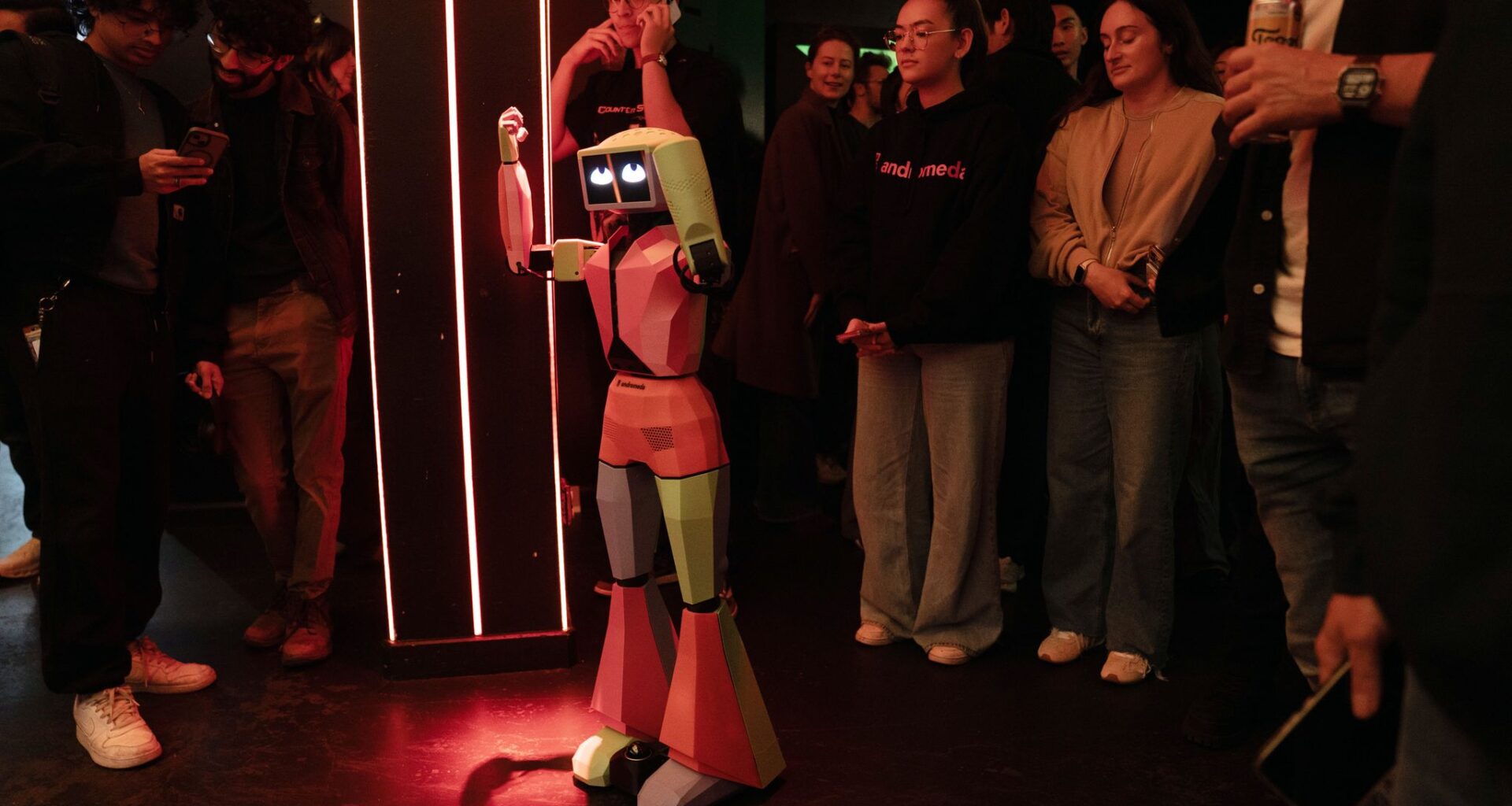
The May 14 event marked the Ultimate Fighting Bots’ first foray into competitive dancing, with the robots performing “dances.”
Minh Connors/For the S.F. Chronicle
The May 14 event marked the UFB robots’ first foray into competitive dancing, which Bulatov sees as the company’s next venture. Toward the end of the match, a robot performed “dances” programmed by different teams, staggering around the ring to a remix of A-ha’s 1980s hit “Take on Me.”
Article continues below this ad
It was also UFB’s first event in partnership with Nebius, an AI infrastructure platform backed by tech giant Nvidia. Akshai Parthasarathy, Nebius’ director of solutions marketing, said the company was keen to show off its robotics technology in a public arena, rather than inside a hospital or laboratory.
The company is at a transitional moment as it works to push its product into the mainstream. That effort has included marketing alongside celebrities — among them, rapper Wiz Khalifa and comedian Reggie Watts — and recruiting a mix of tech founders and content creators to control the robots during the fights.
LEFT: A dance robot stands in front of a crowd at “Ultimate Bots: Fight x Dance” on May 14. RIGHT: A dancer from TURFinc, an Oakland-based dance company, performs at the event.
Photos by Minh Connors/For the S.F. Chronicle
TOP: A dance robot stands in front of a crowd at “Ultimate Bots: Fight x Dance” on May 14. ABOVE: A dancer from TURFinc, an Oakland-based dance company, performs at the event.
Photos by Minh Connors/For the S.F. Chronicle
San Jose-based filmmaker Chris Yen donned a racer jacket and reflective sunglasses to pilot a robot on Thursday night after UFB approached him online.
“This is the randomest,” Yen said before the match, eyeing the two robots in the corner of the room. “I kind of thought they’d be life-size.”
Article continues below this ad
Instead, the robots were roughly the size of 8-year-old children.
They edged around the ring, controlled by a device resembling a Nintendo Switch that “pilots” operated from the sidelines. Occasionally, one of them lost their bobbed wig or fell over during a bout, drawing a roar from the crowd, which was mostly young and male.
The matches were divided into three rounds, won by the number of “cleanly landed punches” in a 90-second bout, Bulatov explained. Those rules were not always clear to onlookers: Shrey Kothari bet $20 on one of the robots, but he wasn’t sure whether he had won or lost until his competitor came to collect the cash.
“It’s so frustrating,” Kothari lamented, watching a robot swing, fail to make contact, then jerk backward. “I don’t think this current format is the future. I feel like the next step is them fighting autonomously.”
Article continues below this ad
Chris Esquivel, who works in real estate, felt like he was in the minority of people in the room who weren’t employed by the tech industry. But the 29-year-old, who heard about the bouts from a friend, sees events like robot fighting as par for the course in San Francisco.
“Living in the Bay, I’m very ingrained in the tech bubble,” he said. “I’m expecting to see something I’ve never seen before and hopefully be wowed and wondered.”