
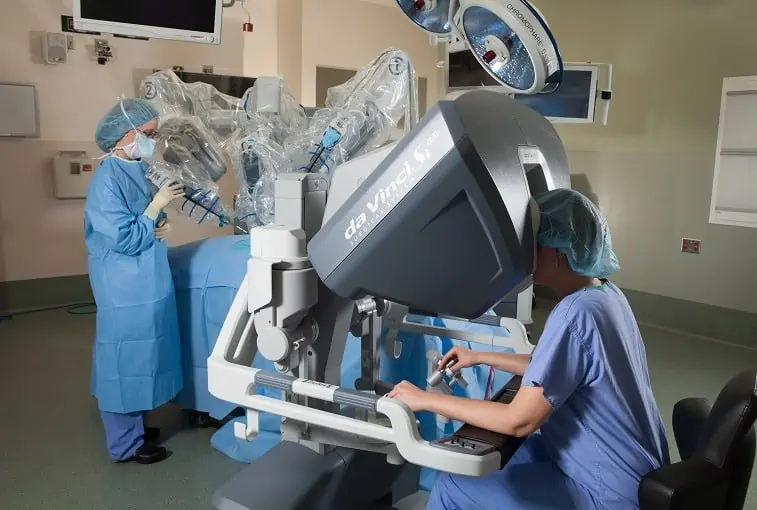
A surgical tool that’s relatively new to a busy Brampton hospital has improved care for a number of patients undergoing a common surgical procedure, particularly those who might have had to travel out of the city before now.
Late last year, William Osler Health System acquired the Da Vinci Xi Robotic Surgical System, a state-of-the-art, minimally invasive surgical technology used in hospitals worldwide and throughout Ontario. Osler says the robot, which assists surgeons, is particularly useful for certain urinary, chest, and reproductive procedures because it enables the medical team to perform complex surgeries with greater precision and control.
The Da Vinci robot, which Osler says provides surgeons with enhanced dexterity, accuracy, and visibility (and ultimately allows patients to recover faster), is especially useful when it comes to providing hysterectomies (the complete removal of the uterus) to women with larger frames–patients who might have previously needed to seek care in Toronto.
“The biggest thing for the program is certainly that we’re improving access to minimally invasive surgery for patients with an elevated body mass index and with complex pathology who may have otherwise required an open procedure or to be referred to a tertiary center in downtown Toronto,” Dr. Emma Skolnik, an obtrician/gynecologist with William Osler, tells INsauga.com.
“So truly, what’s wonderful about the Osler initiative is that they’re bringing innovation and advanced surgical care to women in a community setting, which is important from a health equity lens. It’s also just incredible to be able to offer surgeries with shorter and faster recovery times.”
Hysterectomies are frequently indicated. A 2019 article in the Journal of Obstetrics and Gynaecology Canada says that more than 41,000 surgeries are performed annually in the country. The surgery is often performed to correct benign (non-cancerous) but life-limiting conditions such as uterine fibroids, heavy, unusual menstrual bleeding, uterine prolapse, and endometriosis, but is also used to treat uterine, cervical and ovarian cancers.
Skolnik and Dr. Wilson Chan are two physicians who specialize in performing minimally invasive, robotic gynecological surgeries on patients with complex pelvic diseases.
“We both launched the program together. We’re a team, we operate together and we both have fellowships in advanced minimally invasive surgery. The dexterity, the 3D visualization, the control, just the ease and the efficiency and how streamlined the surgeries are really help us to be efficient and to be able to offer these really complex surgeries to patients with advanced technology.”
For obese patients, the surgery comes with more risks, as the positioning of the body during surgery can put additional pressure on the lungs.
In Canada, obesity is far from uncommon. A 2024 Statistics Canada survey suggests that close to one in three Canadian adults was obese in 2022, up from just over one in five in 2003.
Much like obesity, benign and malignant conditions that impact the female reproductive system are common. A recent article published in PubMed Central indicates that morbidly obese patients face unique surgical challenges, but robotic surgery for uterine cancer has been found to reduce the incidence of surgical and post-surgical complications.
Skolnik says the robot allows surgeons to operate at a lower interabdominal pressure, which is important in surgeries where the patient is tilted backwards to give physicians better access to pelvic organs.
The positioning, Skolnik says, can create challenges for anesthesiologists who ventilate patients during procedures that increase pressure on the respiratory system.
“What’s incredible about the robot is that the visualization is so superior and because our movements are so tiny and precise, we can actually reduce that pressure quite significantly,” she says, adding that the robotic surgery decreases the likelihood of both respiratory and cardiovascular complications.
“A patient with an elevated BMI has a higher risk of having poor ventilation because the pressure from the abdominal wall is so much greater on the chest when you tilt them upside down.”
Skolnik says that while she and Chan perform laparoscopic procedures whenever possible, open surgeries are also an option when they’ll provide the best outcome for a patient. That said, the robot offers patients who might not have been good candidates for a less invasive surgery another option.
It also ensures a patient with a higher BMI who lives in Brampton can access surgery close to home, removing some of the stress of travelling out of town for a major operation.
“It provides the same benefits of laparoscopy to a patient population that may not normally have that access and that access normally is in a downtown tertiary center, and now we have it in the community,” she says.
Chan performed the first robotic hysterectomy at William Osler last October, and since then, he and Skolnik have used the technology every week.
“We prioritize patients with elevated BMIs because of the benefits and because of the limited access in the GTA, but we absolutely we operate patients of all BMIs and all comorbidities, as long as they go through the same assessment to ensure that they’re safe for surgery,” Skolnik says, adding that patients undergoing a hysterectomy with the DaVinci robot do not need to do anything additional to prepare for their procedure.
“It’s the exact same preparation as for laparoscopy,” she says.
Skolnik also says patients report easier recoveries, with some even going home the same day as their procedure.
“I’ve actually had quite a number of patients go home the same day after their hysterectomy, which has been wonderful,” she says, adding that some patients also report minimal discomfort.
“Calling my patients a week or two weeks after their surgery and just seeing how much better they feel, how much their pain is reduced, that’s one of the best parts of my job.”
Regarding other feedback, Chan agrees that offering residents surgery closer to home is highly beneficial.
“People having their procedures locally to where they live, I think that’s gotten very good feedback,” he tells INsauga.com.
“Before, if you had elevated BMI patients with atypical hyperplasia (a pre-cancerous condition), you’re referring them downtown or other centers, and they have their own wait lists, so I think patients appreciate having their surgery in their local area.”
Chan also says that patients who are already being treated in an Osler hospital (the health care organization operates both Brampton Civic and Etobicoke General) can now be referred for surgery within the same health system–one they’re already familiar with.
For Chan, the technology represents a huge benefit to Osler overall.
“When you think about equity of access to technology, it was very important for this to come here. When you get equity of access to technology, you don’t just give patients that, you also bring in surgeons,” he says, adding that Osler can now attract physicians with training in robotic procedures.
“This puts us in a really great playing field that if you’re robotically trained, you can come to a robotic hospital.”
And while the DaVinci robot benefits larger patients who need hysterectomies, both Chan and Skolnik emphasize that robotic surgeries are increasingly used and benefit all patients.
“I think that the robot serves everybody well, not just those with elevated BMI and in fact, many American practices are all robotic practices,” Chan says.
“But it provides an option that someone with an elevated BMI did not have in our community before.”
INsauga’s Editorial Standards and Policies
Last 30 Days: 58,766 Votes
All Time: 1,353,903 Votes
663 VOTES
Are you excited for the World Cup?
WIN A $100 GIFT CARD
Subscribe to INsauga’s daily email newsletter for a chance to win a $100 Amazon gift card.