
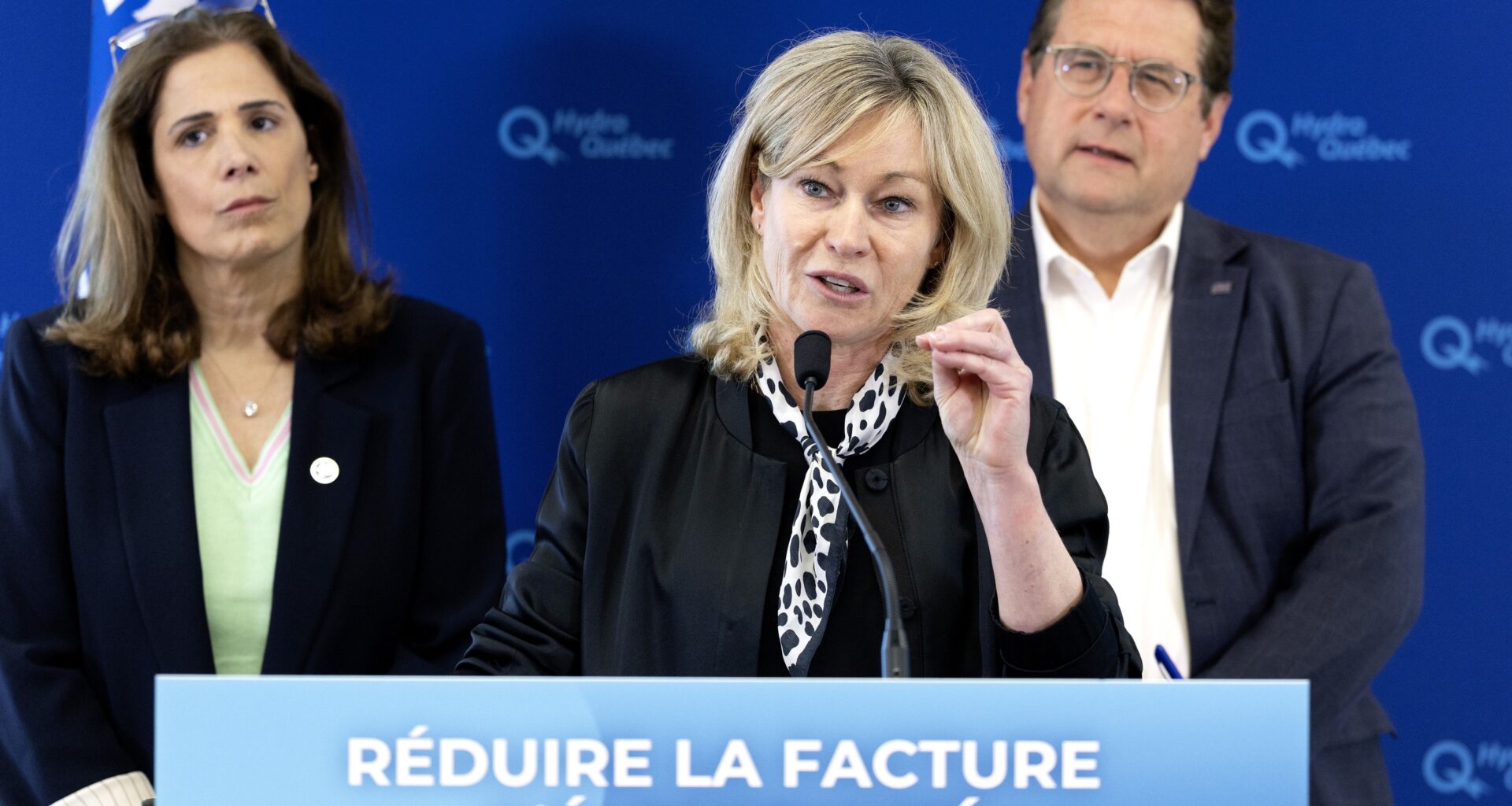
As Quebec readies to renegotiate a new Churchill Falls agreement, Hydro-Québec CEO Claudine Bouchard recalled Wednesday that the utility’s main goal is ensuring the province’s energy security.
Speaking one day after the Newfoundland and Labrador government announced it wants to rework a tentative agreement from 2024, Bouchard noted how crucial the deal is to Quebec.
The Churchill Falls complex allows Hydro-Québec to cover 15 per cent of its energy needs and accounts for a third of its profits. The original agreement, signed in 1969, expires in 2041.
“The year 2041 may seem far off, but in terms of energy, it’s just around the corner,” Bouchard told reporters Wednesday, adding she’s confident a new deal can be reached.
“We have an opportunity before us to negotiate a balanced contract … which will allow us to secure energy from Churchill Falls beyond 2041 and, above all, to build a new power plant near Gull Island to increase Quebec’s overall production capacity.”
The initial, contentious 1969 deal was set to be replaced after the two provinces reached a new agreement in principle in 2024 that promised to guarantee Quebec low-cost hydroelectric power for the next 50 years.
After a change of government last year, however, N.L. Premier Tony Wakeham announced Tuesday he wants to renegotiate a new deal with more favourable terms for the province.
Wakeham’s announcement came as he released findings from an independent panel that ruled the 2024 memorandum of understanding was not in his province’s best interest.
The panel found the agreement has positive elements but raised concerns about the province’s right to use Churchill Falls power in-province and “problematic” power pricing models, among other risks.
Quebec Premier Christine Fréchette has said she intends to soon meet with Wakeham over the matter.
Speaking alongside Bouchard on Wednesday, Quebec Economy Minister Bernard Drainville said the provincial government is confident the two sides can reach a mutually beneficial agreement.
“What will guide us in the negotiations is the best interest of Quebec and Quebecers,” Drainville said, adding the province “won’t sign anything at any price.”
“If Newfoundland demands certain things, obviously, Quebec will also ask for things,” he added. “What’s important is to reach a balance at the end where everyone wins.”
The 1969 deal has caused decades of resentment in Newfoundland and Labrador and has long been regarded as lopsided by the province.
Under the contract, Quebec assumed most of the financial risk of building the Churchill Falls dam in exchange for the right to buy power at a fixed price. As of 2023, the deal had generated more than $28 billion for Hydro-Québec, and returned $2 billion to Newfoundland and Labrador.
The agreement reached in 2024 would have allowed Quebec to continue buying electricity from Churchill Falls — though at a higher price — and increased the amount of energy it imports from Labrador through investments in three new hydroelectric projects, including the Gull Island power plant.
Editor’s Picks