
Breadcrumb Trail Links
Published May 19, 2026 • 2 minute read
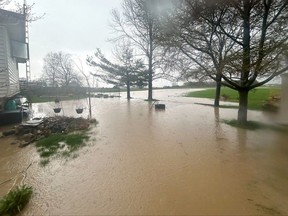 Blenheim resident Greg Bayly took this photo of flooding in his backyard following a massive rainfall in mid-April when rain water flowed of a farm field behind his home. (Supplied photo)Article content
Some help is on the way for homeowners in a Blenheim subdivision that have experienced significant flooding in the past during massive rainfall events from water flowing from a nearby farm field.
Advertisement 2
This advertisement has not loaded yet, but your article continues below.
Article content
But it may not solve the problem entirely.
Article content
Recommended Videos
Article content
Following a massive rainfall in mid-April, several homes on Mango Lane in Blenheim had ankle-deep water in their backyards that included run off from a 18 hectare (40-acre) farm field behind their properties.
Storm water master plans for Blenheim and Wheatley will be initiated this year “to identify upgrades and long-term strategies to improve storm water performance and reduce flooding risk,” said Marissa Mascarro-Amyotte, director of engineering in an email.
Residents will receive more information as these projects are initiated later this year that will include public consultation to identify concerns, receive input and help inform the study process, she said.
“While these plans support long-term improvements, storm systems cannot be designed to prevent all flooding,” Mascarro-Amyotte said.
She noted the municipality has completed storm water master plans for Tilbury, Ridgetown and Shrewsbury and continues to implement their recommendations.
Advertisement 3
This advertisement has not loaded yet, but your article continues below.
Article content
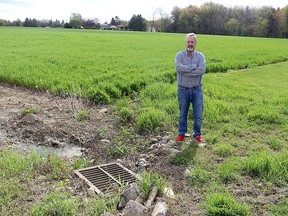 Blenheim resident Greg Bayly stands near a catch basin on the edge of a farm field behind his Mango Lane home that he said gets overwhelmed trying to drain the 18 hectare field during heavy rainfalls. (Ellwood Shreve/Chatham Daily News) jpg, CD, apsmc
The Chatham Daily News previously reported concerns by Mango Lane resident Greg Bayly that the recent incident was the fourth time in 16 years his backyard and basement have been flooded from water flowing off the nearby farm field.
Noting a storm water masterplan is a “nice title,” Bayly said, “first of all, I’d have to see the plan, see the details.”
He also wants to know what the timeline is and if the plan can be executed.
“I’m worried that, eventually, I’m going to have a mass flood,” Bayly said.
So far, water has only seeped in through the weeping holes in the brick of his house, but he said if a stick floating in flood water breaks his basement window “my basement is done.”
Bayly said he is planning to circulate a petition in the neighbourhood.
During large rain events, storm sewers and ditches can become full, and pump stations may reach their maximum operating capacity to move water downstream, Mascarro-Amyotte said.
“When this occurs, sump pumps and private storm water systems may not be able to discharge properly into municipal storm sewers, increasing the risk of basement flooding,” she said.
Advertisement 4
This advertisement has not loaded yet, but your article continues below.
Article content
Information on basement flooding and steps homeowners can take to reduce the risks on private property can be found on the municipality’s website at www.chatham-kent.ca/services/maintenance/Pages/Basement-Flooding-Information.aspx.
Storm water infrastructure is managed through a combination of systems, Mascarro-Amyotte said.
She noted the Ontario Drainage Act provides a framework for drainage in rural areas, where shared systems are designed, constructed, and maintained with costs distributed among benefiting landowners.
“These systems are designed based on typical storm parameters and in accordance with provincial regulations and best practices, and they cannot be designed to prevent flooding in every condition,” Mascarro-Amyotte said.
Additionally, not all ditches and storm sewers fall under this Act, she said.
In urban areas, infrastructure may include municipal systems and Drainage Act systems, Mascarro-Amyotte said.
In addition, some drainage systems may be privately owned and maintained between properties, and do not fall under either framework, she said.
Private property conditions also play an important role, features such as private drain connections and grading can affect performance, so homeowners are encouraged to review available resources and take steps on their properties to help reduce their risk as well, Mascarro-Amyotte said.
Article content
Share this article in your social network