
It’s clearer now than ever before that our futures — the places we live, the people we meet and the things we lose — will inevitably be shaped by the climate crisis. The Vancouver Art Gallery’s (VAG) latest exhibition, Future Geographies: Art in the Century of Climate Change, asks artists from B.C., Canada and beyond what those futures might look like.
VAG curator at large Eva Respini says she’s been thinking about “the question of how artists help us think about our shared future on this planet” for a while. Future Geographies is her way of answering it.
The exhibition, which runs at the VAG until Jan. 10 before reopening at the Art Gallery of Ontario in March, features dozens of works in various forms, media and traditions. All of them were created within the last 25 years — Respini and her team were intentional in limiting the exhibition’s scope to the 21st century. They hoped a shorter time-span would help create links and thematic connections between the pieces on display.
That resonance showed up most clearly in form and scale — several pieces in Future Geographies are large sculptures created from repurposed waste. Liz Larner’s Meerschaum Drift, for instance, is a sprawling mass of plastic containers, bottles and cartons all painted blue, white and green.
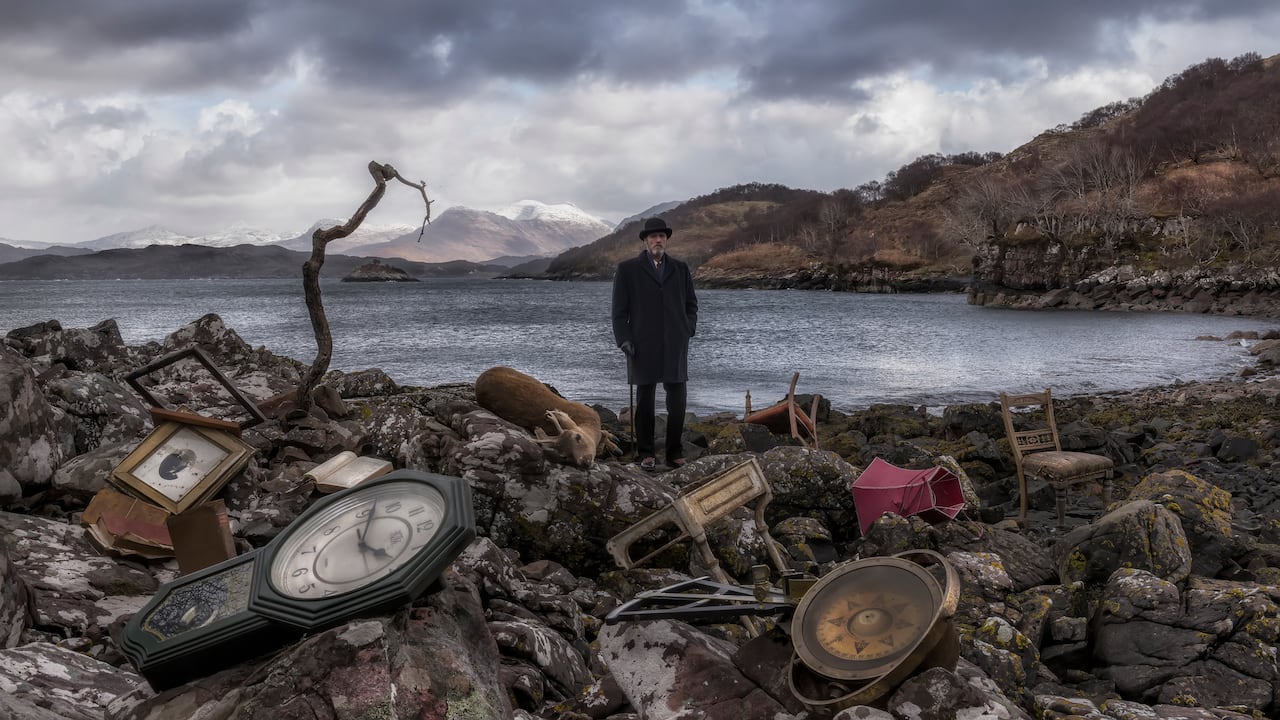 A still from John Akomfrah’s Vertigo Sea, in display at the Vancouver Art Gallery as part of Future Geographies: Art in the Century of Climate Change. (Courtesy Lisson Gallery)
True to the piece’s name, Meerschaum Drift evokes water, but its shape and texture hint at viscous, creeping substances like soap and spilled oil, or the conglomerated masses of waste that float in the oceans.
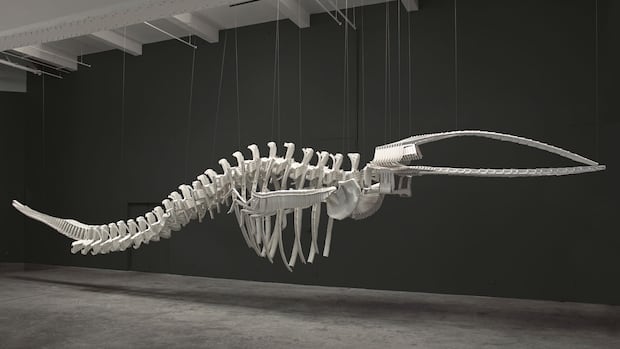
Hanging from the ceiling above Meerschaum Drift is Cetology — a life-sized sculpture of a whale skeleton fashioned from precisely-cut pieces of white plastic patio chairs — by B.C.-based artist Brian Jungen, who is of Swiss and Dane-zaa heritage. Jungen built Cetology in 2002, the second in a trilogy of similar works evoking and twisting the natural form of whale skeletons.
The result is graceful and unsettling, the instantly recognizable form of the whale, given a Giger-esque biomechanicality by the molded curves and machine-cut edges of the plastic chairs.
Marine motifs flow through each of the exhibition’s four thematic sections. The earth’s water systems are where the consequences of our emissions are most observable, and Future Geographies won’t let visitors look away. John Akomfrah’s Vertigo Sea might be the best example.
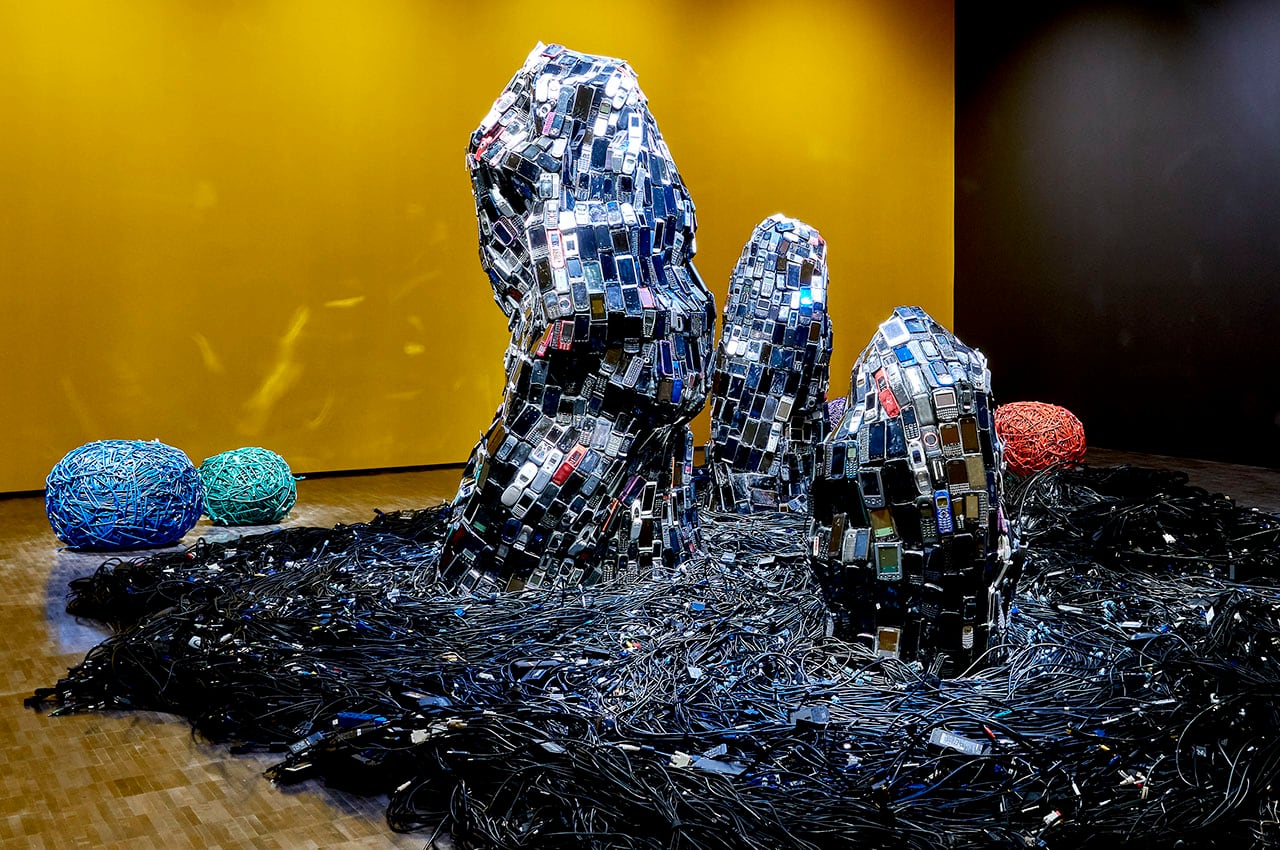 Jean Shin’s Huddled Masses, on display at the Vancouver Art Gallery as part of Future Geographies: Art in the Century of Climate Change. (Asian Art Museum of San Francisco)
Located in a soundproofed annex along the exhibition’s main path, Vertigo Sea is a three-channel montage film that Akomfrah — a British-Ghanaian artist, writer and filmmaker — constructed primarily from materials in the archives of the BBC’s natural history unit. In Future Geographies, the three channels are displayed next to each other, each projected on the wall of the annex.
Vertigo Sea, like its subject, is vast, terrifying and beautiful all at once. Footage of shipwrecks and colossal waves cresting the tops of lighthouses are presented alongside scenes of early 20th century sailors giving each other hair cuts on the decks of sloops, of dogs playing in the rigging.
The staged scenes that Akomfrah interlaces between these archival materials — Elizabethan women standing on the shore holding clocks, men in tailcoats sitting on wave-battered bluffs — are glossy and cinematic. Their overt gestures to themes of time and solitude are incongruous with the rest of the film’s hands-off, documentary tone, and the piece would be stronger for their removal.
Vertigo Sea manages to capture the visceral reality of water and the ubiquity of our relationship with it.
Akomfrah, Jungen and Larner might think of themselves as explicitly environmental artists — to whatever extent such a category exists — but Respini says that isn’t the case for everyone. Several artists she reached out to initially declined the invitation, saying their work wasn’t really “about climate change.”
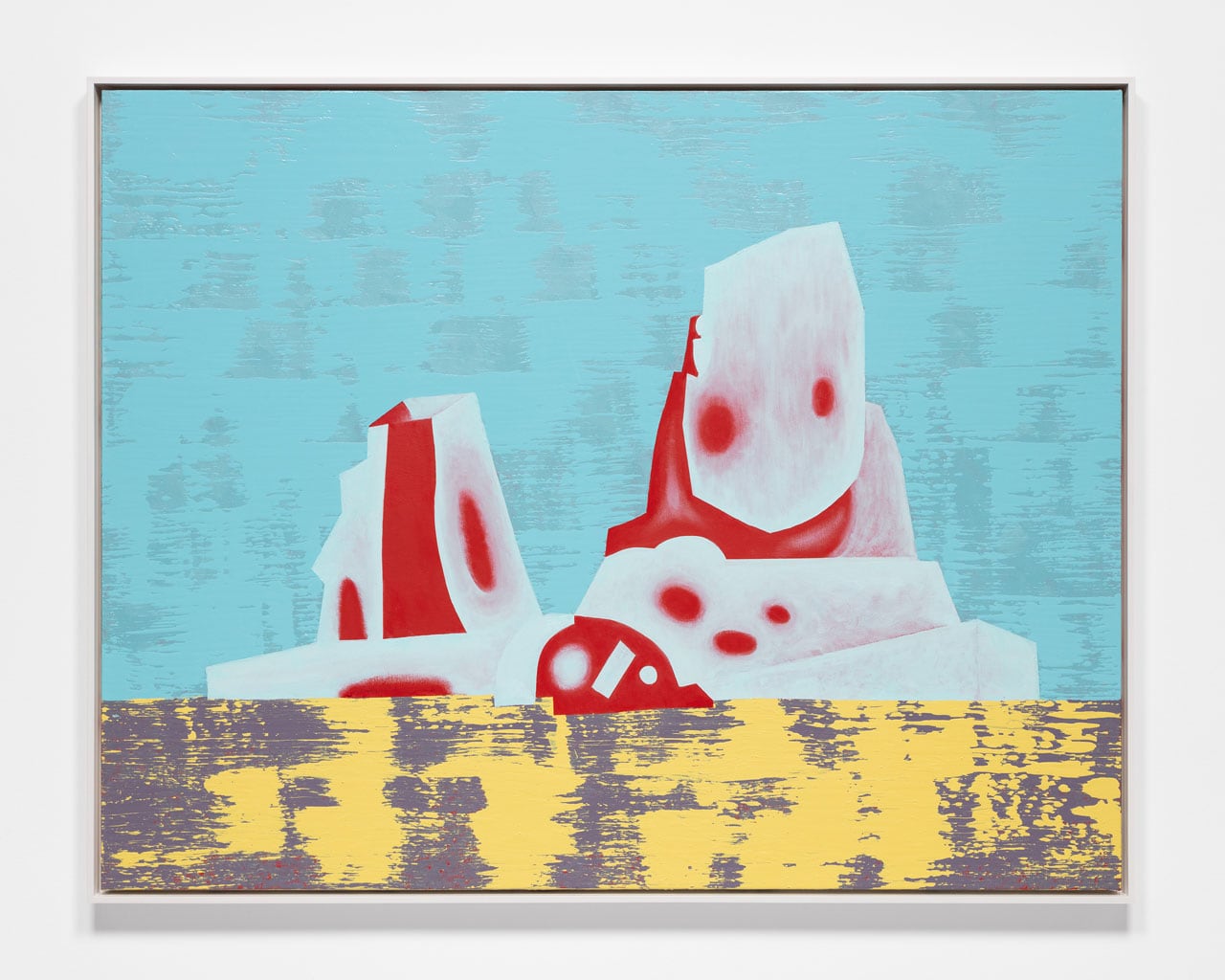 Douglas Coupland’s French’s Mustard, on display at the Vancouver Art Gallery as part of Future Geographies: Art in the Century of Climate Change. (Laura Findlay/LF Documentation)
“It’s very much the point of the show that I wanted to be asking a lot of broad questions,” she says. “I was really interested in opening up the conversation to artists that I thought were really making impactful work, even if it’s not necessarily in this bucket of climate change artists.”
That allegiance to substance over theme is one of Future Geographies’s greatest strengths. There is no subject, particularly in the world of material art, that is untouched by climate change. The meanings of many pieces are transformed simply by virtue of their inclusion.
Pieces like Jeffrey Gibson’s YOU LIBERATE MY ANGER MY DESIRE MY LOVE — a punching bag beaded with glass, quartz and plastic and emblazoned with lyrics from Madonna’s “Justify My Love” — might not reference the crisis overtly, but the ethics of their materiality are inevitably tied up in it.
Gibson is an American Choctaw and Cherokee artist specializing in textiles and beading. He was one of the artists who hesitated when Respini asked him to participate in an exhibition on climate change. He doesn’t consider himself an environmental activist, but his focus on slow, intentional creation has always led him to think about sustainability in his work.
“There’s something about craft that, to me, leads towards sustainable practices,” he says. “The amount of time and labour that it takes to craft something like a fully beaded punching bag is impractical for many reasons. It falls out of line with the way we think about anything that’s produced quickly or for mass distribution.”
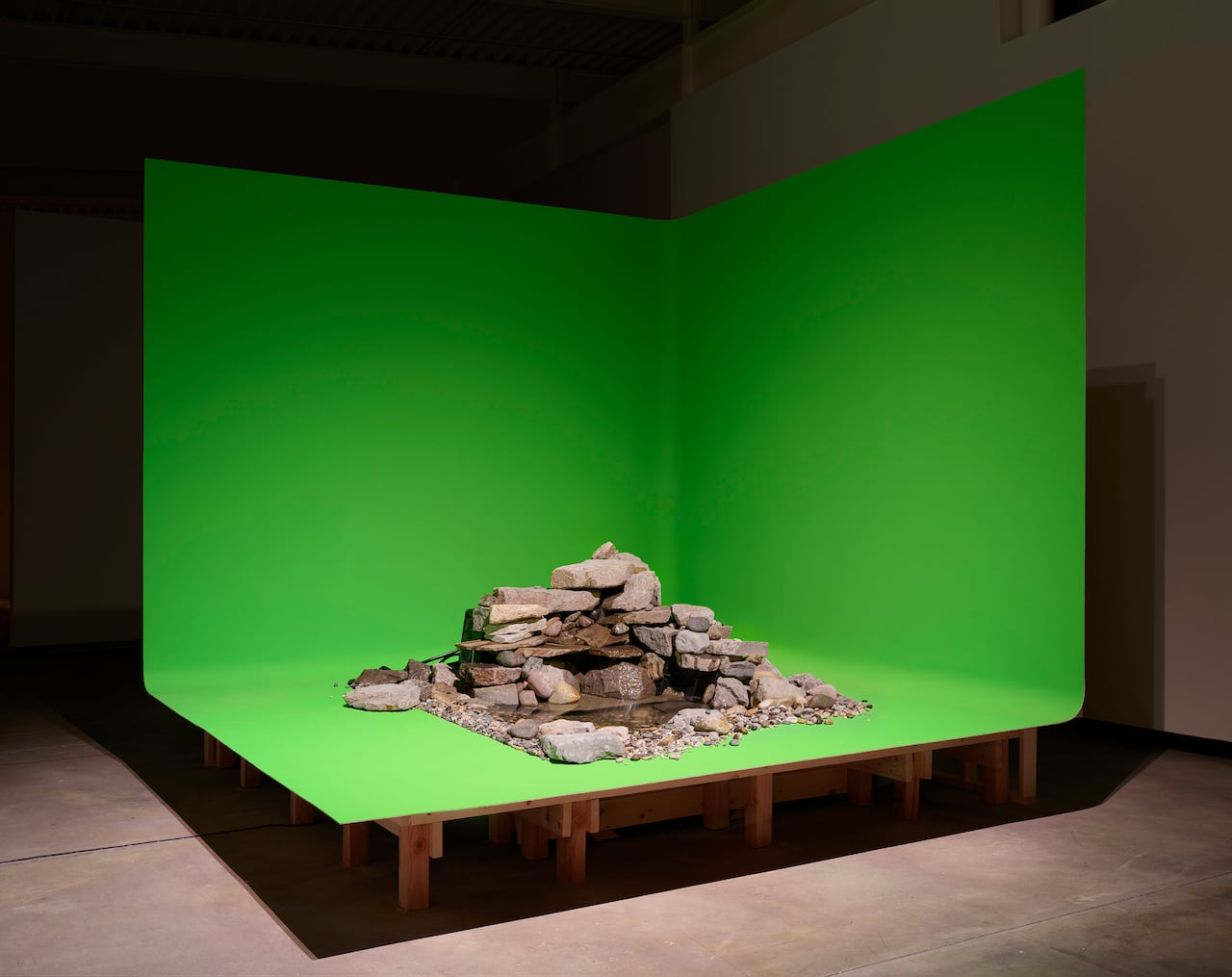 Abbas Akhava’s LOOP, on display at the Vancouver Art Gallery as part of Future Geographies: Art in the Century of Climate Change. (Rachel Topham)
In the end, Gibson decided his work would fit in well — he created YOU LIBERATE MY ANGER specifically for inclusion in Future Geographies. The VAG also collaborated with the UBC Climate Action Lab and the National Observer to expand the exhibition beyond the walls of the gallery.
The Climate Action Lab at UBC is a class of undergraduate students under Dr. Sarah Harris. Respini and Harris were introduced through Naomi Klein, who teaches climate studies alongside Harris at the university.
Over the course of a year-long collaboration, Harris’s students helped the VAG implement practices for sustainable exhibition-making. These ranged from modifying their shipping practices to avoid moving artworks by air or sea to developing an emissions calculator and swapping plastic plaques for repurposed cardboard.
For their part, the National Observer — a news website with a focus on the climate — offered to host the exhibition’s website within their own in hopes of cross-pollinating each partner’s audiences.
As curator at large, Respini thinks about these kinds of meta-exhibitional connections a lot. She’s particularly excited for Future Geographies to share the gallery with That Green Ideal: Emily Carr and the Idea of Nature — the largest exhibition of the legendary Canadian painter’s work in 20 years.
In her art, Carr hoped to document a changing land and its people amid a time of upheaval. She painted villages, dense wilds and the clearcuts that leveled them. Now, Future Geographies grapples with the legacy of what she saw.
Future Geographies: Art in the Century of Climate Change runs at the Vancouver Art Gallery (750 Hornby St.) in Vancouver until Jan. 10, 2027. It opens at the Art Gallery of Ontario (317 Dundas St. W.) in Toronto in March, 2027.