
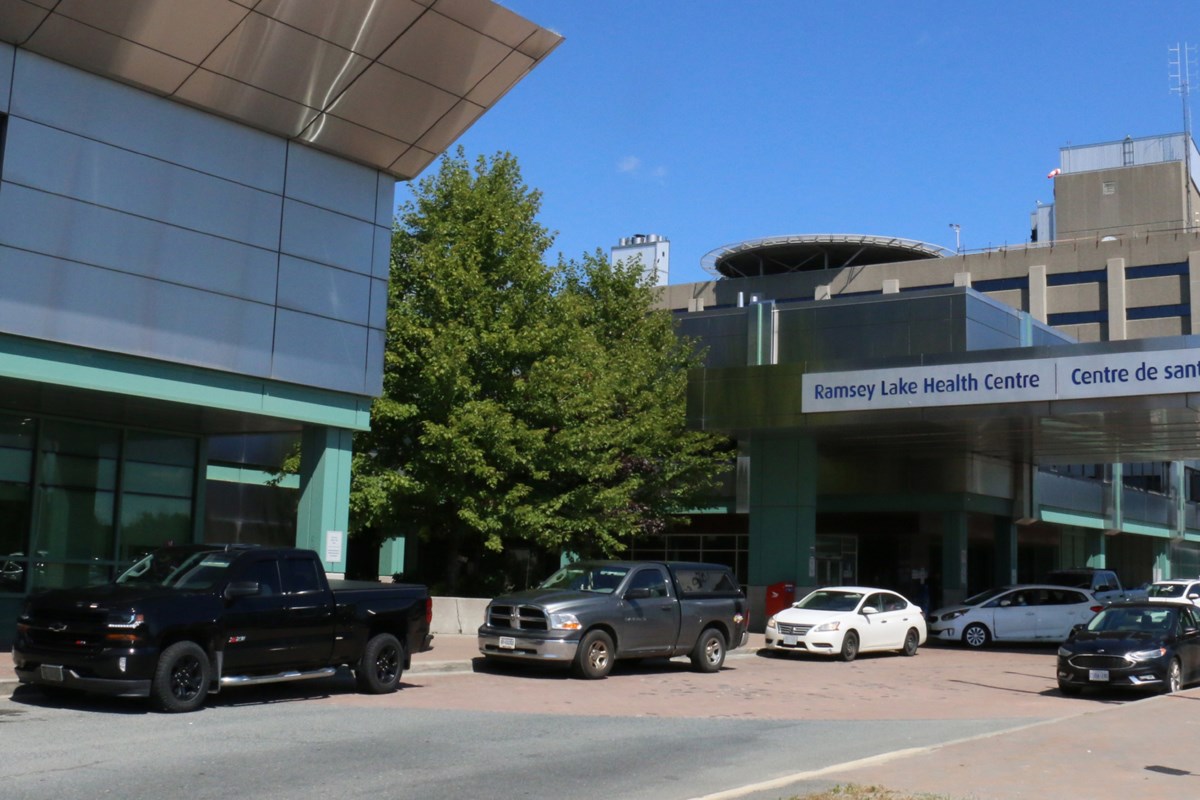
Calling emergency department wait times a ‘canary in the coal mine’ for health-care system performance, a new report from OCHU/CUPE and Canadian Centre for Policy Alternatives shows a 169 per cent increase in time spent waiting for emergency department care
Ontario’s largest health care union is warning of increased emergency room wait times, telling Sudbury media May 20 that patients at Health Sciences North will wait 169-per-cent longer now for care than they did five years ago.
That increase is from an average wait of 2.6 hours in the 2020/21 fiscal year, compared to 2024/25, with an average of seven hours now facing patients.
Revealed at a press conference hosted by OCHU/CUPE (Ontario Council of Hospital Unions and the Canadian Union of Public Employees) and the Canadian Centre for Policy Alternatives, the data is part of a new report, Failure by design: Ontario’s deepening hospital funding crisis.
The report also shows that Greater Sudbury patients are waiting upwards of 51 hours to be admitted to the hospital when they present at the emergency room. That’s up 89 per cent from the 2020/21 average of 27 hours.
Some patients could see wait times higher or lower than that, but that is the average for 90 per cent of patients, said Andrew Longhurst, report author and senior researcher with the policy centre. Longhurst spoke to the media about the findings of his research, calling emergency room wait times “the canary in the coal mine for health care system performance.”
He said his report shows that not only is Ontario’s hospital sector “the most undersized in Canada relative to the size of the population,” but that Northern Ontario is disproportionately affected.
Speaking at the press conference, Sudbury’s Sharon Richer, secretary treasurer of OCHU/CUPE, said longer wait times often mean lower quality of care.
Part of the challenge in Northern Ontario, said Richer, is the lack of family doctors mean people often use emergency rooms to seek primary care, not for actual emergencies.
“Here in Northern Ontario, many people don’t have access to a family doctor, and really are forced to rely on receiving their primary care from the emergency department,” she said. “We also face really high rates of heart disease, diabetes, and addictions. People need care, and when they cannot access community services or their family doctor, where do they turn? They turn to the hospitals.”
The delays contribute to poorer health outcomes, said Richer, “which is completely preventable.” The report shows Ontario’s average wait time for care is 4.5 hours, compared to HSN’s seven-hour wait.
The wait time increases point to systemic underfunding, said Longhurst.
“These are significant increases over that time period, and it suggests that again, provincial underfunding is constraining the ability to have the staffed capacity,” both at Northern hospitals and those across the province, said Longhurst.
He said that is evident when looking at the figures, and in particular, hospital deficits: the difference between what they spent and what came in the form of funding.
Longhurst said the last two fiscal years have seen HSN in a deficit position. “In 2023/24 it was a $10 million deficit,” he said. “In 2024/25 it was an $11.2 million deficit.”
The report states that in the 2024/25 fiscal year, 55 per cent of Ontario’s 136 hospitals have operating deficits; hardest hit are “smaller and rural hospitals” such as Espanola Regional Hospital, said Longhurst at the press event. The report states that smaller hospitals with operating budgets under $100 million disproportionately had deficits in 2024/25.
“Smaller hospitals made up 61 per cent of the hospitals in deficit but made up only 49 per cent of all Ontario hospitals.”
Longhurst said the numbers are clear indicators of provincial underfunding, “and it’s not just this analysis that is raising concern.”
He told the media that Ontario spends the least per capita on its hospitals in comparison to the rest of the country, and it also spends the least per capita or per person in the overall health system.
“Ontario is falling behind. It’s continued to have this distinction for a number of years now, and we’re seeing the effects. These are the impacts that patients are feeling.”
When asked the source of the underfunding, what role increased costs, austerity or cuts to services have as contributing factors, Longhurst told Sudbury.com “the gap” comes from what he sees as the provincial government‘s unwillingness to meet inflation with funding.
“The provincial government is saying ‘we are not going to fund you at more than four per cent in base’ — it’s not even four per cent base funding; it’s a mix of targeted and base funding to make up that up to four per cent — and then the hospital sector itself saying cost pressures are six per cent.”
He said the effects of inflation, aging infrastructure, increased chronic disease prevalence “especially in Northern Ontario,” are the driving factors of the cost increase, in addition to new treatments coming online as research and health care improve.
“To be blunt, I think it’s a profound misunderstanding on the part of the provincial government about what is driving costs in the hospital system, and the fact that they are stubbornly holding to that up to four per cent when the hospital sector itself and administrators are saying ‘we can’t provide the high-quality care that we know patients deserve with this level of funding’,” he told Sudbury.com.
He said “the provincial government provided $1.1 billion of additional funding in the budget, and then chastised the hospitals for not saying thank you, when it’s not even enough to make up their deficits,” he said. “I think it’s a very unfortunate situation where they don’t recognize the cost drivers in the system, and that’s really the cause of the underfunding.”
There is also the concern that underfunded public systems can attract more privatized health care, for those who can afford it, and for those who can access it. Longhurst spoke of Academic Orthopedic Surgical Associates of Ottawa (AOAO), a new private orthopedic clinic opened by surgeons who formerly worked at The Ottawa Hospital.
Health Minister Sylvia Jones announced in late 2025 that four new licenses for surgical and diagnostic centres like AOAO would be issued in early 2026 as part of a two-year, $125 million spend.
“Apparently, the provincial government can find $125 million for these types of initiatives, but how is that going to help residents in Sudbury” Longhurst told Sudbury.com.
That, and why is there the need for a new facility, when the hospitals and operating rooms are already built, “but they don’t have the staffed capacity.”
Longhurst said the idea “that we’re funneling public dollars into investor-owned health-care facilities, when existing operating rooms are not staffed or used efficiently,” doesn’t make sense.
“Why would you be funneling public dollars to private, for-profit health care when we haven’t stabilized the hospital system that we’ve already built and paid for? Why would you build something like ORs (operating rooms) when you’ve already got hospitals that have been built, but are sitting idle,” Longhurst told Sudbury.com. “I think private interests are benefiting from this, and the public interest is not being served.”
Jenny Lamothe is a reporter with Sudbury.com, covering vulnerable and marginalized populations, as well as housing issues and the justice system.