
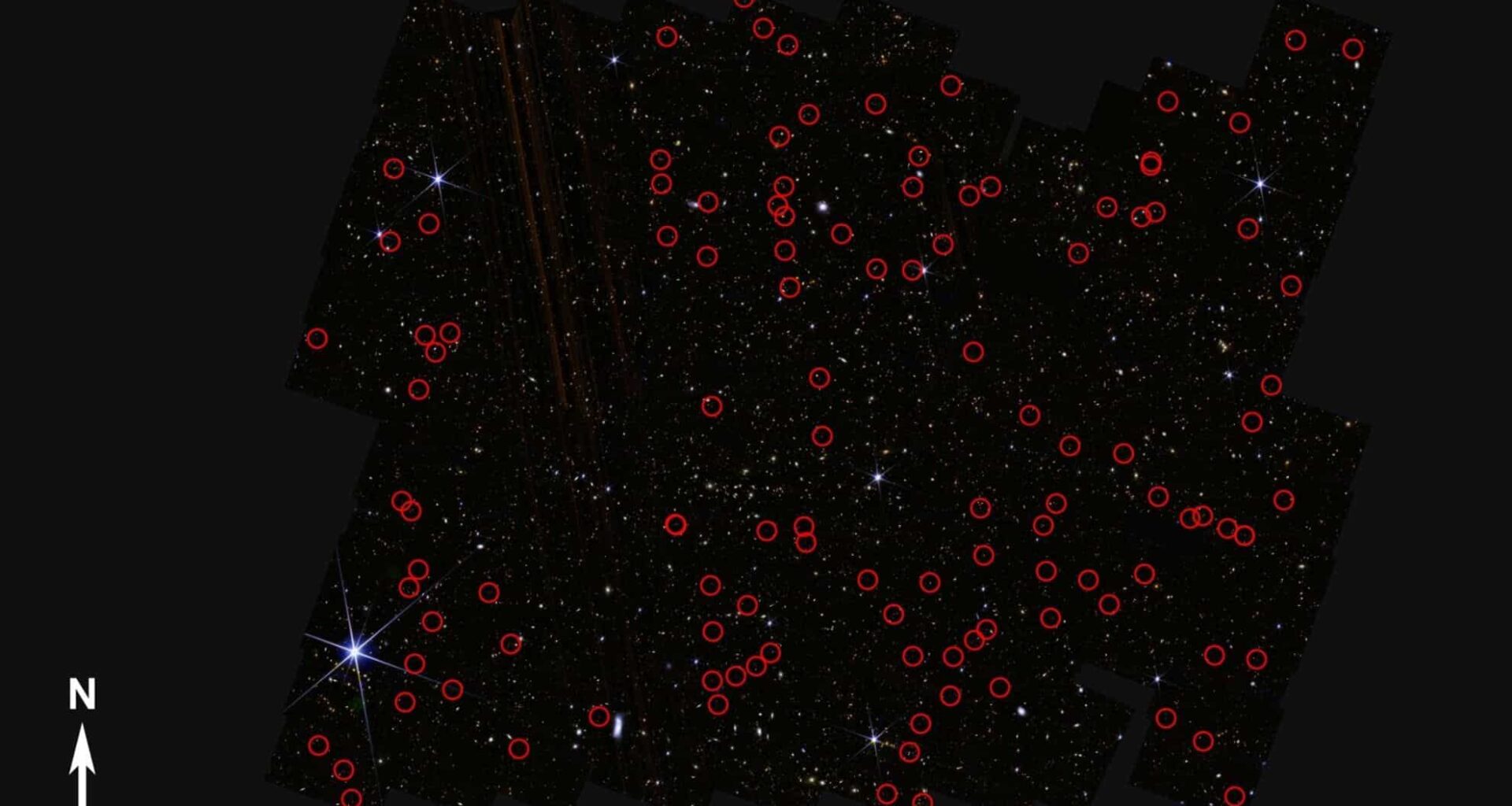
A recent study led by scientists at the University of Missouri, published in The Astrophysical Journal, revealed some astonishing findings made possible by the James Webb Space Telescope (JWST). The research identified 300 unusually bright objects in the deep universe that are challenging existing theories about how galaxies formed during the earliest stages of the cosmos. Using the telescope’s infrared imaging capabilities, the team of astronomers discovered objects that could represent the earliest galaxies ever observed, opening new possibilities for understanding the formation of galaxies in the early universe.
This discovery might shake up established ideas about cosmic evolution and force scientists to reconsider the way galaxies came into existence, particularly during the epoch when the first stars and galaxies began to emerge. As astronomers delve deeper into these findings, they are beginning to see that the nature of these objects may not just challenge old assumptions, but lead to revolutionary changes in how we think about the early universe.
The Unexpected Brightness of Distant Objects
The team of researchers from the University of Missouri used infrared imaging from JWST to uncover 300 bright objects that appear far brighter than expected. These objects, which are candidates for early galaxies, are characterized by a high degree of brightness that is unusual for galaxies from such distant epochs. As Haojing Yan, a co-author of the study, pointed out, “These mysterious objects are candidate galaxies in the early universe, meaning they could be very early galaxies.” If even a small portion of these objects turn out to be what the team believes, the discovery could significantly alter the current understanding of galaxy formation in the early universe.
The challenge here lies in confirming whether these objects are truly early galaxies or if they are simply misidentified cosmic phenomena. However, the research team’s findings have sparked excitement in the field, as “even if only a few of these objects are confirmed to be in the early universe, they will force us to modify the existing theories of galaxy formation,” said Yan. The implications of such discoveries could expand the timeline and processes of galaxy formation much earlier than previously thought.
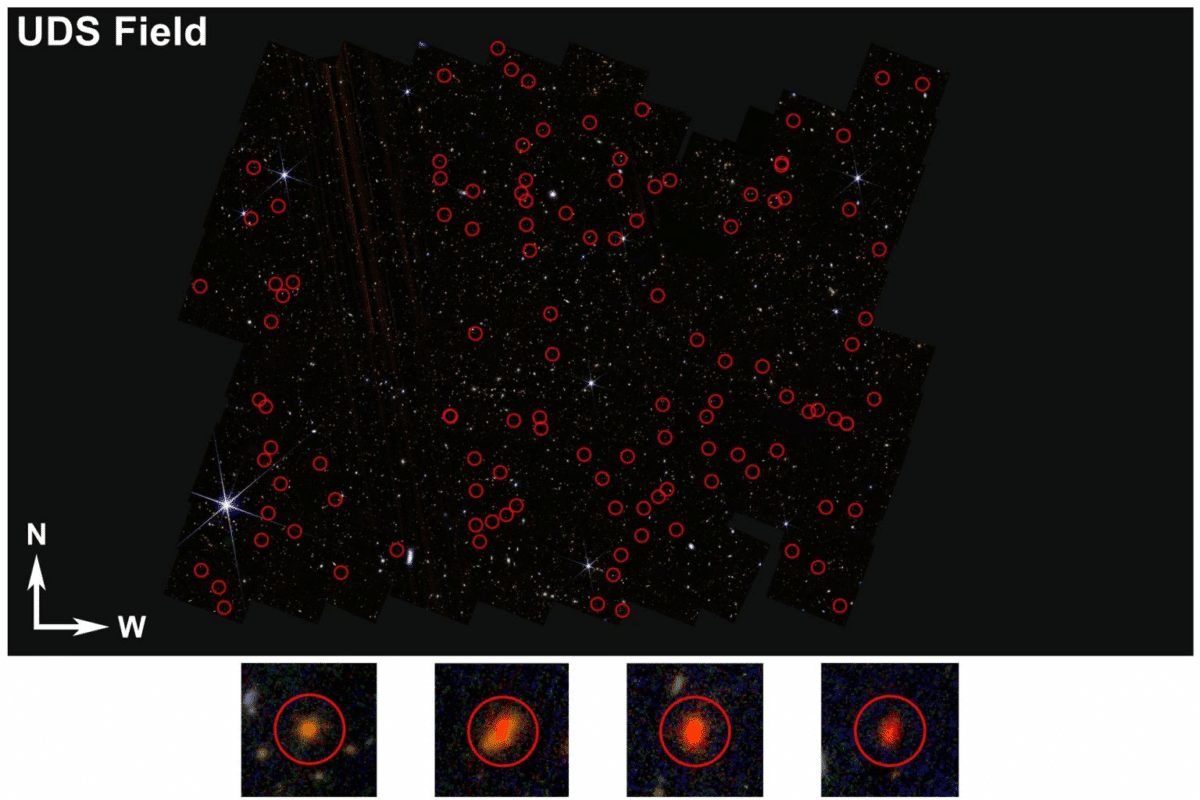 Credit: Bangzheng “Tom” Sun/University of Missouri
The Role of Redshift in Identifying Early Galaxies
A key to this discovery lies in the concept of redshift, which is a crucial tool for determining the distance of astronomical objects. As light from distant objects travels through space, its wavelength stretches, shifting from visible light into the infrared. This stretching, referred to as redshift, is essential in helping astronomers measure how far away an object is and how far back in time it resides. As Yan explained, “As the light from these early galaxies travels through space, it stretches into longer wavelengths—shifting from visible light into infrared. This stretching is called redshift, and it helps us figure out how far away these galaxies are.”
Redshift provides critical insight into the time period an object was created, and a higher redshift corresponds to greater distances and an earlier era in the universe. These findings suggest that the objects the team has identified could be among the first galaxies to form, dating back to a time when the universe was still in its infancy. The ability to measure and understand redshift is thus a pivotal component of the study, as it directly informs scientists about the age and formation of these galaxies.
The Dropout Technique: A Powerful Method for Discovery
To identify these 300 objects, the University of Missouri team employed the dropout technique, a method that has proven to be effective in spotting high-redshift galaxies. This technique focuses on looking for objects that appear brighter in redder wavelengths but disappear in bluer ones. According to Bangzheng “Tom” Sun, the lead author of the study, “It detects high-redshift galaxies by looking for objects that appear in redder wavelengths but vanish in bluer ones—a sign that their light has traveled across vast distances and time.”
This phenomenon is linked to what is called the “Lyman Break,” which occurs when ultraviolet light is absorbed by neutral hydrogen. As redshift increases, the signature of this break shifts toward longer wavelengths, making it easier to spot distant galaxies. The dropout technique is essential for isolating these objects, as it allows scientists to identify potential candidates for early galaxies by analyzing their light patterns.
Spectroscopy: The Final Frontier for Confirmation
While the dropout technique can help identify potential early galaxies, the next crucial step in confirming these objects is the use of spectroscopy. Spectroscopy is a technique that disperses light into its constituent wavelengths, allowing scientists to detect unique signatures that provide more accurate measurements of redshift and other properties. As Sun explained, “Ideally this would be done using spectroscopy, a technique that spreads light across different wavelengths to identify signatures that would allow an accurate redshift determination.”
Spectroscopy is the gold standard for confirming the nature of distant objects, and it can provide definitive proof of whether these bright objects are indeed early galaxies. The research team has already confirmed one object through spectroscopy, but they recognize that further analysis is needed. “One of our objects is already confirmed by spectroscopy to be an early galaxy,” Sun noted, “But this object alone is not enough. We will need to make additional confirmations to say for certain whether current theories are being challenged.”
Rewriting the Story of Galaxy Formation
The discovery of these unusually bright objects presents a challenge to current models of galaxy formation. Until now, scientists believed that the formation of galaxies occurred over a longer period, with the earliest galaxies forming well after the Big Bang. However, these new findings suggest that galaxies could have formed much earlier than previously thought, forcing astronomers to rethink the timeline of cosmic evolution.
If the objects identified by the University of Missouri team are confirmed as early galaxies, it could imply that galaxies began forming at an earlier stage in the universe than what was originally proposed. This could have profound implications for our understanding of the formation of stars, galaxies, and the large-scale structure of the universe.