
The wait time for long-term care in the Island Health region averages 345 days, with some seniors waiting as long as 1,861 days.
The province’s cancellation of contracts for as many as seven new long-term-care homes is drawing attention to the thousands of older people languishing in hospital beds while waiting to get into a home, with some dying on the wait-list.
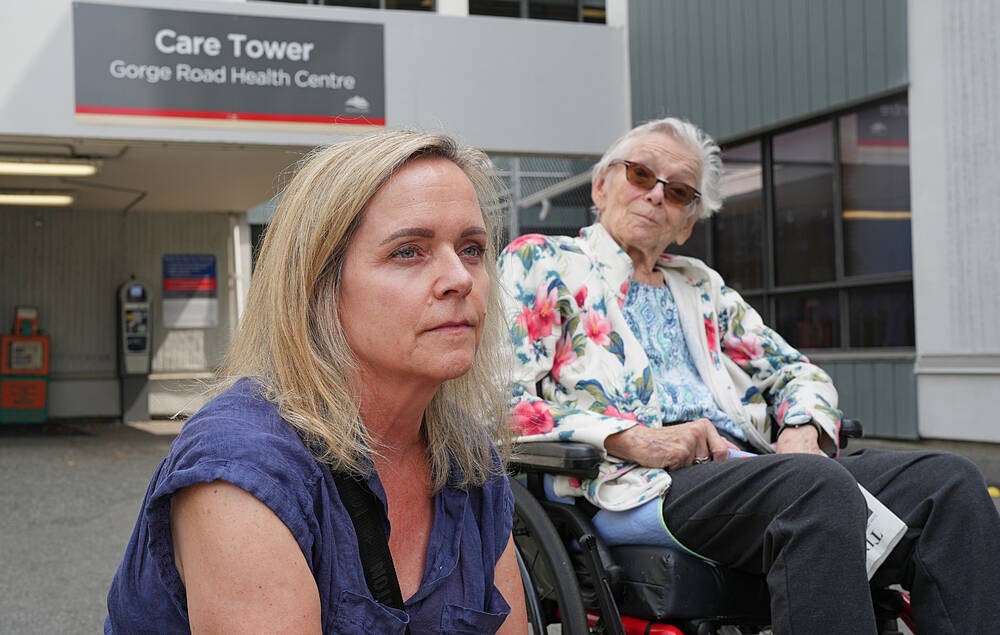
Laura Kyle says her mother, Barbara Donaldson, spent seven months in hospital with Parkinson’s, first at Victoria General and then at the Gorge Road Health Centre, before dying in September.
She says that Vancouver Island Health Authority officials had told them that the wait for a long-term care bed could have taken another two years and that several programs that would have allowed Donaldson to stay at home no longer existed.
“When my mom went into the hospital in February of 2025, she was really only needing to be in hospital in an acute-care setting for about a month because she recovered and was deemed ready for discharge, but VIHA said we have to stay there until we figure out what she’s doing, because she couldn’t go back to her independent living suite,” said Kyle.
“VIHA presented me with four different options, one after the other, and confirmed that they could do each one of these kind of in a row that would allow her to stay in her suite and get full care from VIHA, and one after the other, we were told that each option was eliminated until the only option left was to wait in hospital for a public long-term care bed.”
Kyle said by that point, the wait-list had grown to 12 to 18 months and health workers eventually said it would be two years until her mom could get a bed.
She said she sent emails to her local MLA, Health Minister Josie Osborne and Premier David Eby, but the only response she got was a form letter from Osborne’s office. She and her husband were even preparing to borrow against their home to get Donaldson into a private home just before she died.
“My mom came to the top of the wait-list for that private facility that we’d applied for, so we thought, great, we got everything all arranged for her to move in the following week, got everything set up in her new home, and the day we showed up at the hospital to move her into her new home, we found her slumped over in her chair and basically incoherent,” said Kyle. She said her mother was moved into palliative care two days later.
“That’s what I sit with today, is you know, knowing that our provincial government, David Eby, Josie Osborne, knew that this crisis was coming, yet they have chosen to basically ignore it.”
Statistics provided by Osborne during debate on the budget for her ministry show that 7,829 seniors are on wait-lists for long-term care beds in B.C.The wait time in the Island Health region averages 345 days, with some seniors waiting as long as 1,861 days.
The situation is even worse for some in Vancouver Coastal Health, with the maximum wait hitting 2,825 days. The average wait time in the health authority is 315 days. Northern Health has the highest average wait time at 376 days.
Brennan Day, seniors critic for the B.C. Conservatives, said he hears stories every week of seniors dying in hospital while waiting for a long-term care space, although statistics on how many seniors are waiting in hospital or how many have died are not readily available.
He said it’s clear the province needs more long-term care beds, but the government’s decision to put seven projects on hold — in Delta, Abbotsford, Campbell River, Kelowna, Chilliwack, Squamish and Fort St. John — has meant the province will only fall further behind as the population ages.
“We know in certain areas of the province, the average wait time to get into long-term care is now in excess of three to four years, and in the extreme cases, as the minister confirmed, those wait-lists are up to 2,800 days. That’s eight years for people to be waiting on a wait-list,” said Day.
He said those in need of long-term care who are stuck in hospital hallways and beds have a direct impact on how long it takes to get ER services.
Osborne admitted the waits are not ideal but said the province is doing everything it can to ensure seniors can get the care they need when they need it.
She said 37 new health-care projects have been approved since 2017, with a total of 3,397 net new care beds completed or underway.
“The rates of construction costs and everything that we’re seeing now, they’re no longer sustainable, they’re just simply not tenable. But we know how important it is, because people are waiting,” said Osborne, adding that for some, long-term care homes are the option that they need.
B.C.’s seniors advocate, Dan Levitt, says the province knows that it is well short of the beds it needs, with the current shortfall estimated at 2,000 beds. Over the next 10 years, he expects that number to grow to more than 16,000 beds.
Seniors who need long-term care but are stuck in acute care often “decondition” or decline, “because they’re not getting the kind of care that a senior who requires long-term care would get if they were living in those care homes,” said Levitt.
He said the province also needs more assisted living facilities. “We’re going to need more affordable supportive housing for seniors. We’re going to need more community-based services.”