

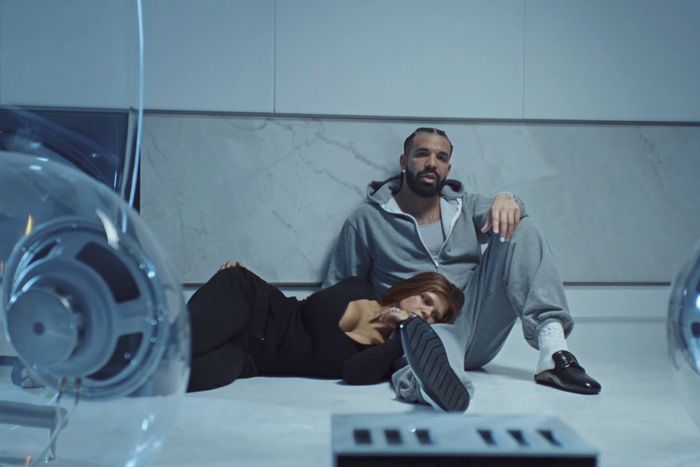
His new album trilogy is at once some of his most exciting and most perfunctory music of the decade.
Photo: Drake/Youtube
Two years ago, Drake experienced one of the most embarrassing defeats in rap-beef history by going up against Kendrick Lamar and half a Rolodex of old friends. He then tried to make his label pay for the dent in his good image, moving with all the grace of a cartoon character tumbling down a rocky cliffside. Drake’s lawsuit against Universal Music Group famously claimed he was a victim of a bot-farming scheme that gave Lamar’s “Not Like Us” unfair traction in their feud. It also framed page after page of social-media reactions as proof that real fans believed every word of the song, which he says contains libelous rumors such as his being a pedophile. The suit failed spectacularly and continues to flail in appeals. Drake now understands that any consensus around him is irreparably broken. Some see a king; others, a fraud. Last week he returned with his long-awaited and highly publicized ninth album, Iceman, plus two more full-lengths no one saw coming, Maid of Honour and Habibti. It is at once some of his most exciting and most perfunctory music of the decade.
Iceman frontloads the fallout from the 2024 “20 vs. 1,” as Drake calls it, on account of an avalanche of spite from his erstwhile friends. The album is an expanse of frosty raps that picks off adversaries one by one. Maid of Honour and Habibti buzz off toward different genres — global party jams, wounded R&B — and map the Toronto rapper-singer’s journey out of an all-consuming vengeance. “I made this to make this to make this,” Drake said on a livestream announcing the trilogy. There are separate albums for people who come to his music to pout, dance, and swoon. The middle album, Maid of Honor, fares best by minimizing both Iceman’s boiling ire and Habibti’s sleepy bedroom banter. The differing temperaments share a goal of reeling us back into Drake’s world while collectively drowning out his public headaches. Chris Brown and Morgan Wallen have similarly industrialized bloat to recover from appalling incidents, allegations, and court cases via sensory overload, putting out motion-picture-length works reliably stuffed with clashing sounds and ideas.
Over two and a half hours and 43 songs, you get Drake as folk singer, alt-rocker, ’80s electro MC, ’90s West Coast rapper, crypto baron, and other characters. It feels like a museum of past and possible Drakes attempting to meet the divided and ideologically siloed internet. Drake revisits the approach of his 2018 double album, Scorpion, which was half venting sessions about Pusha T publicly embarrassing him and half top-flight radio jams. That album was plagued by a nagging emotional unevenness. With his triple album, he confines disparate emotions and approaches to genre to individual albums, making each one (particularly the lengthier Iceman) feel like a secluded vacation — that lasts a few days too long. This doesn’t save the project from filler, but it grants each mood environment its own respective commercial and critical reception. Drake is collecting both pans and acclaim, sometimes from the same publications.
As with JAŸ-Z’s The Blueprint 2: The Gift & the Curse, released after the peak of his aughts tiff with Nas, there are enough sturdy ideas between the three projects to pack a tightly pruned, formidable single album. But the gesture is the point. Drake would like you to think nobody else at his station would go for this. (Beyoncé lets us marinate in a reinvention for years; Taylor Swift snuck a second half of The Tortured Poets Department in the wee hours of release night, but the 31-song version was unified in its themes of regret and revenge.) Drake occupying the top-three spots on Billboard’s album chart, as he’s projected to do, would underscore his insinuations that he’s a much bigger deal than anyone he’s retaliating against, all of whom at some point have needed the stimulus package of his co-sign. This era is a show of dominance.
Iceman got the extended promotional push in a series of livestreams full of song snippets and slices of Toronto life and is on track to move three times as many equivalent units as the other two albums. After a summer of mysterious teasers, Drake’s fourth and final livestream ahead of the album drops suggested that Iceman’s title is a reference to Richard Kuklinski, the tristate-area mob hit man (not the X-Men icon). Drake adopts the Iceman nickname to traverse his city exacting revenge on naysayers and fence-sitters throughout the stream. The videos are an unsubtle rejoinder to the West Coast ruler status Lamar flaunted on GNX. They scream, That’s not the only region in rap! The king in the north goes after Lamar and LeBron James — who is guilty of the grave sin of attending Lamar’s Kia Forum victory-lap performance in 2024 — in “Make Them Remember,” lurking in what appears to be the Toronto City Council chamber and Mayor Olivia Chow’s city-hall office. In “2 Hard 4 the Radio,” he kicks Cali flows inside the CN Tower. Iceman hits from inaccessible places of power.
This album makes you feel like it’s been only two weeks since “Not Like Us.” The sleek, snooty “Janice STFU” — “Handin’ out turkeys on-camera inside of your hood, then you go back to the hills” — is an answer track that should have immediately followed Lamar’s hit. These aren’t Drake’s best raps, but they’re honest about being in the unusual position of getting deep-fried by a decade’s worth of friends at an ultimately low cost to his marketability. Drake’s mob-boss-on-quaaludes act on “Burning Bridges” — “Your baby mama ain’t even post your single” — is a hilarious postscript to A$AP Rocky’s January jab at his partner Rihanna’s world-famous ex: “Stole my flow, so I stole ya bitch.” Iceman’s aim is to turn the tables, not to explain why Drake was ever under fire, so mixed messages are bountiful. On “Whisper My Name,” he juggles disdain for someone (likely J. Cole) “sitting with Farrakhan” and boasts about having gangsters in his circle who are out observing Ramadan, repudiating and basking in Nation of Islam history and optics in the same song and video. He’s a Coachella alum now, he also announces. He digs into the web of attention-farming tactics in mass media but only as it suits him. He wants you to think his rap Royal Rumble was fixed against him, and he’s aggressively monetizing the backlash.
If you’ve been aching to see Drake leave his haters behind, Maid of Honour and Habibti, for the most part, drop the issue. A looseness in sound works for him on Maid, the highlight of the package. It takes after his brilliant 2017 mixtape More Life, a fusion of hip-hop, R&B, U.K. grime, dancehall, and Afrobeats where he slipped in and out of regional accents. One plus side to the 2024 free-for-all is that Drake hates half his roster of big-ticket features now, most of whom are men, which freed up space for women to get a boost throughout the trilogy. Brooklyn’s Stunna Sandy shines on Maid’s sweet and mantralike “Outside Tweaking,” and St. Louis’s Sexyy Red pops up on “Cheetah Print,” a breezy electro jam that fizzles out on an unfortunately rote freestyle music detour.
We’re told at the end of Iceman that “innocent Drake” is never coming back — until he does on the horny but sometimes corny Maid: “Girl, it’s your birthday, you can cry if you want to / You can walk in the mall, you can buy what you want to,” he sings when the beat changes in “Cheetah.” “We got so much motion,” he says on the dizzily infatuated “WNBA,” “I’m taking shit for motion sickness.” The second album’s restlessness capitalizes on the success from “Nokia” off $ome $exy $ongs 4 U, an upbeat break from beef that went to No. 1 on the Billboard Hot 100 in 2025. Maid lounges almost entirely in a spirit of moonlit longing, yielding some of the most left-field moves of Drake’s decade. The yearning new jack swing “Stuck” sounds like it’s blaring off a warped cassette tape from a good Keith Sweat year, and “Goose and the Juice” dislodges from time as it mixes ’80 gated reverb and auto-tuned pillow talk.
Habibti is the patchiest of the batch. The third installment sinks further in slow jams that would have dragged down other albums, and portions feel superfluous since Maid approaches that aesthetic with more range. But it has moments that pop. Like Iceman’s “Burning Bridges,” “Gen 5” is a haughty and anesthetized performance of an exhausted asshole addressing business he doesn’t care to, with Drake barking out a half-sorry to a significant other for something unmentioned in the track. “High Fives,” a bubbly love song punctuated by a sweet “Mashallah,” gets Drake back to shouting out various women in his life, as on the Scorpion No. 1 “In My Feelings.” Without getting jammed up in animosity like Iceman, Habibti — “& other nicknames I call my dear city,” the artist’s Apple Music description adds of the Arabic term of endearment — waves off those like Rick Ross, who gleefully dismissed Drake’s Blackness during the 2024 battle, resisting any binary thinking about culture and race.
The trilogy dabbles in Arabic phrases and documents Drake’s trips all over the Middle East; nods to his Muslim associates; and jabs at DJ Khaled, whose parents emigrated to the U.S. from Palestine, over his silence on Gaza. (Drake signed the Artists4Ceasefire letter in 2023.) Habibti quietly acknowledges Toronto as home to countless faiths and races, to Black and Arab experiences, as it turns the dial back to the old romantic Drake. He wants to appeal to all the proverbial political aisles: The day of the albums’ release, the White House Twitter account dropped a MAGA version of Iceman’s cover, leaning into the Thriller-glove gesture’s resemblance to the white-power “okay” hand sign. The next week, the White House Tiktok account posted a Trump fan cam featuring ICE making arrests soundtracked by the album’s outro. Drake isn’t rushing to condemn this use of his work as Sabrina Carpenter, Radiohead, and others have done.
Drake is in his “Hollywood” Hulk Hogan phase. In the ’90s, the paragon of nobility in pro wrestling was caught in a character-unraveling lie about steroid use. He evolved most notably in arrogance and callousness, resulting in further scandals and the public losing faith in his good character. An entertainment heavyweight with seniority in the field has choices. You either ease into a more adult purview — as the trilogy does in its moments of concern about mortality and legacy, such as the revelation that his family is navigating his father’s cancer diagnosis in the trilogy-opening “Make Them Cry” — or keep figuring out how to get back at people you feel wronged by. This year, Drake reckons ambitiously that, actually, you don’t have to choose. He seems ever more likely to circle a victim-aggressor axis forever, but for now, he is trying to figure out how not to be entirely defined by it.
Sign up for the Vulture Daily
An entertainment newsletter for the pop-culture obsessed.
Vox Media, LLC Terms and Privacy Notice
Related