
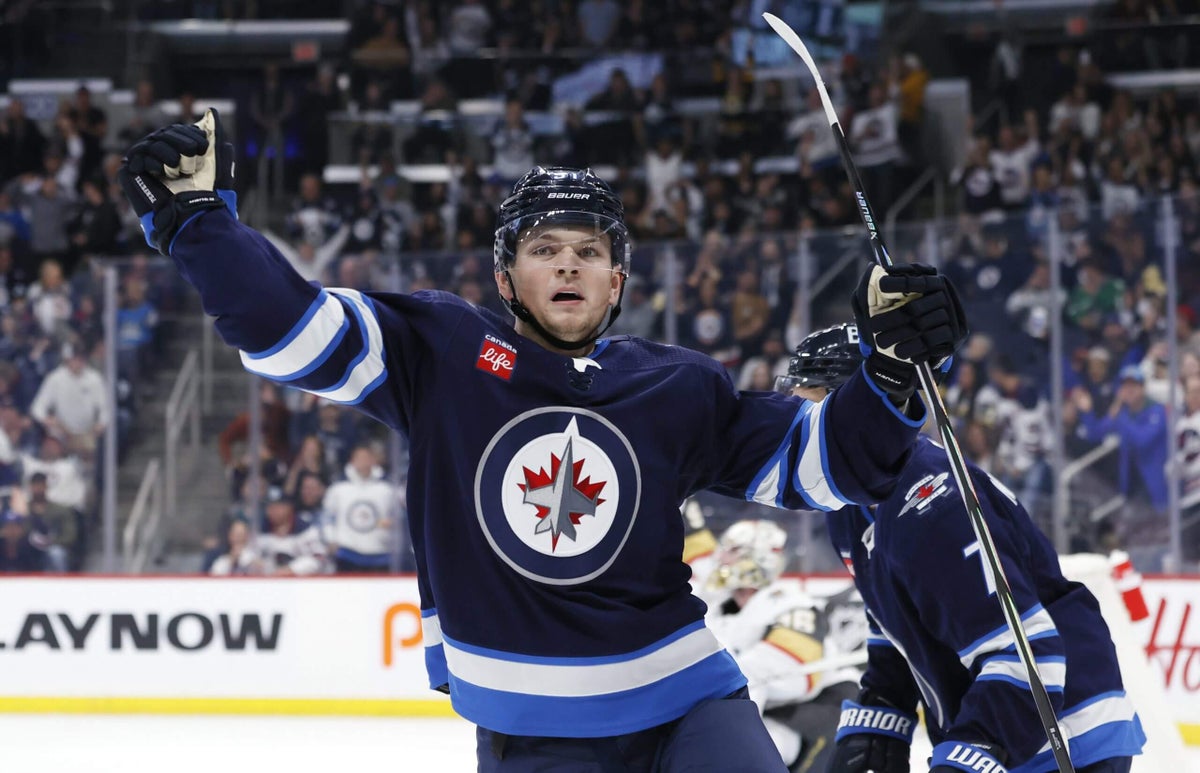
Cole Perfetti has experienced miraculous playoff highs and ankle-twisting lows since his last contract negotiation.
The goal he scored in Game 7 against St. Louis set a new record as the latest Game 7 tying goal in NHL history. Then Nikolaj Ehlers’ departure opened up a job on the Jets’ top power play, allowing Perfetti to feast on a unit that led the NHL in efficiency one year ago. If anyone was going to have a breakout season, it was him, fresh off 50 points and starting the season with newfound playoff confidence.
Then a high ankle sprain took him out of the lineup. He scored just five points in his first 24 games to start the season and didn’t look like the same clever, incisive player that had produced in a secondary scoring role the previous year. As his ankle healed and his confidence in it grew, Perfetti’s scoring returned: he produced at a 50 points per 82 games rate from Jan. 1 through the end of the season. Add it all up, though, with the games missed due to injury, and Perfetti scored just 32 points in 68 games.
Now the two-year, $3.25 million AAV bridge deal Perfetti signed in 2024 has come to an end — not with a massive breakout season but with a late return to form. He’s 24 years old, continues to show poise with the puck, good hands, and great vision, but his poor counting stats from last season will hurt him.
Perfetti has more leverage this summer than he did two years ago. He’s a restricted free agent with arbitration rights and his first crack at UFA status could come as soon as 2027. If he wanted to play hardball, he’d simply file for arbitration and then wait for the hearing. It would guarantee him a one-year contract, putting the Jets under pressure next summer, with him just one year away from UFA status. This is similar to the strategies employed by former Jets like Andrew Copp and Jacob Trouba, which each resulted in trades.
I don’t think it’s going to come to that. I project that the Jets will get Perfetti signed to a long-term contract, and it might age as a bargain, given Perfetti’s injury-impacted year and the series of cap increases projected in the years to come. But what will it cost the Jets?
Today, we look at Perfetti’s contract through four different lenses, starting with a Jets comparable, adding a list of the NHL’s most recent RFAs, and then looking at two analytical models to project his most likely contract.
Gabriel Vilardi: An in-house comparable?
Two factors stopped the Jets from signing Perfetti to a long-term deal back in 2024. The first was that Perfetti’s $3.25 million AAV bridge deal kept his cap hit low, giving Winnipeg an opportunity to add contracts at the 2025 trade deadline. They took a serious run at Brock Nelson that would not have been possible had Perfetti been signed to a larger cap hit on a long term deal; the strategy is sound, even if the result was a failure.
The second reason was that Winnipeg was not yet sold on Perfetti’s ceiling. He’d scored 75 points in 140 games at the time — similar to the 78 points in 152 games Gabriel Vilardi had scored prior to his his $3.4 million AAV bridge deal the previous summer — but Perfetti shared an injury history with Vilardi, too. Neither player had played a complete 82-game season prior to signing their bridge deals. In both cases, Winnipeg chose to wait and see.
In Vilardi’s case, it cost them but worked out well, creating a $7.5 million AAV contract the Jets are happy to pay. He followed up his 2023 bridge deal with poor health and good results, playing with Kyle Connor and Mark Scheifele on the first line and the top power play unit. He scored 97 points in 118 games in that role, then cashed in on the six year, $7.5 million AAV contract that started in 2025-26.
Perfetti has scored 82 points in 150 games since signing his bridge deal. He played mostly with Ehlers and Vladislav Namestnikov in 2024-25, then a mixture of Vilardi, Adam Lowry, Jonathan Toews, and Namestnikov in 2025-26, which contributed to his decline in scoring. He also received some first-unit power play time, but didn’t immediately become a mainstay on PP1 the way Vilardi did before him. You may also be aware that Winnipeg’s power play scored 21 fewer goals this season than it did in 2024-25.
Does Vilardi’s trajectory make things simple, then? Could it be as easy as taking Perfetti’s points per game and giving him two-thirds of Vilardi’s cap hit percentage? Perfetti is two years younger than Vilardi was when he signed his deal, but otherwise their draft pedigree and contract trajectories have been similar.
If so, then Perfetti is heading for a six-year, $5.44 million AAV extension.
Alexis Lafrenière, Matt Coronato, and historical precedents
One other way to approach Perfetti’s contract projections is to look at all of last summer’s restricted free agents, pick out the ones who signed long-term contracts, and compare them to Perfetti’s performance to date.
Here’s a list of players drafted between 2019 and 2021 who signed long-term RFA contracts in 2025. I’ve also included each player’s points per game in 2024-25 and in their career before signing their contracts.
Player
Contract
Season PTS/GP
Career
5 x $8.40 M
0.87
0.72
6 x $7.75 M
0.74
0.58
5 x $7.70 M
0.88
0.63
7 x $7.45 M
0.55
0.41
8 x $7.14 M
0.86
0.74
6 x $7.00 M
0.68
0.74
7 x $6.50 M
0.61
0.50
TBD
0.47
0.54
A few items jump out. The first is that most of the top young RFAs who signed long-term deals last summer have produced more points than Perfetti has to date. He lags well behind top earner Wyatt Johnston, whose $8.4 million AAV is not comparable for our purposes here. The second is that Dylan Guenther is underpaid relative to his peers and Utah did well to sign him so early in his career.
The third is that Perfetti’s high ankle sprain could cost him a lot of money.
It’s reductive to point solely to injury, knowing the trouble Winnipeg had with its secondary scoring this season — Toews, Lowry, and Namesntikov weren’t a murderer’s row of linemates for Perfetti to work with. It’s also true that six out of seven players on the chart got more top unit power play time than he did. But the NHL is a league where players get paid for points and time on ice. Perfetti’s injury and its impact on his season cost him points in his platform year and it will cost him money.
“If Perfetti scored five points in 24 games to start his season, he scored 27 points in 44 games to finish it,” goes the counterargument. “That’s the exact same, 50 points per 82 games scoring rate he put up in 2024-25, but this time he did it without Ehlers.”
It’s an important argument for fans and media: It reminds us that Perfetti did produce once he got healthy and should be thought of as a viable secondary scoring option despite his low point total. It’s not an argument to give him JJ Peterka money. Take Perfetti’s January through April scoring rate of 0.61 points per game to Kevin Cheveldayoff and he’ll argue that Perfetti needs to stay healthy before getting that kind of AAV.
Perfetti’s closest comparables among last summer’s RFAs are Alexis Lafrenière and Matt Coronato. I suspect New York paid Lafrenière at least partly for his pedigree, but Coronato’s seven year, $6.50 million AAV contract is a sensible comparable. We’ll add seven years at $7.08 million AAV, via Coronato’s contract adjusted for the $104 million cap, to six years at $5.44 million AAV, via Vilardi.
But what if we could look at all comparable contracts, predicting Perfetti’s cap hit based on a sample size bigger than the seven RFA long-term deals from last summer? The models at Evolving Hockey and AFP Analytics can sort through hundreds of contracts instead.
Evolving Hockey and AFP Analytics
Evolving Hockey’s contract projection model is really two models working in unison — one that predicts the length of a contract and one that predicts its value. If you want to pick it apart, read their glossary here. Here’s what it projects for Perfetti’s contract this summer:
PlayerTermCap hitLikelihood
1
$4.03 M
8%
2
$4.49 M
15%
3
$5.41 M
26%
4
$5.76 M
24%
5
$6.04 M
13%
6
$6.46 M
7%
7
$6.96 M
3%
8
$7.64 M
5%
If Evolving Hockey’s projections come true, Perfetti could be looking at a three or a four year contract worth $5.4 million AAV or $5.8 million AAV. Note that the cap hits increase as the contract gets longer, with the biggest jump between two and three years. That passes the common sense test, with Perfetti two years away from UFA eligibility. A player’s UFA years cost more.
AFP Analytics presents two options for Perfetti’s next deal — a long term (five year) contract and a one year deal. Sensibly, it avoids two years, which would walk Perfetti straight to free agency:
PlayerTermCap hit
1
$4.30 M
5
$6.40 M
There is little difference between the two models’ view of Perfetti’s one-year AAV, but AFP Analytics projects a higher AAV on a five-year deal.
We are now left with four projections:
The Vilardi comp, using one and only one Jets teammate to project six years at $5.44 million AAV
The 2025 RFA list, choosing Coronato based on comparable point-per-game game rates to project seven years at $7.01 million AAV
Evolving Hockey, which projects a three or a four year contract between $5.4 million and $5.8 million AAV
AFP Analytics, which projects a five year contract at $6.4 million AAV
So what will Perfetti make? Let’s call it a four-to-six-year deal at $5.5 million to $6.5 million AAV.
What it all really means
Back to real life for a minute. Cole Perfetti is a 24-year-old player coming off an injury-impacted season that deflated his point totals. Some players in that situation would push for a one year contract, betting they could crush their previous scoring rates and earn more money as a result.
When I asked Perfetti about his contract, he said that a long-term deal would be “a real honour” for him. He said it would be a sign that the team believed in him and I believed him when he said it. I don’t think this is a situation that turns into a vitriolic arbitration case or an early exit, as in the Copp and Trouba examples. Even if he took a mercenary approach, he’s 24; a six year contract extension would make him an unrestricted free agent in 2032, at 30 years old. He could earn close to $40 million before then and cash in further at that time.
When I think from Winnipeg’s perspective, Perfetti’s step back in point production may be a fortunate bounce. If he signs a six-year deal at $6.5 million AAV, then stays healthy and starts scoring 60 points per season, the contract will be a bargain. Even a $6.5 million Perfetti would constitute a slightly smaller percentage of next season’s $104 million cap than Bryan Little’s $4.7 million AAV did in 2017-18. The flat cap era is over; it’s increasing by roughly 10 percent per year.
In the end, budgets are about priorities. If Jets management is cynical about Perfetti’s health or his ceiling, it might try to take more of a “wait and see” approach on a one- or a three-year deal. But I don’t expect that kind of cynicism. The Jets have ample cap space, the UFA market is unforgiving, and Perfetti is Winnipeg’s top RFA. The Jets are well-positioned to pay him through his 20s and to do well on a long-term contract if they choose.
Cap info via PuckPedia