
“Before it was a lot of work for me. I still have a few people doing it, but there were certain things that we couldn’t do. Right now you can even look at what’s been happening in the morning and give advice to the guys playing in the afternoon on the same day. It’s very, very useful, especially when you do it in majors or courses where you haven’t played many events and you’re in contention. I feel like that’s a huge advantage.”
So how do Molinari’s players become privy to his information during tournament weeks?
“Basically they get a WhatsApp or a text, and it’s exactly on the day,” he says. “Sometimes we send stuff 20 minutes before they go out. It can be pretty powerful. When I started this six or seven years ago, I had in mind that you could do something like that, but it was very difficult to put it in place. Arccos were certainly a big help in that, in terms of the technology that we use.”
As Molinari notes, his model can be more valuable during weeks when players visit unheralded layouts. He is speaking with TG at the Turkish Airlines Open, which had moved venue this year from the Regnum Carya to the neighboring National course, where there is no historic data to lean on.
“That’s when the live data becomes even more handy,” he explains. “If you play in the afternoon and you didn’t know whether to hit a driver or 3-wood and lay-up short at the first hole, then if you see all the guys that played in the morning with that wind direction and those conditions, they scored in a certain way with a certain play. You still take into account players’ skills and patterns, but most of the time the optimal play is the same for the whole field.
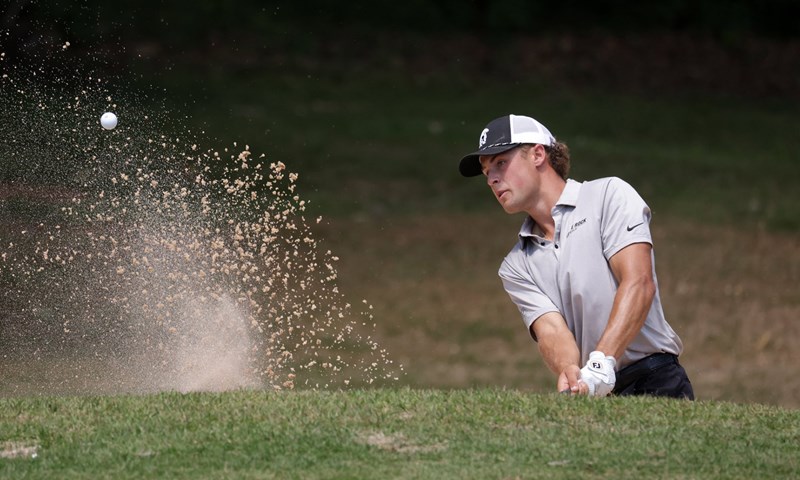
“This morning, with today’s wind direction, the best strategy on the second hole was to hit the driver or to lay up to a certain number. The up-and-down from the bunker today was impossible. You’re better off missing it somewhere else.
“It’s things that usually you try to work out in the practice rounds. But I feel like if you get a text or someone telling you half an hour before you go out to make sure that on the second hole you carry the front bunker, then it’s much more powerful because it’s based on real data and not just gut feeling.”
It is not a stretch to say that Molinari is driving transformation in the elite game. Analytics have long been informing practice sessions and what a player puts in the bag, ranges now littered not only with entourages but gizmos firing out myriad numbers for each dig into the dirt. Yet the real-time strategic guidance Molinari is offering his clientele on the course feels different.
Revolutionary? Perhaps.
“I’m not saying I’m leading a revolution,” the humble Molinari dismisses, “but there’s a few things that I do that I don’t think anyone else does. I don’t want to give away too much, but I would say any time a player comes from another company or they just enquire and see the differences, out of 10 new players, nine of them at least are blown away. ‘I didn’t even think that this was possible.’ That tells me that I’m quite advanced in what I do.”
One could only speculate how Molinari and others may have fared had this information been so readily available in bygone eras. “I would have felt I have a massive advantage for sure, and that’s most of the feedback I get from the players I work with,” he says. “I don’t want to publish it too much or talk about it too much, because I feel like we have a big edge here. I try not to advertise it at all. I never go out to players and talk to them. Most of the time they hear from someone or sometimes they hear a conversation between a player and a caddie on the course and it’s like, ‘How do they know this?’ Eventually they reach out, but I try to keep it very low-key.”
There is a paradox between Molinari maintaining this bespoke service and stemming growth in a burgeoning business. “There’s always a middle ground there,” he says. “I could still grow it a bit and make it a bit bigger, but the thing is I’m still playing. If you have too many players, then it’s difficult to have conversations with them. Sometimes they ask questions and they want to have a quick answer, which I do right now. But obviously if I have 100 players, then it becomes difficult. So either I quit playing or until I stop playing full-time, I think it’s quite tricky to grow it even more.
“But I can see a day where I decide I’ve had enough of playing and then you can expand it a bit more. I would like to play another few years. I don’t think I’ll ever play a senior tour. I’d like to stay at home and grow the stats business. And if they want me involved in the Ryder Cup again, I’ll happily do it.”