
Beuther, H., Kuiper, R. & Tafalla, M. Star formation from low to high mass: a comparative view. Annu. Rev. Astron. Astrophys. 63, 1–44 (2025).
Bonnell, I. A., Vine, S. G. & Bate, M. R. Massive star formation: nurture, not nature. Mon. Not. R. Astron. Soc. 349, 735–741 (2004).
Zhang, Q. et al. Magnetic fields and massive star formation. Astrophys. J. 792, 116 (2014).
Li, H.-B. et al. Self-similar fragmentation regulated by magnetic fields in a region forming massive stars. Nature 520, 518–521 (2015).
Planck Collaboration et al. Planck intermediate results. XXXV. Probing the role of the magnetic field in the formation of structure in molecular clouds. Astron. Astrophys. 586, A138 (2016).
Kauffmann, J., Pillai, T. & Goldsmith, P. F. Low virial parameters in molecular clouds: implications for high-mass star formation and magnetic fields. Astrophys. J. 779, 185 (2013).
Liu, J., Qiu, K. & Zhang, Q. Magnetic Fields in star formation: a complete compilation of all the DCF estimations. Astrophys. J. 925, 30 (2022).
Mouschovias, T. C. Nonhomologous contraction and equilibria of self-gravitating, magnetic interstellar clouds embedded in an intercloud medium: star formation. II. Results. Astrophys. J. 207, 141–158 (1976).
Nakamura, F. & Li, Z.-Y. Magnetically regulated star formation in three dimensions: the case of the Taurus molecular cloud complex. Astrophys. J. 687, 354–375 (2008).
Tassis, K., Dowell, C. D., Hildebrand, R. H., Kirby, L. & Vaillancourt, J. E. Statistical assessment of shapes and magnetic field orientations in molecular clouds through polarization observations. Mon. Not. R. Astron. Soc. 399, 1681–1693 (2009).
Beltrán, M. T. et al. Self-similarity of the magnetic field at different scales: the case of G31.41+0.31. Astron. Astrophys. 686, A281 (2024).
Lebreuilly, U. et al. The Rosetta Stone Project. I. A suite of radiative magnetohydrodynamics simulations of high-mass star-forming clumps. Astron. Astrophys. 701, A217 (2025).
Beuther, H. et al. Gravity and rotation drag the magnetic field in high-mass star formation. Astrophys. J. 904, 168 (2020).
Klos, K. S., Bonnell, I. A. & Smith, R. J. The role of magnetic fields in the formation of high-mass star-forming cores. Mon. Not. R. Astron. Soc. 539, 2307–2322 (2025).
Li, H.-b., Fang, M., Henning, T. & Kainulainen, J. The link between magnetic fields and filamentary clouds: bimodal cloud orientations in the Gould belt. Mon. Not. R. Astron. Soc. 436, 3707–3719 (2013).
Sanhueza, P. et al. Gravity-driven magnetic field at 1000 au scales in high-mass star formation. Astrophys. J. Lett. 915, L10 (2021).
Cortés, P. C. et al. Magnetic Fields in Massive Star-forming Regions (MagMaR). II. Tomography through dust and molecular line polarization in NGC 6334I(N). Astrophys. J. 923, 204 (2021).
Fernández-López, M. et al. Magnetic Fields in Massive Star-forming Regions (MagMaR). I. Linear polarized imaging of the ultracompact H II region G5.89-0.39. Astrophys. J. 913, 29 (2021).
Cortés, P. C. et al. MagMaR III—resisting the pressure, is the magnetic field overwhelmed in NGC6334I? Astrophys. J. 972, 115 (2024).
Saha, P. et al. Magnetic Fields in Massive Star-forming Regions (MagMaR): unveiling an hourglass magnetic field in G333.46–0.16 using ALMA. Astrophys. J. Lett. 972, L6 (2024).
Zapata, L. A. et al. Magnetic Fields in Massive Star-forming Regions (MagMaR). IV. Tracing the magnetic fields in the O-type protostellar system IRAS 16547–4247. Astrophys. J. 974, 257 (2024).
Sanhueza, P. et al. Magnetic Fields in Massive Star-forming Regions (MagMaR). V. The magnetic field at the onset of high-mass star formation. Astrophys. J. 980, 87 (2025).
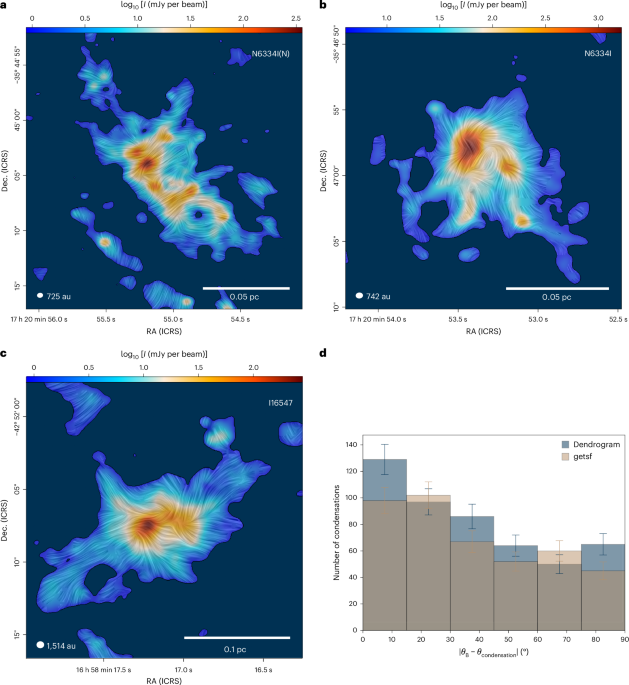
Rosolowsky, E. W., Pineda, J. E., Kauffmann, J. & Goodman, A. A. Structural analysis of molecular clouds: dendrograms. Astrophys. J. 679, 1338–1351 (2008).
Men’shchikov, A. Multiscale, multiwavelength extraction of sources and filaments using separation of the structural components: getsf. Astron. Astrophys. 649, A89 (2021).
Padoan, P. et al. Theoretical models of polarized dust emission from protostellar cores. Astrophys. J. 559, 1005–1018 (2001).
Soler, J. D. et al. The relation between the column density structures and the magnetic field orientation in the Vela C molecular complex. Astron. Astrophys. 603, A64 (2017).
Misugi, Y., Inutsuka, S.-i. & Arzoumanian, D. Evolution of the angular momentum of molecular cloud cores formed from filament fragmentation. Astrophys. J. 943, 76 (2023).
Ishihara, K. et al. Digging into the Interior of Hot Cores with ALMA (DIHCA). IV. Fragmentation in high-mass star-forming clumps. Astrophys. J. 974, 95 (2024).
Motte, F. et al. ALMA-IMF. I. Investigating the origin of stellar masses: Introduction to the large program and first results. Astron. Astrophys. 662, A8 (2022).
Tan, J. C. et al. in Protostars and Planets VI (eds Beuther, H. et al.) 149–172 (Univ. Arizona Press, 2014).
Commerçon, B., Hennebelle, P. & Henning, T. Collapse of massive magnetized dense cores using radiation magnetohydrodynamics: early fragmentation inhibition. Astrophys. J. Lett. 742, L9 (2011).
Palau, A. et al. Does the magnetic field suppress fragmentation in massive dense cores? Astrophys. J. 912, 159 (2021).
Beuther, H. et al. Density distributions, magnetic field structures, and fragmentation in high-mass star formation. Astron. Astrophys. 682, A81 (2024).
Liu, J. et al. Magnetic fields in the early stages of massive star formation as revealed by ALMA. Astrophys. J. 895, 142 (2020).
Liu, J. et al. Multi-scale physical properties of NGC 6334 as revealed by local relative orientations between magnetic fields, density gradients, velocity gradients, and gravity. Astrophys. J. 945, 160 (2023).
Liu, J. et al. Dark dragon breaks magnetic chain: dynamical substructures of IRDC G28.34 form in supported environments. Astrophys. J. 966, 120 (2024).
Zhang, Y., Guo, Z., Wang, H. H. & Li, H. B. Anchoring magnetic fields in turbulent molecular clouds. II. From 0.1 to 0.01 pc. Astrophys. J. 871, 98 (2019).
Allen, A., Li, Z.-Y. & Shu, F. H. Collapse of magnetized singular isothermal toroids. II. Rotation and magnetic braking. Astrophys. J. 599, 363–379 (2003).
Wurster, J. & Li, Z.-Y. The role of magnetic fields in the formation of protostellar discs. Front. Astron. Space Sci. 5, 39 (2018).
Frank, A. et al. in Protostars and Planets VI (eds Beuther, H. et al.) 451–474 (Univ. Arizona Press, 2014).
Ohashi, N., Hayashi, M., Ho, P. T. P. & Momose, M. Interferometric imaging of IRAS 04368+2557 in the L1527 molecular cloud core: a dynamically infalling envelope with rotation. Astrophys. J. 475, 211–223 (1997).
Mininni, C. et al. ALMAGAL. IV. Morphological comparison of molecular and thermal dust emission using the histogram of oriented gradients method. Astron. Astrophys. 699, A34 (2025).
Machida, M. N., Matsumoto, T., Hanawa, T. & Tomisaka, K. Evolution of rotating molecular cloud core with oblique magnetic field. Astrophys. J. 645, 1227–1245 (2006).
Joos, M., Hennebelle, P., Ciardi, A. & Fromang, S. The influence of turbulence during magnetized core collapse and its consequences on low-mass star formation. Astron. Astrophys. 554, A17 (2013).
Lazarian, A. Tracing magnetic fields with aligned grains. J. Quant. Spectrosc. Radiat. Transf. 106, 225–256 (2007).
McMullin, J. P., Waters, B., Schiebel, D., Young, W. & Golap, K. in Astronomical Data Analysis Software and Systems XVI, Vol. 376 (eds Shaw, R. A. et al.) 127–130 (ASP, 2007).
Olguin, F. A. et al. Digging into the Interior of Hot Cores with ALMA (DIHCA). I. Dissecting the high-mass star-forming core G335.579-0.292 MM1. Astrophys. J. 909, 199 (2021).
Vaillancourt, J. E. Placing confidence limits on polarization measurements. Publ. Astron. Soc. Pac. 118, 1340–1343 (2006).
Naghizadeh-Khouei, J. & Clarke, D. On the statistical behaviour of the position angle of linear polarization. Astron. Astrophys. 274, 968 (1993).
Girart, J. M. et al. Resolving the polarized dust emission of the disk around the massive star powering the HH 80-81 radio jet. Astrophys. J. Lett. 856, L27 (2018).
Contreras, Y. et al. Infall signatures in a prestellar core embedded in the high-mass 70 μm dark IRDC G331.372-00.116. Astrophys. J. 861, 14 (2018).
Liu, J. et al. Calibrating the Davis–Chandrasekhar–Fermi method with numerical simulations: uncertainties in estimating the magnetic field strength from statistics of field orientations. Astrophys. J. 919, 79 (2021).
Teyssier, R. Cosmological hydrodynamics with adaptive mesh refinement. A new high resolution code called RAMSES. Astron. Astrophys. 385, 337–364 (2002).
Mouschovias, T. C. & Spitzer, J. L. Note on the collapse of magnetic interstellar clouds. Astrophys. J. 210, 326 (1976).
Hennebelle, P. et al. Collapse, outflows and fragmentation of massive, turbulent and magnetized prestellar barotropic cores. Astron. Astrophys. 528, A72 (2011).
Truelove, J. K. et al. The Jeans condition: a new constraint on spatial resolution in simulations of isothermal self-gravitational hydrodynamics. Astrophys. J. Lett. 489, L179–L183 (1997).
Bleuler, A. & Teyssier, R. Towards a more realistic sink particle algorithm for the RAMSES code. Mon. Not. R. Astron. Soc. 445, 4015–4036 (2014).
Reissl, S., Wolf, S. & Brauer, R. Radiative transfer with POLARIS. I. Analysis of magnetic fields through synthetic dust continuum polarization measurements. Astron. Astrophys. 593, A87 (2016).
Houde, M., Hull, C. L. H., Plambeck, R. L., Vaillancourt, J. E. & Hildebrand, R. H. Dispersion of magnetic fields in molecular clouds. IV. Analysis of interferometry data. Astrophys. J. 820, 38 (2016).
Taniguchi, K. et al. Digging into the Interior of Hot Cores with the ALMA (DIHCA). III. The chemical link between NH2CHO, HNCO, and H2CO. Astrophys. J. 950, 57 (2023).
Schöier, F. L., van der Tak, F. F. S., van Dishoeck, E. F. & Black, J. H. An atomic and molecular database for analysis of submillimetre line observations. Astron. Astrophys. 432, 369–379 (2005).
Goodman, A. A., Benson, P. J., Fuller, G. A. & Myers, P. C. Dense cores in dark clouds. VIII. Velocity gradients. Astrophys. J. 406, 528 (1993).
Liu, J. Data supporting Liu et al. 2026. Zenodo https://doi.org/10.5281/zenodo.19062258 (2026).
Astropy Collaboration et al. Astropy: a community Python package for astronomy. Astron. Astrophys. 558, A33 (2013).
Hunter, J. D. Matplotlib: a 2D graphics environment. Comput. Sci. Eng. 9, 90–95 (2007).