

Seeing politicians running through our streets (or at least photos of them doing so) creates similar unease to bumping into your headmistress at the shops on a Saturday. It’s meeting them out of character, seeing them at their most shockingly human. This week Andy Burnham and Wes Streeting have both been pictured out on the pavements, caught in possession of knees.
Like so many of us in middle age, they appear to be running for general health rather than race medals. I’ve been using running to enhance my mental and physical wellbeing for decades so I thought I would share my tips on how I optimise my weekly time outdoors to stay well and in shape for as long as possible.
I’ve never battled for the leadership of a major political party but I’m guessing it’s fairly stressful and leaves you with no free time and a lot of late-night pizza. Unlike team sports or resistance training, running is the ultimate convenience exercise. It’s ideal for busy people with no time to arrange a football team or take themselves to a room full of heavy objects. Running promotes better mental health, stronger bones, a more robust heart and lungs, burns calories and the venue is on the other side of your front door. But that doesn’t mean you can just go for a plod around the park three times a week and expect to get in really good shape. Here are my strategies for making efforts that really count.
Getting started
If you’re not a runner, or haven’t run for many years, starting is notoriously hard. You fear injuries, weather and just looking embarrassingly inept and slow. The way around all this is through a mixture of jogging and walking. Set yourself a time goal and alternate walking with little bouts of faster movement. The jogging periods will naturally become more extended with each outing, until you find you’re actually going out for a run. Try to suspend any feelings of self-consciousness. However, if you need to find a secluded spot this is legitimate. I have spoken to running coaches whose clients insisted on training after dark.
Resist the temptation to hit the road and power through a 5k without any build-up — that’s a recipe for injury. If you want to improve without pulls and strains, slow, incremental progress is vital. The only goal to set and stick to is the time spent moving — try not to stop until your time is up. Just leaving the house will create the habit you need. Battle any self-judgment and celebrate the fact that you did what you planned to do.
How to save your knees
This is the perfect time to think about your form. Running suffers from being something we’ve all done at some point so, unlike tennis or weight lifting, we can do it without guidance. However, I was influenced by a running coach who explained that hitting the ground on your heel with a straight leg — the way most of us run — will sooner or later damage your joints. By distributing the impact across your entire foot, you are able to run for longer without knee issues. I try to hit each stride with as much of my foot on the floor as possible.
Also, I try not to look at my feet while I’m moving, I keep my head up and gaze into the distance. This helps to keep an upright posture and avoid hunching forwards. It feels weird at first, as though you are rather pleased with yourself, but soon becomes automatic. If in doubt, film your form on your phone to check whether you are still heel-striking.
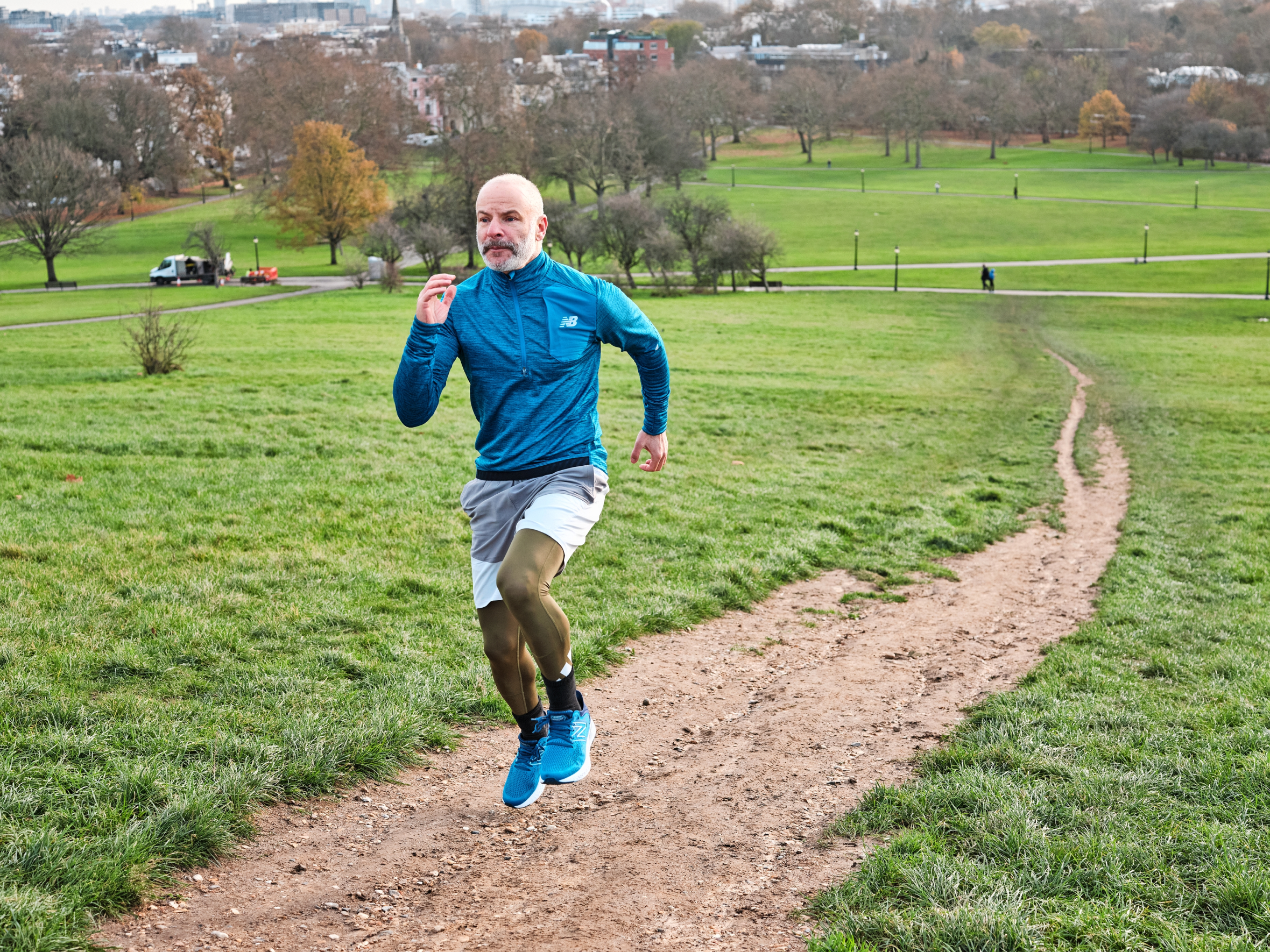 Phil Hiltonmichael leckie for the Times
To make progress, vary speed and distance
Once you can run continuously, you can explore various lengths and levels of effort. For competing runners there are many formats — the Runner’s World site, for example, lists eight types of run with varying distance and intensity that will help you to get faster. I’ve settled on three different runs across my week, which are detailed below. At 62 I want to clear my head, keep my body slim and mobile, and maintain the kind of heart and lungs that will see me through infections and illness. These three runs are the building blocks of my fitness week. I continue with them when I’m abroad, and so far, they have served me well both mentally and physically. Each serves a different purpose and each feels completely distinct as an experience.
Go for a weekly long and steady jog
The keystone of my running programme is a long, slowish cruise. I usually take an hour for this one once a week, and I find somewhere attractive and leafy and choose appropriate rhythmic but easy-going music. This is my Zone Two. The zones are a measure of effort and they run from one to five. I’m aiming to have my heart working at about 65 per cent of my maximum and keep it there, holding steady throughout. If this sounds a little technical, then use the same guide I do and run at a pace where you could hold a simple conversation, but not perform entire chapters of Little Dorrit.
The magic of Zone Two is that it increases your mitochondria — the number and the size. These are the powerhouses of your muscles and hugely beneficial to your athletic capability and overall health. The job is to stay in the zone where you are able to flush the lactate from your muscles — lactate is the substance produced through physical effort. At a tougher pace, lactate builds up, creates discomfort and eventually stops you going any faster. But you don’t really need to worry about any of this biology, just set the headphones to easy EDM (I suggest Floating Points) and let your thoughts wander.
Use interval training for cardiovascular fitness
My second run of the week is interval-based. This is the running equivalent of a bouncy cardio class at the gym. The goal is to increase my VO₂ Max — the maximum amount of oxygen my body can use for movement. It’s a great predictor of longevity, and it can’t be built overnight — so it’s a true test of the way my heart, lungs and muscles work together. My score was 48.3 two years ago, which is up near the top for my age bracket. I’m not boasting, just sharing proof that this works (also boasting).
The best way to do this is the Norwegian 4×4 protocol: four minutes at about 85-90 per cent effort and three minutes of steady walking as a rest period, repeated four times. This is tough — going hard for four minutes is not without pain but I like sensing that I’m making progress.
I found it really useful to understand what four minutes feels like so that I could find a pace that I could sustain. It takes a little practice. Don’t attempt this without a warm-up and psych yourself up for it. This is not for beginners and I always ensure decent rest days to recover from this one. The best tip is to find a good spot, it turns out there aren’t that many places where you can run fast for four minutes. This suits the parts of the park with an uninterrupted path, or a long, straight country lane. It took me a while to settle into a location without too many twists and turns, pushchairs and bicycles. I use a pacey music track as a timer. Outkast’s Hey Ya is three minutes and 55 seconds and bounces along at a decent pace. Full disclosure: I always run intervals, but I’m not always up to the full Norwegian torture. I sometimes allow longer rests or shorter bursts of work but the overall principle is the same.
If you’re serious you need to do hill sprints regularly
Finally, and easily my favourite: hill sprints. This is therapy after a day at the desk, a long car journey or hearing the news… it’s a liberating scream into a pillow. I find an extremely steep hill and after a decent 10-minute warm up, I perform a 15-20 second all-out, arms pumping, knees-high sprint, then I rest for long enough to go again. I usually do three or four. These promote strength in my lower body and explosive power. They encourage fast-twitch muscles — the hardest to retain as you age. These are the muscles that allow you to adjust and cope if you trip and fall.
The hill serves to protect you from injury — there is less impact on the slope because it rises to meet your stride and acts as a break on your speed. For these, I plug the Ramones into my headphones and aim for total commitment and focus. Hill sprints can change my mood, wake me up, give me a burst of can-do optimism. At the top of every hill there is a view, I try not to double over but stay upright, manage my breathing and look out at the skyline. I challenge anyone not to emerge from a few of these feeling they can do anything.
I have flat feet and short legs, whoever made me did not have running in mind. However, it’s such a beautiful, easy way to calm the mind and transform the body that I intend to keep at it for as long as possible. There are days when the first three minutes of a run feel like self-imposed hell, but when I’m done, the world feels brighter, my mood is lifted and I’m ready for anything. The legs remain short, however.
What to eat to fuel your run
All your food is, in reality, your workout fuel. I emphasise vegetables and protein in each meal with carbohydrates taking up less room on the plate. There is nothing you can eat prior to exercise that will have a transformative effect. In the final hour I never eat anything at all, I do not want my body wrestling with a protein bar as I’m trying to run. If I was a competing ultra-athlete then I’d have to be looking at specially designed space-age fuel but for most of us eating well throughout the week is all the sports nutrition we need. Drinking enough liquid is vital and, I find, surprisingly hard. The key is availability — a water bottle within arm’s reach seems to increase my intake by about 50 per cent.