
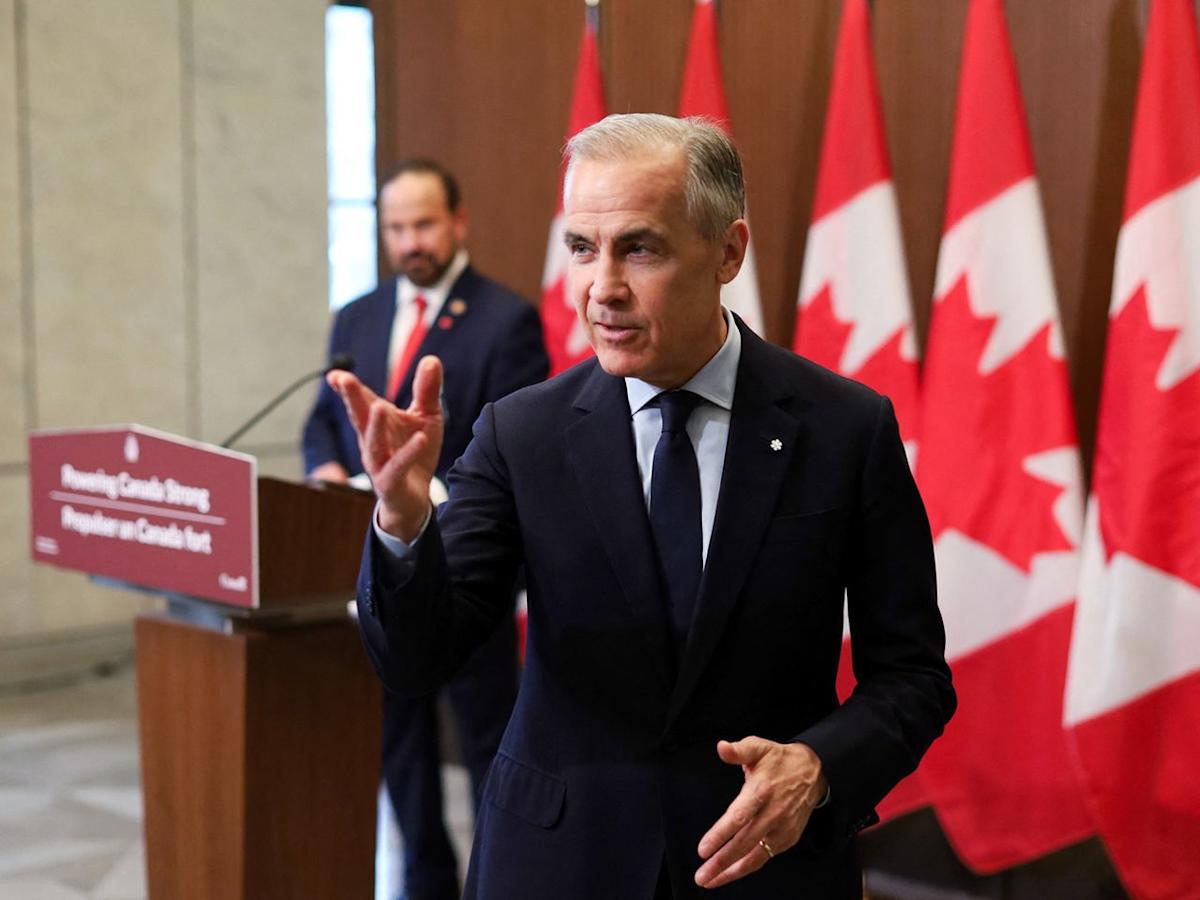
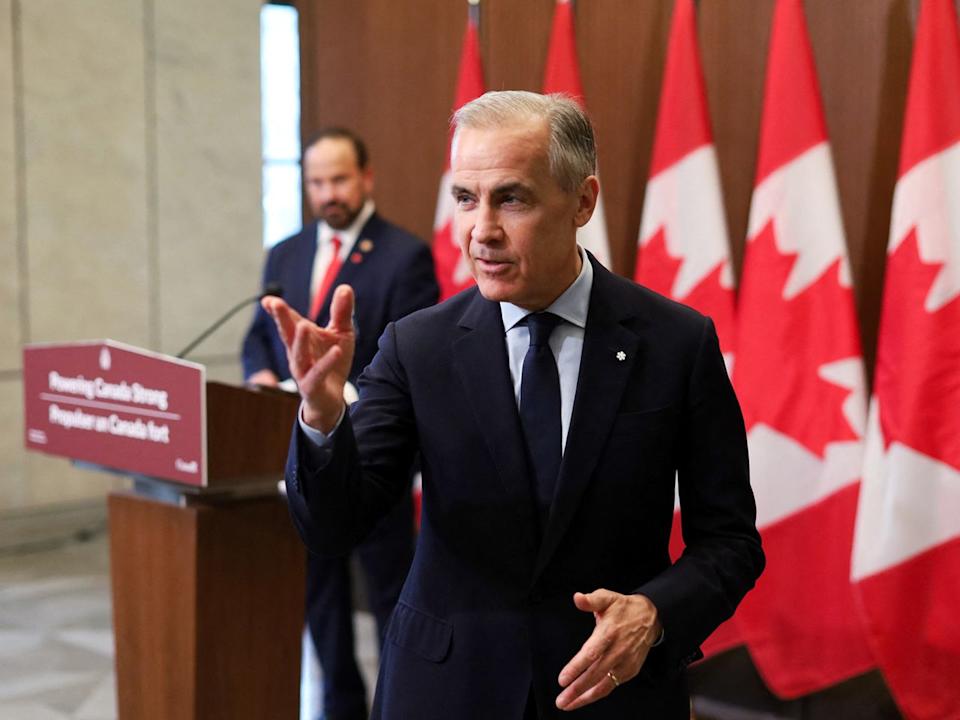
 Canadian Prime Minister Mark Carney departs after speaking during a news conference on Parliament Hill in Ottawa, Canada, on May 14, 2026. (Credit: Dave Chan/AFP via Getty Images)
One of the peculiar aspects of Prime Minister Mark Carney’s Build Canada Strong pipeline from Alberta through British Columbia to Asia is the list of Make Canada Weaker conditions that must be met before the project is approved.
That’s not quite the message Carney delivered Wednesday during his promotional visit to British Columbia. Speaking to the Greater Vancouver Board of Trade, Carney filled the air with his now too-familiar flourishes of clichéd optimism, promising more resilience, more prosperity, more independence, global energy leadership, net-zero carbon emissions, the doubling of non-U.S. exports, Indigenous ownership benefits, relentless focus on affordability, and big gains for provinces.
It was all great optimistic stuff, but only if the audience ignored the actual policies behind all the wondrous economic benefits that Carney said would be delivered by his master plan for Canada’s future as a global energy superpower.
The main reason for the prime minister’s visit to Vancouver, the Canada Strong project under discussion, was the oil pipeline to the B.C. coast. While nominally approved by Carney and Alberta Premier Danielle Smith in an updated Memorandum of Understanding (MOU) signed last week, the pipeline comes with major high-cost conditions that will do nothing to make Canada stronger while adding financial burdens that will undermine the project — and the economy.
The two major economic risks are the industrial carbon price and the proposed mandate that carbon emissions from oil in the pipeline be buried underground to save the global environment and help Canada achieve net-zero carbon emissions. There are other conditions that have yet to be specified. On Wednesday, Carney included commitments to allocate oil pipeline benefits such as “co-ownership” to Indigenous communities and to allow B.C. to “share” in the pipeline’s development.
But carbon capture and carbon pricing are the two main artificial costs that will burden the pipeline and the Canadian economy.
Carbon capture: It takes a lot of imagination to get behind the concept of Carbon Capture Utilization and Storage (CCUS), and a lot of money. A 2024 series of reports from McMillan LLP laid out the foundational problems lurking within the idea that carbon can be grabbed and stored, perhaps underground, to prevent it from hitting the atmosphere.
Among the issues: How to capture it and when, how to transport it, economic uncertainty, and the risk of making Canada’s fossil fuel production uneconomic. Above all, the McMillan report titled Making Dollars and Sense of Carbon Markets concluded that CCUS makes no sense without massive amounts of government backing: “CCUS, as it stands, is not a revenue-generating stream for the industry yet.” Nor are the plans “economically viable,” which means they require “enormous upfront capital outlays in the billions of dollars.” Projects also require billions in tax credits and price guarantees, with the report noting “there are also enormous potential liabilities in the event of failure of a storage facility which have not been adequately addressed and incentive programs have been slow to materialize.”
That was in 2024. This week veteran Alberta energy consultant Yogi Schulz — who last month said the $20-billion CCUS project is in fact “a pathway to an expensive boondoggle” — did not see reason to change his views based on the new MOU.
Industrial carbon pricing: The new MOU between Alberta and Ottawa aims to impose a carbon “price” of $140 per tonne in 2040 to carbon emissions attributable to the pipeline. The strong case against carbon taxes or prices has already been made by many, including on this page, who have deemed it a pseudo-market scam. That no government has ever imposed a significant carbon tax on individual consumers is proof that it has no economic or political support.
Environmental activists such Rick Smith, president of the Canadian Climate Institute, condemned the new Ottawa-Alberta MOU because it fails to reduce carbon emissions sufficiently to meet Canada’s official targets.
Over at the Fraser Institute, analysts Julio Mejia and Elmira Aliakbari took another view in a recent commentary. The MOU will bog Canada’s energy sector down even further into its existing lack of global competitiveness, they said. An earlier Fraser Institute economic study of industrial carbon pricing found that it could reduce Canada’s economic growth rate and weaken the attractiveness of Canada as an energy nation. The lead author of the Fraser paper, Guelph University’s Ross McKitrick, said that while the economic burden of the industrial carbon price helps governments dodge consumer backlash, the impact on jobs, investment and other economic measures will weaken Canada’s economy, not make it strong.
That message was supported last week by oil executive Jon McKenzie, CEO of Cenovus: “We are the only country among the 10 largest producers globally that has a carbon tax. And the carbon tax on our industry is nothing more than a cost. It doesn’t incent us to decarbonize. It is solely a cost of doing business … What we’ve done is that we’ve put a carbon tax on in Canada that is solely borne in Canada and we compete in a global market. So the products that we sell get a global price and we are not able to pass that along to the consumers … So it’s simply a cost of doing business that has to be incorporated into any investment decision … an incredibly complicated policy framework that makes investment in Canada difficult and non-competitive with other countries, like the U.S. and countries in Asia.”
In other words, a weaker Canada.