
UPGRADED ALERT:
The risk inside DR Congo is now considered ‘very high,’ while neighboring countries face a ‘high’ threat as the outbreak continues, the WHO said
Ebola is spreading faster than responders can track it in eastern Congo, where health workers managed to follow up with barely one in five identified contacts in a single day.
Authorities in the Democratic Republic of the Congo (DR Congo) reported 83 confirmed infections, 746 suspected cases and 1,603 identified contacts as of Thursday, but health workers were able to follow up on only 342 contacts that day — about 21 percent of the total under monitoring — data released by the DR Congo Ministry of Public Health on Friday showed.
The figures suggest the response is falling behind the outbreak itself, even as governments and international agencies ramp up emergency measures after the WHO declared the epidemic a public health emergency of international concern on Sunday last week.
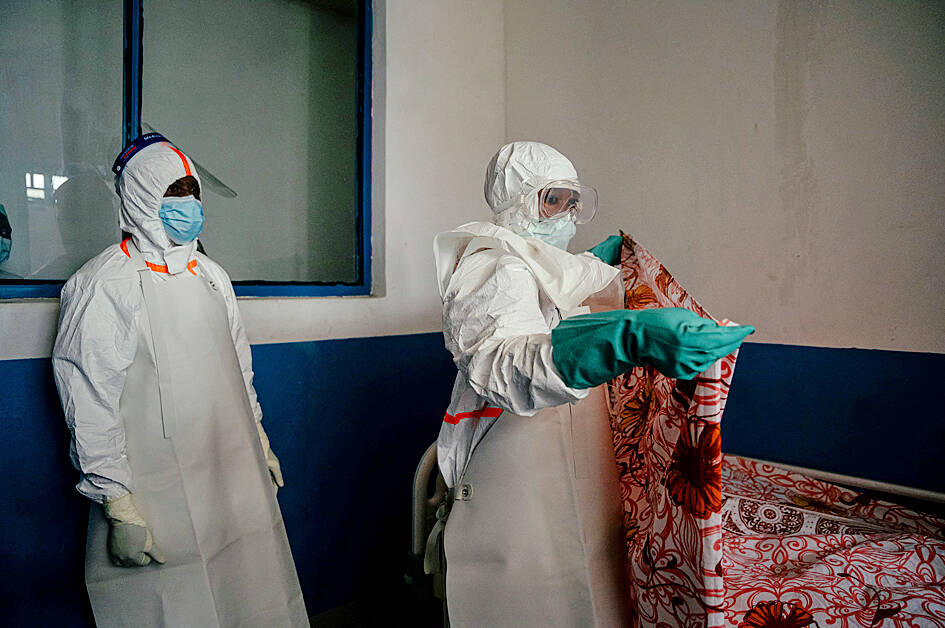
Photo: AFP
The outbreak has now spread across three provinces including South Kivu, where officials confirmed a case near Bukavu, a major city near the border with Rwanda. Two cases were confirmed earlier this week in Uganda, while health officials warn that insecurity, population movements and distrust of authorities are complicating efforts to trace infections and isolate cases.
Tensions are already surfacing around containment measures. Relatives of a man who died at Rwampara Hospital near Ituri Province’s Bunia clashed with health workers after authorities refused to release the body for burial because of infection risks, local media reported.
Ebola treatment tents run by the aid group Alima were set on fire during the unrest, and six patients fled the facility, including three confirmed Ebola cases, according to reports from the area.
The outbreak is caused by the rare Bundibugyo strain of Ebola, for which there is no approved vaccines or antibody treatments. The virus appears to have circulated undetected for months in Ituri Province before authorities recognized what they were dealing with.
Health officials are trying to track thousands of people who might have been exposed as infections spread through remote mining areas and urban centers including Bunia and Goma, cities with populations approaching 700,000 and 860,000 respectively.
More than 12 tonnes of emergency supplies — including protective equipment, treatment kits and materials for safe burials — have already been airlifted into Bunia, the WHO said on Friday.
Nyankunde, home to a major referral hospital serving about 200,000 people, has also emerged as a growing cluster with 11 confirmed cases and 340 contacts under follow-up, the ministry said.
The WHO warned that weak surveillance and laboratory capacity are hampering the response, adding that that the GeneXpert diagnostic platform widely used during previous Ebola outbreaks cannot detect the Bundibugyo strain.
Countries should rapidly expand laboratory testing, contact tracing and community outreach while negotiating “security corridors” to allow responders to safely reach affected communities, the WHO said.
The Congolese government reported a positivity rate of almost 46 percent, suggesting many infections might still be going undetected.
The risk inside Congo is now considered “very high,” while neighboring countries face a “high” regional threat, the WHO said.
The risk to the general public in the EU remains “very low,” although the bloc has begun coordinating laboratory preparedness and traveler guidance through its Health Security Committee, European health authorities said.
The US has taken a more restrictive approach, such as temporarily barring some green card holders who recently visited affected areas from re-entering the country.