
There is a Posy Simmonds cartoon called The National Character: A Love of Poetry. I think of it every time I reach the brow of a hill on a walk. In each scene of the strip, a new party of ramblers comes across some daffodils. “Oh look!” says the first: “a host of golden daffodils!” “I wandered lonely as a cloud…” says the next. “How’s it go? Something something crowd of daffodils.” And the next. “Look! A host of golden…” And the next. “Help me, Jessica… how does it go? I wandered something as a cloud… something over hill…”
It’s a brilliantly observed tease on the way we Brits feel about our landscape. We may fold and unfold our Ordnance Survey maps on the way, but vales and hills and lakes and trees are so much more than geography.
You would have to climb a very remote mountain to find a corner of the British landscape that has not been memorialised in art or poetry. Every weekend walk calls up fragments of half-forgotten verse. Over hill, over dale, thorough brush, thorough briar… The sedge has withered from the lake… In England’s green and pleasant land.
Each of us will have our index. Driving down the M4 to visit my brother and sister-in-law there is a moment when Windsor Castle appears above the motorway. I always think first of Paul Sandby’s Windsor watercolours and then of John Piper’s glowering turrets and George VI’s famous remark: “You seem to have very bad luck with your weather, Mr Piper.”
On a family holiday to Romney Marsh last year we were caught out by the one rotten week in a cloudless summer. We took our buckets and spades to Dymchurch, where the wind whipped the sand in columns across the beach.
I consoled myself, while attempting to shelter two children under one Barbour, with the thought that this was indeed the harsh and battering Dymchurch Paul Nash had captured in his lithographs. I cannot encounter a chalk figure, whether it’s the Long Man of Wilmington or the White Horse at Uffington, without seeing it side by side in my mind’s eye with an Eric Ravilious watercolour.
It is a well-established phenomenon. Even the greats felt it. Painting in Suffolk, John Constable remarked: “I fancy I see Gainsborough in every hedge and hollow tree.”
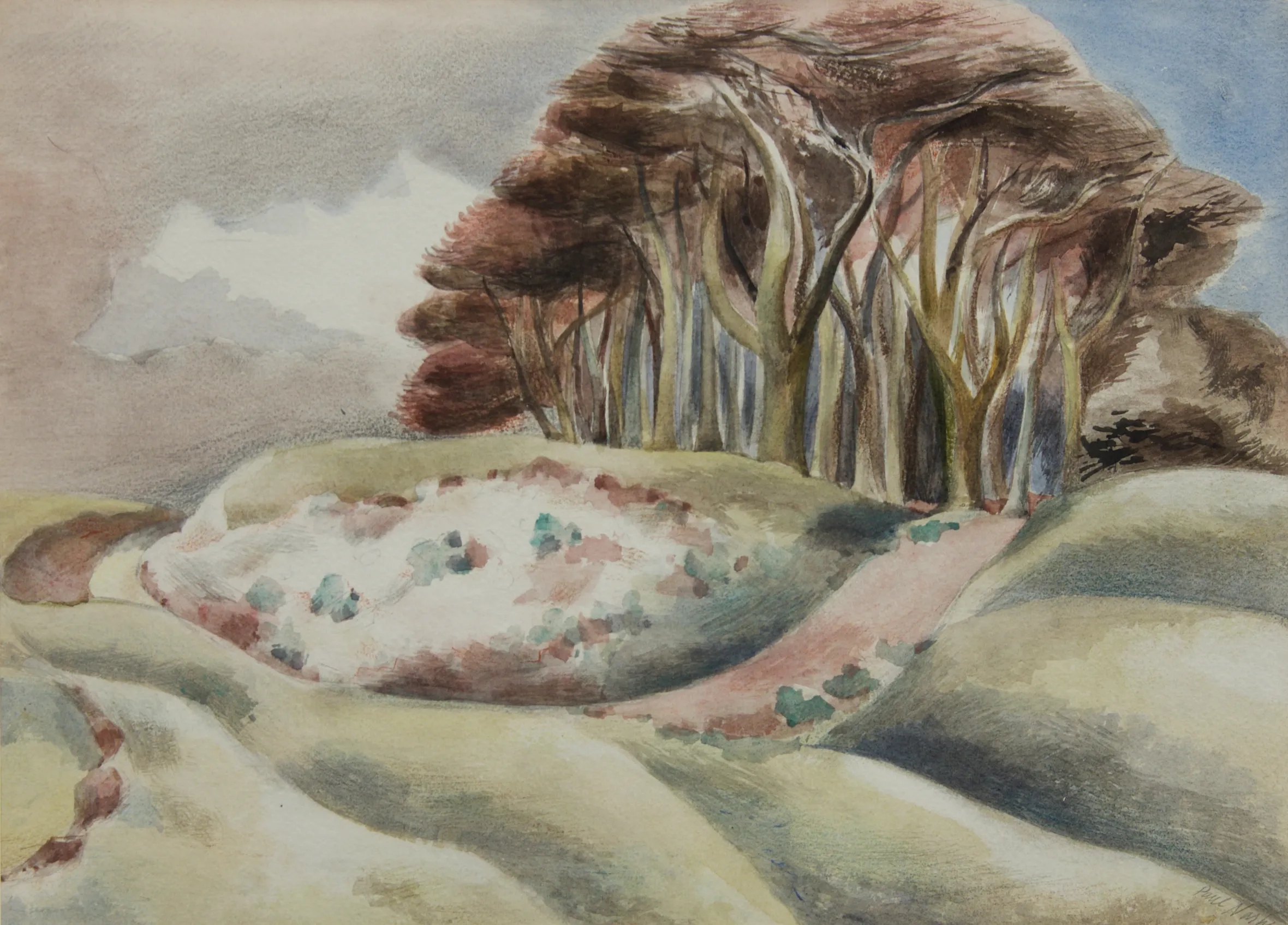 Wittenham by Paul Nash, 1935
“A sense of place” is the guiding force of Pallant House’s summer exhibition, curated by the gallery’s director, Simon Martin, which opens in Chichester on May 30. If you are taking the train, don’t read a book, don’t scroll on your phone: look out of the window all the way. Gathering together works by more than 60 British artists, the exhibition illuminates the emotional, psychological and cultural responses connected to particular spots.
It begins in the 18th century with the “picturesque” moment popularised by such artists as William Gilpin, who wrote of “that kind of beauty which would look well in a picture”, and the watercolourists Alexander Cozens, his son John Robert Cozens, John Sell Cotman and JMW Turner — heroes of the “Golden Age of English watercolour”.
It was in the 18th century that the idea of genius loci, or the “spirit of the place”, became a principle for architects, garden designers and painters. Alexander Pope would have great fun sending up the designers who “consult” the genius of the place, swear “let Nature never be forgot” then get on with raising whatever buildings, follies, grottoes and statues their clients can afford.
The focus of the exhibition, though, is the 20th century. After the Industrial Revolution there was every reason to expect that landscape painting would become a quaint and acquainted pursuit. The modern world was the metropolis. What place for hay stooks in the age of the machine?
The story told in the exhibition is pleasingly counterintuitive. The British landscape tradition, far from dying back, put forth new shoots. It took on the visual language of modernism while maintaining a deep devotion to the land.
Before the war, Martin explains in the accompanying catologue, machines had been seen as a force for progress by artists such as Wyndham Lewis, Edward Wadsworth and CRW Nevinson. “Vorticism” looked to cubism in Paris and futurism in Italy for a hard-edged, fragmented visual style that rejected the past for a revolutionary manner with, in Lewis’s words, “the rigid reflections of steel”.
Artists who served in the First World War and who saw at first hand the appalling destruction of life and landscape wreaked by mechanised warfare drew away from this imagery of struts and steel. Paul Nash, an official war artist, wrote home to his wife from Ypres in Belgium of the devastation before him.
“It is unspeakable, godless, hopeless. I am no longer an artist interested and curious. I am a messenger who will bring back word from the men who are fighting to those who want the war to go on forever. Feeble, inarticulate, will be my message, but it will have a bitter truth, and may it burn their lousy souls.” Nothing could have been less feeble or inarticulate than paintings such as We Are Making a New World, in which Nash memorialised the scarred and lifeless landscape of the front.
The aftermath of the war brought a new impulse to cherish and record the countryside. Men who had seen fields turned into no man’s lands must have looked on meadows and downland with eyes desperate for the solace of pasture and harvest.
Throughout the 1920s and 1930s, at a time when Paris was becoming ever more avant garde, many British artists turned their gaze instead to the sea and the coast, the downs and the high hills, and towards a new and faintly alarming subject: the suburbs.
The hardy took their watercolours out in all weathers, the more fair-weather sought terraces and rooms with a view. “I always work from the window of a house if it is at all possible,” wrote the poet and watercolourist David Jones. “I can’t paint in the wind. I like the indoors-outdoors, contained but limitless feeling of windows and doors.” Two of his lovely, loose, in-and-out watercolours are included in the show.
Nash, recovering from the horrors of the war, painted at Iver Heath in Buckinghamshire, at Dymchurch and at ancient sites such as Avebury in Wiltshire and the Wittenham Clumps in Oxfordshire, which he described as “a beautiful legendary country haunted by old gods long forgotten”. You need a little notebook in your pocket as you go round this exhibition for jotting down ideas for future day trips.
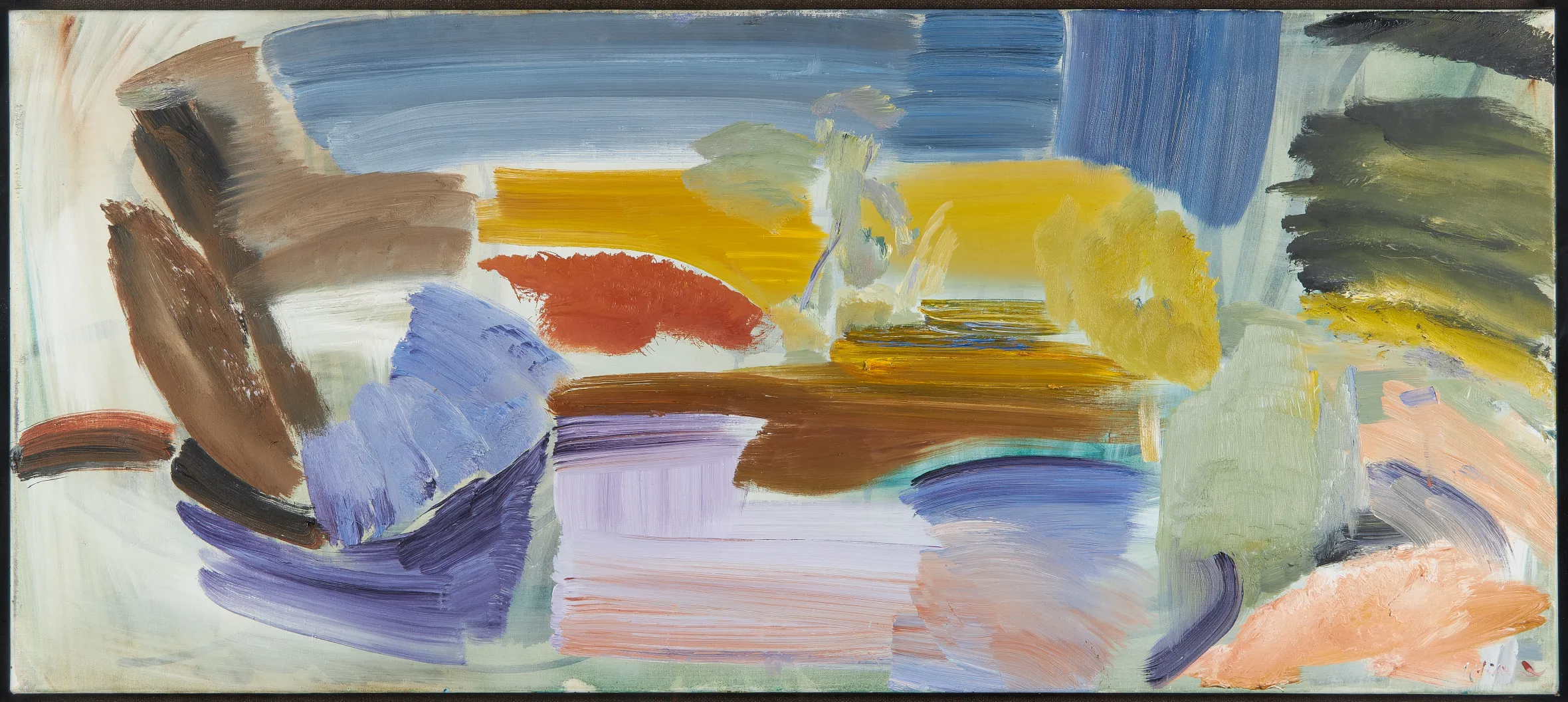 Sussex River, near Midhurst by Ivon Hitchens, 19652026 The Estate of Ivon Hitchens
Edward Bawden designed wallpapers that celebrated the neat patterning of fields (I have a sample of his “Tree and Cow” framed above my desk). Ravilious recorded a new bungalow (a word as worrying as “suburbs”) being built beside a red-brick village school. There was a boom in guides to the countryside and an accompanying run of stylish advertisements for the train lines and petrol companies that would get you there. The campaign “You Can Be Sure of Shell” employed artists including Nash, Graham Sutherland and Vanessa Bell.
Some expressed dismay at the encroachment of new housing developments. The architect Clough Williams-Ellis, known today principally as the creator of the village of Portmeirion (the backdrop to the 1960s TV series The Prisoner), wrote a polemic called England and the Octopus with a cover design showing an octopus wrapping its tentacles around a picture-perfect English village.
Developers were one enemy, the Second World War brought another. The threat of invasion created new anxieties and new urgency. Kenneth Clark set up both the War Artists Advisory Committee to create a visual record of the Second World War and the Recording Britain scheme, which commissioned artists to document the British landscape and its architecture before it was gone altogether. More than 1,500 watercolours and drawings would fill this “pictorial Domesday” sketchbook.
In this gently elegiac show, rapture and sadness go hand in hand. Each painting, etching and watercolour inspires a sense of recovery (do you remember when we walked that path and how the mist came in?) or discovery (show me the way! when can we go?) or loss. Is Nash’s Wittenham still as he painted it or will I find a bungalow where the trees once stood?
British Landscapes: A Sense of Place is at Pallant House, Chichester, May 30-Nov 1, pallant.org.uk