
When you buy through links on our articles, Future and its syndication partners may earn a commission.

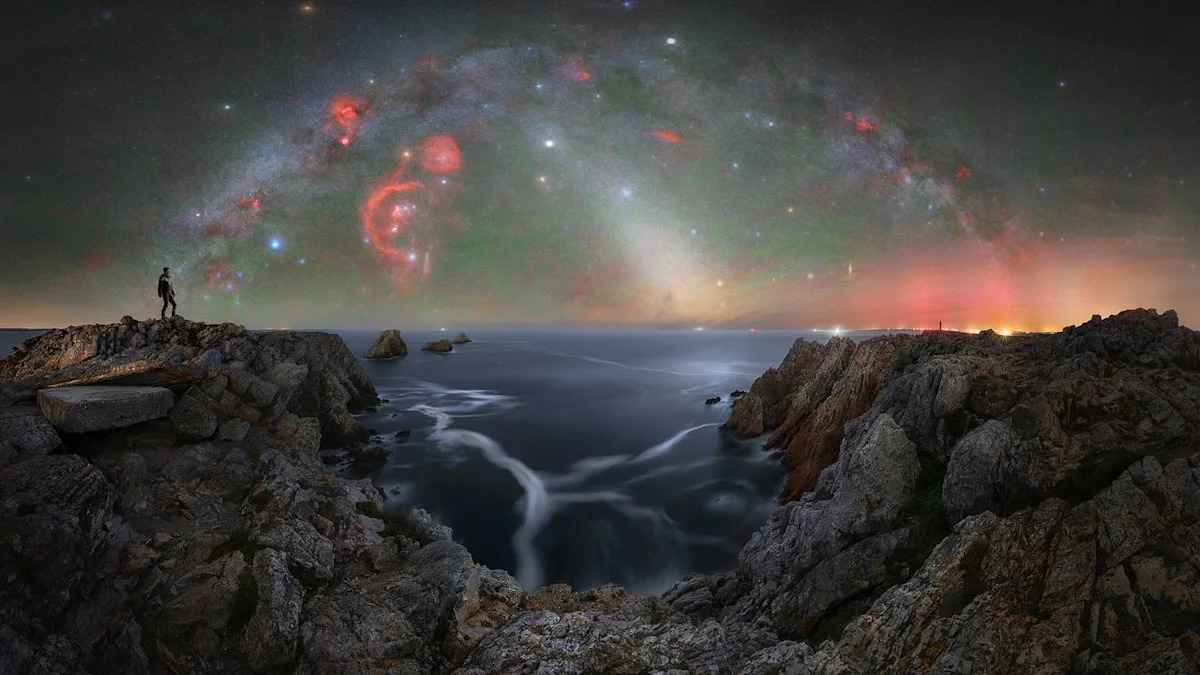
While reviewing the image, a rare combination of night sky phenomena came to light. | Credit: Andrea Curzi
“Sometimes, the most memorable images emerge when conditions seem to fail, only to align in ways you could never have planned,” says photographer Andrea Curzi, reflecting on a stunning 200° panorama night sky image captured during a two-week camper trip along the coasts of Normandy and Brittany in France.
Despite constant battles with wind and cloud cover, one night completely changed Curzi‘s trip. The conditions finally aligned, revealing an unexpected combination of rare night sky phenomena.
Advertisement
Advertisement
Armed with his Canon cameras, Curzi captured an astrophotography image that revealed details he hadn’t anticipated – a hard-to-believe moment unfolding in the sky.
The image Where Earth Meets the Cosmos, has now been selected for Capture the Atlas’ 2026 Milky Way Photographer of the Year collection, which highlights 25 of the world’s most striking astrophotography images.
How ‘Where Earth Meets the Cosmos’ was captured
The Canon EOS R is a full-frame mirrorless camera, boasting crisp 30.3MP imaging | Credit: James Artaius / Digital Camera World
Gear: Canon EOS R (for foreground), Canon EOS 6D astro-modified (for sky), Tamron 17-35mm f/2.8-4
Accessories: Sirui AM324 tripod, Minitrack LX2 star-tracker, Astronomik 12nm Max FR filter
Exposure: Sky: 7 shots at 180sec, f/4, ISO 800, 17mm for RGB + 20 shots at 180sec, f/4, ISO 3200 with H-alpha filter for red nebula, foreground: 12 shots at 180sec, f/4, ISO 800, 17mm with focus stacking
Curzi says, “I was positioned on the Pen Hir peninsula, scouting for a wide panoramic composition of the Milky Way. As darkness fell, I began capturing a 200° panorama using focus stacking.
Advertisement
Advertisement
“While reviewing one of the final frames, I noticed an unexpected red glow in the sky: aurora. At first, it was hard to believe.
“After completing the planned sequence and confirming the phenomenon, I shifted my attention fully to the sky. As the night unfolded, zodiacal light also became visible, adding yet another rare element to the scene.
“Within a single composition, the sky revealed an exceptional combination of phenomena: airglow, the winter arc of the Milky Way, Orion with Barnard’s Loop, the Pleiades, the Rosette and California nebulae, Andromeda, Jupiter, zodiacal light, and aurora borealis.
“This image captures what astrophotography often represents at its core: careful preparation meeting complete unpredictability.
Advertisement
Advertisement
The final result is a blend of 12 focus-stacked exposures for the foreground and seven tracked exposures for the sky, captured using an Omegon Minitrack LX2 star tracker mount, an astro-modified camera, and an H-alpha filter.”
You might like…
Capturing stunning images of the night sky and space starts with having the right gear. Check out our guides to the best cameras for astrophotography and the best lenses for astrophotography.
Looking for competitions to enter? Here are 10 global photo contests now open for entries from May to December.