
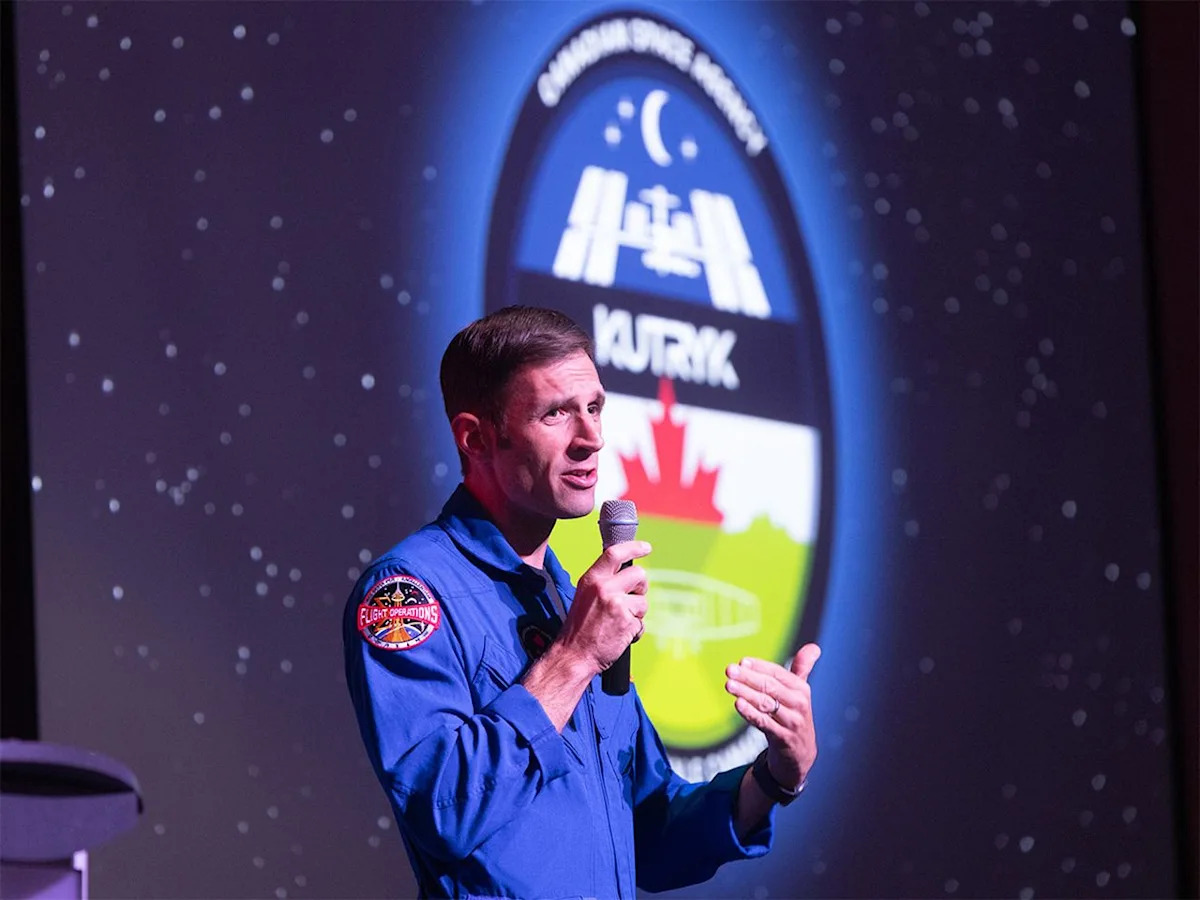
Before he ventures into space, Canadian Space Agency astronaut Joshua Kutryk stopped in Calgary on Sunday to speak about his upcoming involvement in the Crew-13 mission.
Kutryk visited the TELUS Spark Science Centre, where he answered questions from young people about his upcoming mission. On Monday, he will be at the University of Calgary for a lecture and Q&A.
Born in Fort Saskatchewan, Kutryk said he grew up on a cattle farm near Vegreville, which played a role in his love for outer space.
“I think I definitely did spend a lot of time alone at night looking at the night sky, and so that might have had something to do with it,” he said.
In September, NASA’s SpaceX operation will send a crew to the International Space Station via a Falcon 9 rocket inside a Crew Dragon capsule from the Kennedy Space Center in Florida.
Crew-13 refers to the third launch of the commercial crew program to the space station.
Four astronauts will be on board: Kutryk, as well as two from the United States and one from Russia.
Over the following six months, he said their job will be twofold.
“The first is we take responsibility for the space station, operating it, maintaining it, fixing it in all its capacities, and that’s a pretty challenging task,” Kutryk said. “That’s why we’ve been training for so many years to do it, but the second part of the job is the science.”
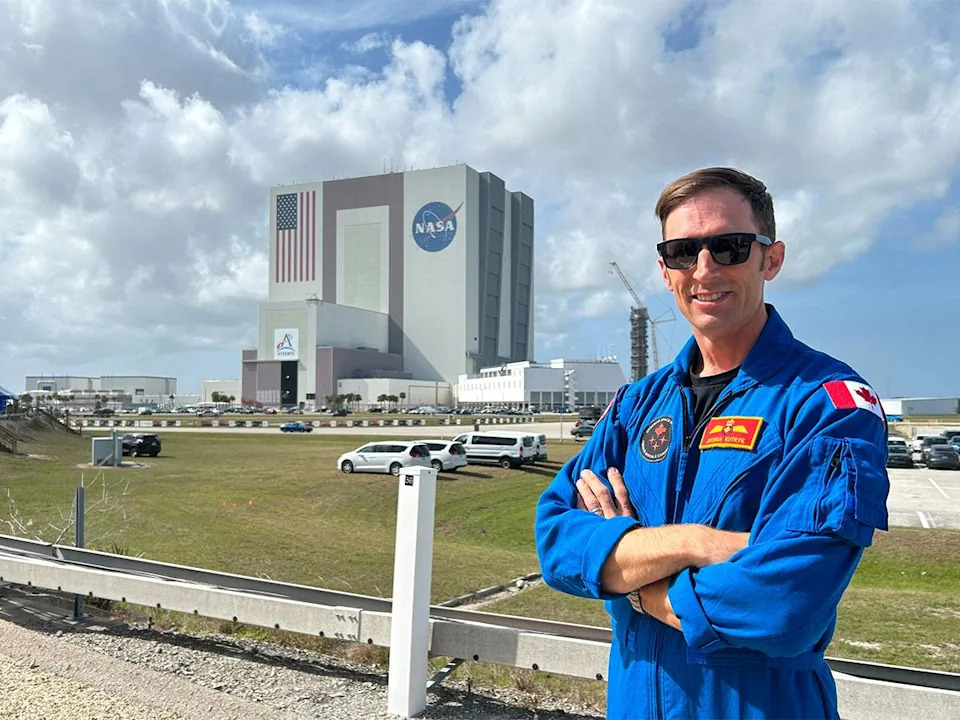
The Vehicle Assembly Building is seen in the distance as Canadian astronaut Joshua Kutryk poses for a portrait at NASA’s Kennedy Space Center in Florida on March 30, 2026.
In the orbiting laboratory, he will conduct a variety of scientific inquiries on behalf of researchers from Canada and around the world.
Those experiments can only be done in space and can be related to a variety of challenges, including medical care, aging and cancer treatment.
Although it’s going to be busy, Kutryk said he is going to try to enjoy every minute, as this has been a lifelong dream of his.
“The thing I’m probably looking forward to the most would be the most simple of them all, and that is just the first look out the window and seeing Earth,” Kutryk said. “Not as the Earth that we all know it, but as just its one, own little thing. A blue ball and hanging in space.”
For his downtime, the only item from Earth he plans to bring on his maiden voyage is a Kindle, as he loves to read.
Kutryk hopes to inspire younger Canadians
Following his outreach trip in Calgary, Kutryk will return to NASA Mission Control in Houston for the final phases of training before going into quarantine in August.
Following his journey, he hopes to share his stories from space.
Between the Artemis II flyby last month and the upcoming mission in September, it’s been a busy year for the agency’s human spaceflight program.
He noted that fellow Canadian astronaut Jeremy Hansen’s participation in the flyby was especially unique, since Canada is now the only other country alongside the United States to send humans farther and faster than anyone has ever gone in history.
It speaks to Canadian leadership on the world stage that helps create opportunities for space exploration through carefully made Canadian policy and sustained investment, he said.
“And it’s a result of what Canadians do in Canada for exploration, (like) things that we make, invent and innovate, and ultimately give to NASA and the world to help with exploration,” he said. “That’s why we’re invited to participate.”
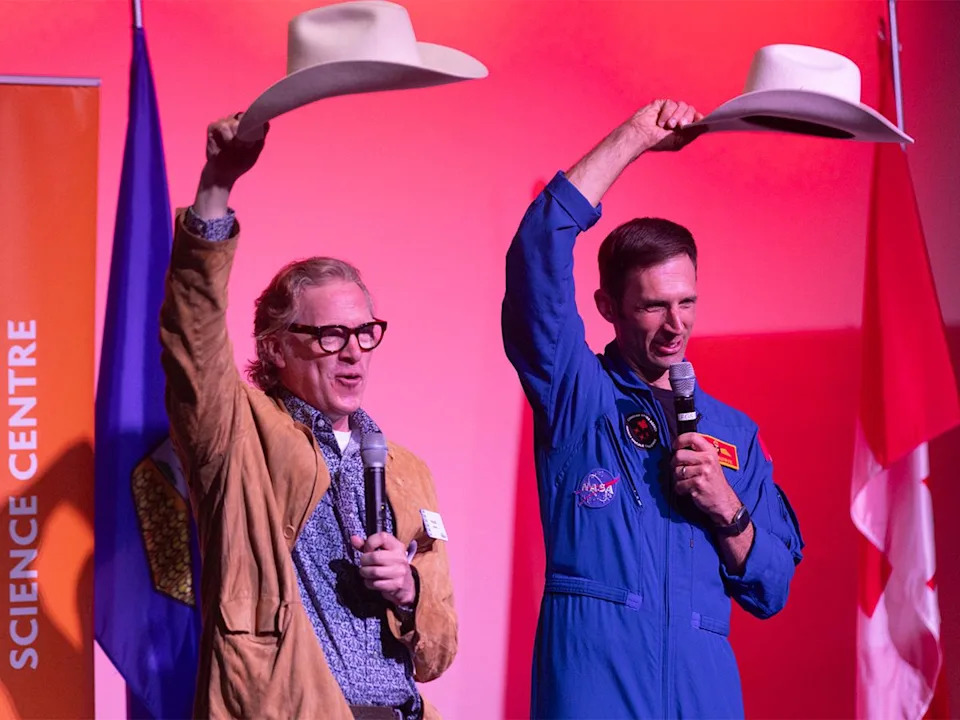
Alberta-born astronaut Col. Joshua Kutryk was presented a white cowboy hat in a ceremony by Tourism Calgary’s Fraser Abbott at Telus Spark in Calgary on Sunday, May 24, 2026.
As the International Space Station program begins to sunset, the next phase of space exploration is going to be focused on a return to the moon.
Advancements in technology allowing humans to survive in space for longer periods of time point towards having a sustained human presence and conducting science experiments on the moon.
Although he is uncertain what it might look like, Kutryk believes Canada is going to have an important role in that future.
“I think, in the next couple of years, we know that the journey from here to there will involve untold scientific discovery and invention,” he said.
He hopes their work inspires and creates interest in space exploration for younger Canadians.
“It’s something that we’ve worked really hard to develop in Canada because of the tangible benefits of inspiring future Canadians to go on and do great, great things for us,” he said. “That’s one of the things that it’s all about. It’s important to Jenni, Jeremy, David, myself and all of us at the CSA to keep doing that.”