
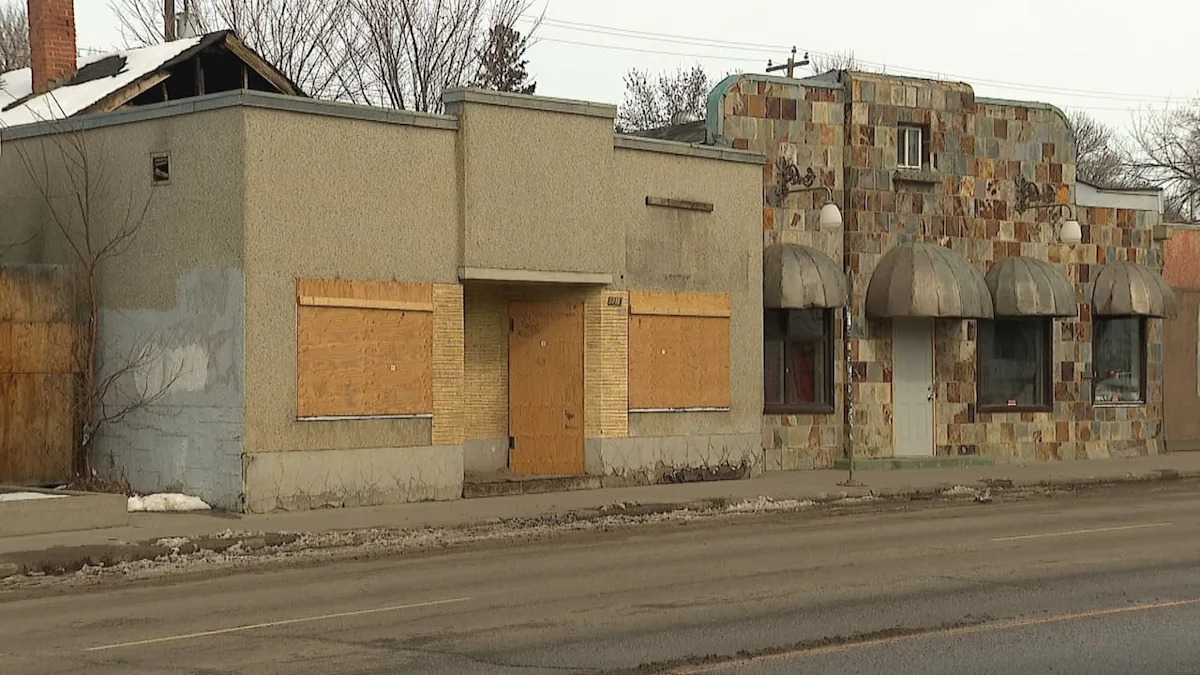
The City of Edmonton is teaming up with the Town of Peace River, in northwestern Alberta, to push for changes to provincial rules around derelict non-residential properties.
The councils have committed to writing a proposal for Alberta Municipalities — an organization that represents the province’s municipalities — to ask the provincial government to amend parts of the Municipal Government Act to let municipal governments create a derelict tax subclass for non-residential properties.
Only some municipalities in Alberta, like Edmonton and Calgary, can establish such a tax subclass under current legislation, according to Coun. Ashley Salvador, who represents Ward Métis, a central Edmonton district.
“Edmonton has been a real leader when it comes to taking stronger action with derelict properties,” Salvador told CBC News Thursday. “We’ve worked to advance a non-residential derelict tax subclass and we’re moving forward on that.
“There are some opportunities for provincial advocacy … to open the door for other municipalities across the province of Alberta.”
Salvador presented a motion during last week’s council meeting, which proposed bringing the issue to Alberta Municipalities. Council unanimously passed the motion.
The councillor hopes expanding subclassing authority to all municipalities, through an amendment to legislation, can provide them with more agency in addressing derelict properties in their jurisdictions, she said.
An amendment for commercial properties, she added, could include an exemption from the five-to-one tax-ratio limit. The limit keeps the maximum tax assessed for those properties under five times the lowest taxation rate.
“We need to have that in order to … incentivize and motivate these property owners to either clean up their property — so that it’s no longer in a derelict state — or sell it to someone to redevelop,” Salvador said.
Salvador also wants to ask the provincial government to scrap its requirement that non-residential buildings must be unoccupied for one year before they can be considered derelict, she said.
Jack Alarie, press secretary for Municipal Affairs Minister Dan Williams, told CBC news in a statement that the tax ratio helps maintain a competitive tax environment. It also supports economic growth, he said, because it encourages investment.
Calgary and Edmonton have more flexibility, but they still have to meet the five-to-one ratio to ensure tax rates stay “reasonably competitive,” Alarie said.
Proposal to be submitted this month
The proposal will be submitted to Alberta Municipalities at the group’s annual convention later this month, and may be used by the group in its advocacy and lobbying efforts.
To get the proposal to the convention, another municipality had to sign on. That’s how the Town of Peace River got involved.
Sherry Shannon, the town’s mayor, hopes including a smaller centre can show how important this issue is.
“Peace River has many of the same issues that Edmonton does with derelict properties,” Shannon told CBC News Friday.
“We need to find common ground. A resolution put forward that is supported by both small and large municipalities has a better chance of being understood, because we all share in those issues.”
Derelict non-residential properties pose safety risks, with the potential to become sites of arson and accidental fires, for example, Salvador said. But they could also cost communities more because of higher demands for bylaw and law enforcement.
Shannon agreed, noting safety is the main reason her community is interested in this initiative.
Right now, the City of Edmonton doesn’t have official data on the number of derelict non-residential properties, because it is working to clearly define what these properties are, said Cate Watt, a taxation assessor for the city, in a statement to CBC News.
But city administration is aware of about 20 properties that could be considered for a non-residential derelict tax subclass, she said.
A March report from the city said a potential definition could include fully or partially constructed non-residential improvements, that shows neglect or that a building is unusable for its intended purposes.
This informal definition, according to the report, would not include properties that are actively undergoing renovation, construction, or demolition.
According to Shannon, representatives at the Alberta Municipalities convention must approve Edmonton and Peace River’s joint proposal before it can be taken to the Alberta government.
Salvador said she’s confident the proposal will pass at the conference later this month. If it is, Shannon said she wants the province to take “a proactive approach,” factoring the needs of municipalities of varying sizes.
The provincial government understands municipalities are looking for ways to address local challenges, and it will always consider proposals as part of future reviews, said Alarie, Williams’ press secretary.
Salvador said other communities, in other parts of Canada, are taking notice.
“They’ve been reaching out to our city staff to see what we’ve done, so that they can apply a similar tax subclass in their own city,” she said.
“[I’m] just really, really excited to see that there is interest from other municipalities.”