
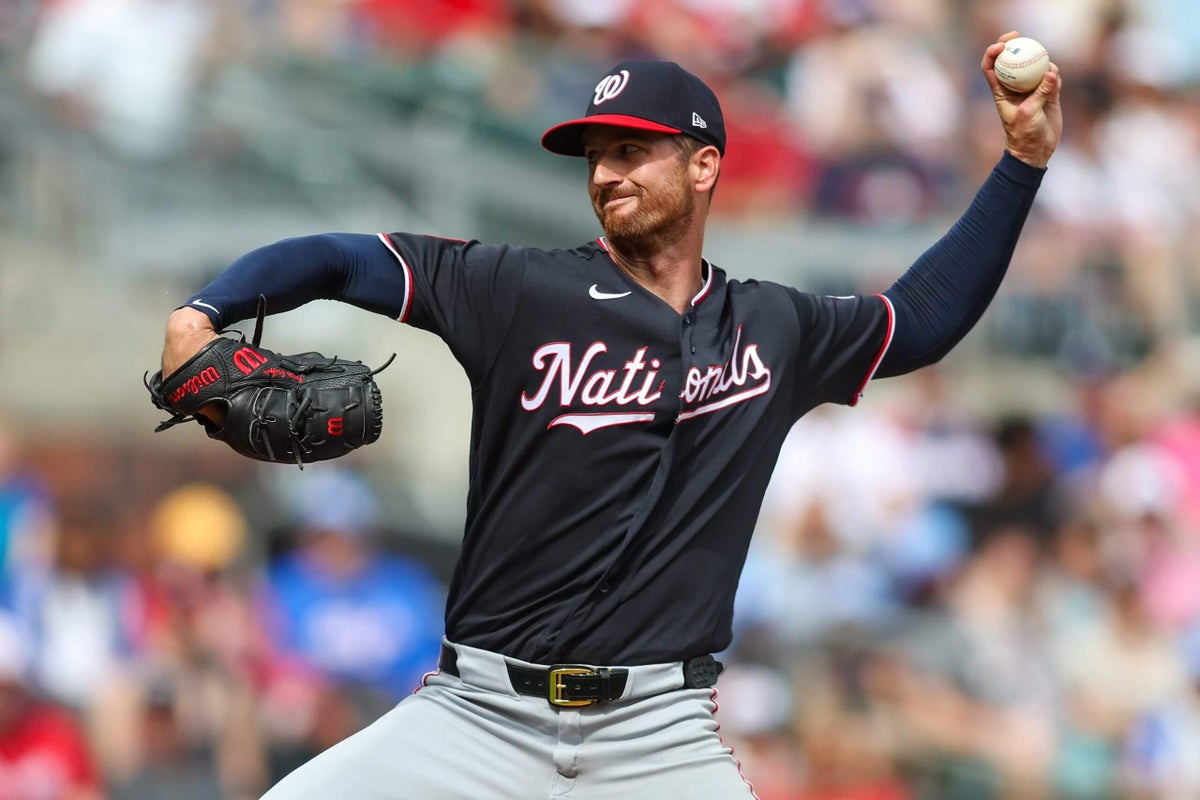
As he will be during the first game each week this season, Nationals beat writer Spencer Nusbaum will watch the game alongside fans starting around first pitch at 6:10 p.m. ET on Monday.
Foster Griffin spent three years overseas trying to learn Japanese and reinvent himself as a starting pitcher in Nippon Professional Baseball. He returned to the United States on a one-year, $5.5 million contract and with voices in his head.
Those details indicated that only one of those ventures was successful.
As he stood in the Washington Nationals’ clubhouse on a recent afternoon, he searched for a way to get his point across. He scanned the place where he once again gets to play cards, talk shop and joke around in English and pointed toward a couple of discussions taking place nearby.
“You know how you can kind of hear those conversations going on over there?” Griffin said. “You block that out for nine months, essentially. And then when you come back, and you’re in the airport … I remember looking at my wife like, ‘I feel like I have all these voices in my head.’”
In Japan, it was as if the entire environment — from the hitters he had to face to the silence he had to embrace — was tailored to challenge him.
Society was quiet and respectful, words Griffin’s Nats teammates now use to describe him. Starters get by with crafty arsenals and thorough planning. Overseas, a pitcher can either use the solitude to solve their problems or succumb to it, crumble and call it a career.
It’s evident which road Foster took.
Perhaps the mild-mannered lefty isn’t on your radar. The modern man throws 100 mph and is a Driveline devotee. Griffin usually tops out around 92 mph and learned how to pitch with a Yomiuri Giants binder that nearly burst at the seams.
Four years ago, he was an up-and-down reliever who was cut by the Kansas City Royals and Toronto Blue Jays.
On Sunday, he was the man who got the Nationals back to .500, bouncing back from a pair of rough outings to toss six scoreless innings in a 2-1 win over the Atlanta Braves. He’s largely been a pacifier for MLB’s worst run prevention unit, posting a 3.63 ERA across a team-high 62 innings.
If Griffin keeps this up, it feels more likely than not the team will flip him for prospects at the deadline. To this point, a contract extension has not been discussed, according to a league source, though there is time for that to change.
Griffin would not be here without Japan, its opportunities and its obstacles. His time overseas altered his prefrontal cortex and his arsenal. Now, they talk about him like he’s an expert. He calls his own pitches, walks teammates through their game plans and thinks through every pitch with respect for what it sets up later in the game.
It’s him and his seven pitches against the world.
“He’s got an arsenal that can answer almost any question,” pitching coach Simon Mathews said.
In Japan, ‘I had a binder like this’
In 2023, Griffin walked off the mound after his overseas debut, conducted an in-stadium interview in front of 35,000 noisy fans and a brass band at the Tokyo Dome and went straight to the binder.
Even after seven scoreless innings, he realized he had a lot of work to do.
When the Nationals’ new executives and coaches came in, they set a series of philosophical goals. One of them was to become the best problem solvers in baseball. They sought out trainers who hadn’t worked professionally and lower-level college coaches who had turned programs around with limited access to data and technology.
They also sought out Griffin.
There’s a reason pitchers often return from Japan with a deeper arsenal and a more nuanced approach. There’s the schedule, where pitchers face the same five teams for most of the season. There are the hitters, who treat strikeouts like failure. And there are the lineups, which typically pattern out with a weaker lower third than MLB lineups, in part, because pitchers hit over there. When they’re on the mound, those pitchers must pay particular attention to where they can and cannot avoid damage in the lineup.
It demands a keen eye.
They have to study tendencies. They have to read swings. They have to game it out, and become the pitcher their old-school family member says is going extinct. And without 95 mph in his back pocket — he had given up on that pursuit after undergoing Tommy John surgery in 2020 — Griffin needed something to solve these contact-oriented lineups.
“Lefties would just stand on top of the plate and take me the other way, and that was starting to get me really angry,” said Griffin, who had pitches that only moved away from those lefties.
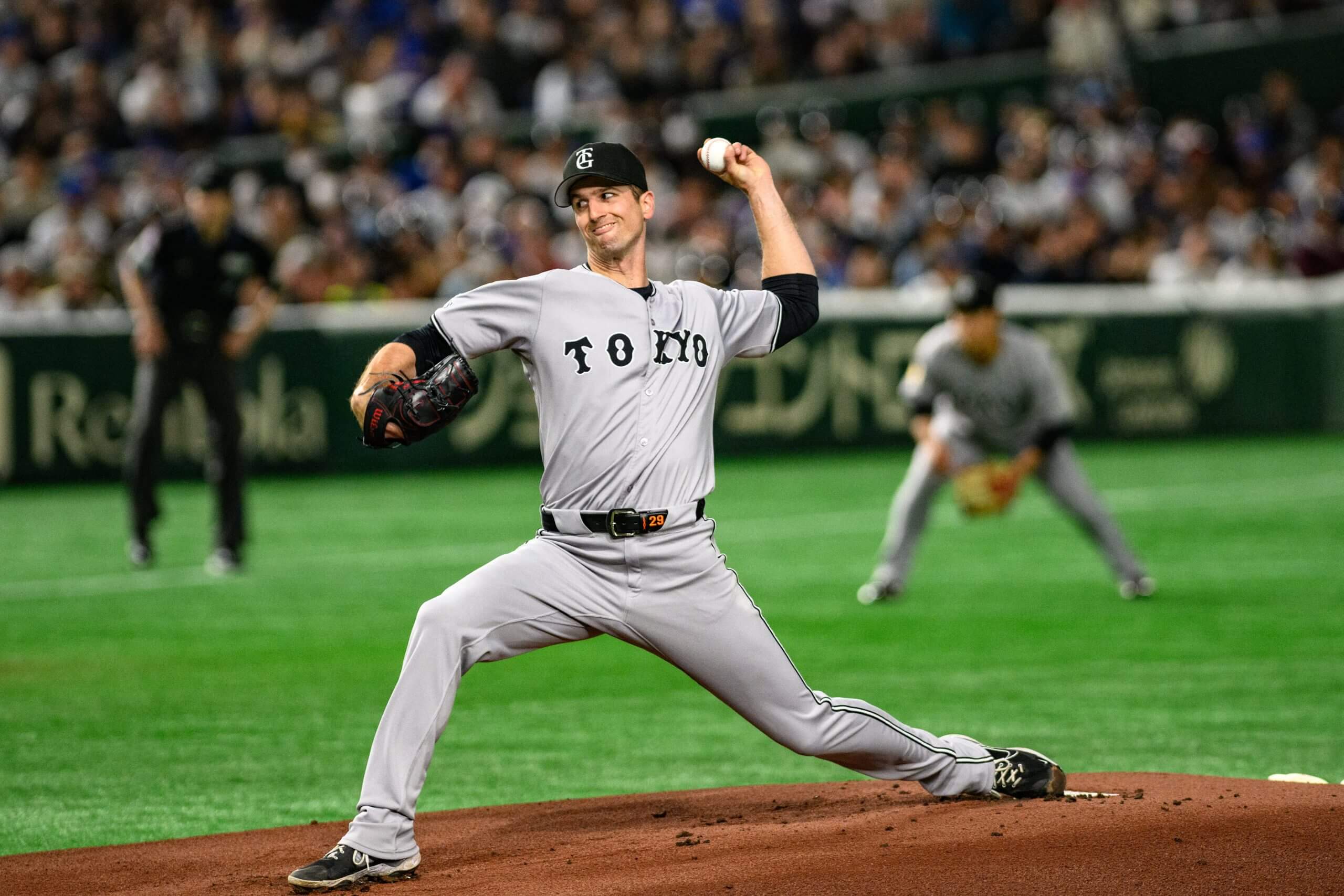
Foster Griffin spent three seasons pitching for the Yomiuri Giants in Japan’s Nippon Professional Baseball. (Philip Fong / AFP via Getty Images)
So he added the sinker.
Then they started spoiling pitches at the top and bottom of the zone.
So he added a sweeper.
Then they tightened up with two strikes.
So he added a splitter.
“I just kept getting frustrated,” Griffin said with a chuckle.
With most of the team’s game-planning information limited to batting averages and swing percentages, he found a source outside the organization who had access to more comprehensive Trackman data. Without any experience speaking Japanese, he learned enough to get around, order food and talk baseball.
Without much to turn to socially — save for two teammates, Yuji Akahoshi and Iori Yamasaki, who studied English closely in school — he became a bit of a recluse. The outside world was reduced to a murmur.
He refused to complain.
When he didn’t pitch, the schedule permitted Griffin to head home to eat dinner with his wife and tuck his kid into bed. In the fourth or fifth inning, he’d put the game on TV and watch with his notepad out. This month, Griffin stood in the Cincinnati Reds’ visiting clubhouse and walked through the process.
“By Year 3,” Griffin began, as he clasped his hands together, then widened them until they were about a foot apart, “I had a binder like this.”
‘It’s like a chess game to him’
It shouldn’t have been so easy to pick apart Jake Irvin’s first bullpen this spring. The team asked Irvin to throw 15 pitches, breaking it down into five three-pitch segments. In each segment, he was asked to get an imaginary batter out. At the end, he heard a voice behind him.
“Oh, so you like to pitch like this,” Griffin asked matter-of-factly, before laying his estimate of Irvin’s entire approach out.
“Yeah, I’m adding a couple things to the arsenal,” Irvin said.
“I love your sequence — try starting the ball here, and then tunnel this other pitch off of it,” Griffin told Irvin.
The explanation went on. Irvin listened, stunned. It was the very first time Griffin had ever seen him throw.
“Obviously, we have (pitching coaches Simon Mathews, Sean Doolittle and Dustin Glant) and (catching coach Bobby Wilson) are already working on that stuff with us,” Irvin said. “But to have another pitcher in your ear being like, ‘Yeah, I’ve gotten these results in game. It will be effective.’ That stuff really helps with confidence.”
This is where Griffin fits in culturally.
When Nationals president of baseball operations Paul Toboni went on a hiring spree this winter, he looked for coaches who did not have an ego. Good ideas, he reasoned, could come from anywhere. It’s partially why he hired Mathews and brought back assistant pitching coach Sean Doolittle — two coaches who are more than happy to cede the floor to Griffin, if he has advice for someone else’s arsenal.
In Japan, lineups are often constructed such that pitchers often have to think about what comes next — either a weak pocket at the bottom of a lineup, or a hitter whose swing in one at-bat hinted at what he was targeting in the next at-bat.
Irvin is far from the last to offer kudos to Griffin.
Last month in New York, Cade Cavalli flipped through a binder before his start. Griffin walked over, peered over his shoulder and started pointing to the tendencies of each hitter in the Mets’ lineup. That night Cavalli struck out 10.
“It’s like a chess game to him,” Cavalli said. “He’s always thinking ahead.”
Nationals center fielder Jacob Young plays with a PitchCom in his ear, which allows him to hear what Griffin is thinking on the mound as he pitches. He said he’s even learned about pitching when Griffin is on the mound; how he messes with hitters’ timing with leg kicks and sequences.
Griffin spends his games atop the dugout rail, watching posture and reading hitters’ eyesights. He maps the game out, as if he were out there, too. He thinks about each pitch in terms of how it might set up the next pitch, if not the next 30 pitches.
At times, he can almost think himself into a pretzel.
In Miami, Mathews had to come out for a mound visit after Griffin allowed the first three batters to reach base. He had to remind Griffin it was OK to simplify things, to throw a cutter, his most-used pitch.
“Hey, buddy,” Mathews said. “Remember what that best pitch of yours is.”
There’s the final key to this start. Look only at the radar gun, Mathews said, and you’ll miss what makes Griffin’s pitch mix special. The cutter is dynamite. The fastballs profile well off of each other. The off-speed pitches have real juice. His command is exceptional.
Perhaps that’s why there is a relentless optimism to the Nationals’ lefty. He did not grow up as a particularly curious child, or so he says. He did not tinker much until Tommy John surgery, and really didn’t lean into it until he got to Japan. But once he started, it always seemed to work.
Now he can’t stop.
“I’m at the point in my career where I’m done trying to chase velocity,” Griffin said. “We’re at the point now where it’s just kind of fun to find out what you’ve got, then go out and compete.”