
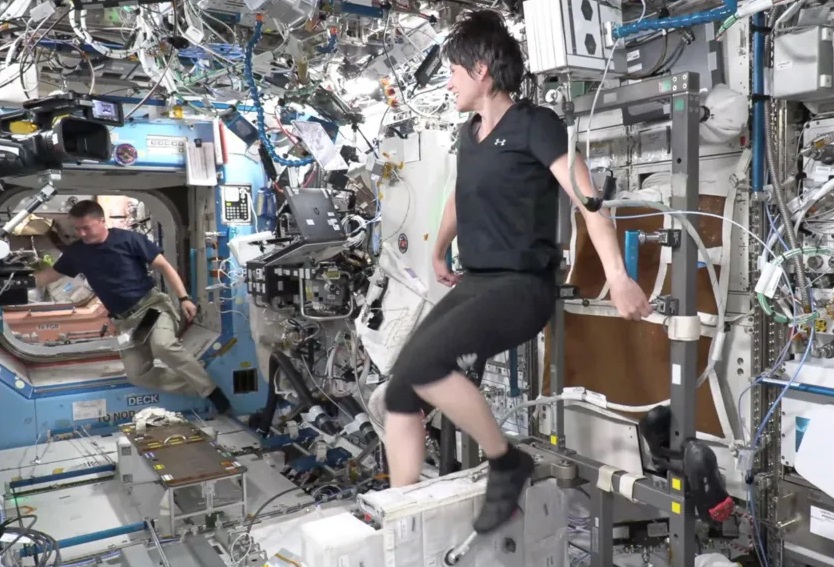
A British-designed exercise device that could transform astronaut fitness routines has completed testing in space-like conditions.
Revolutionary Fitness Technology Takes Flight
According to a BBC report, Olympic bronze medalist Matthew Wells participated in parabolic flight tests conducted 8,500 meters above the ground. During the tests, researchers evaluated the equipment in 22-second bursts of weightlessness created by a specially manoeuvring aircraft.
The device is called HIFIm (High-Frequency Impulse for Microgravity). It is among several projects worldwide competing for placement on upcoming moon bases and space stations. The invention aims to drastically reduce the time astronauts spend maintaining fitness. It could cut daily exercise requirements from approximately two hours on the ISS to just 30 minutes.
Why Astronaut Fitness Matters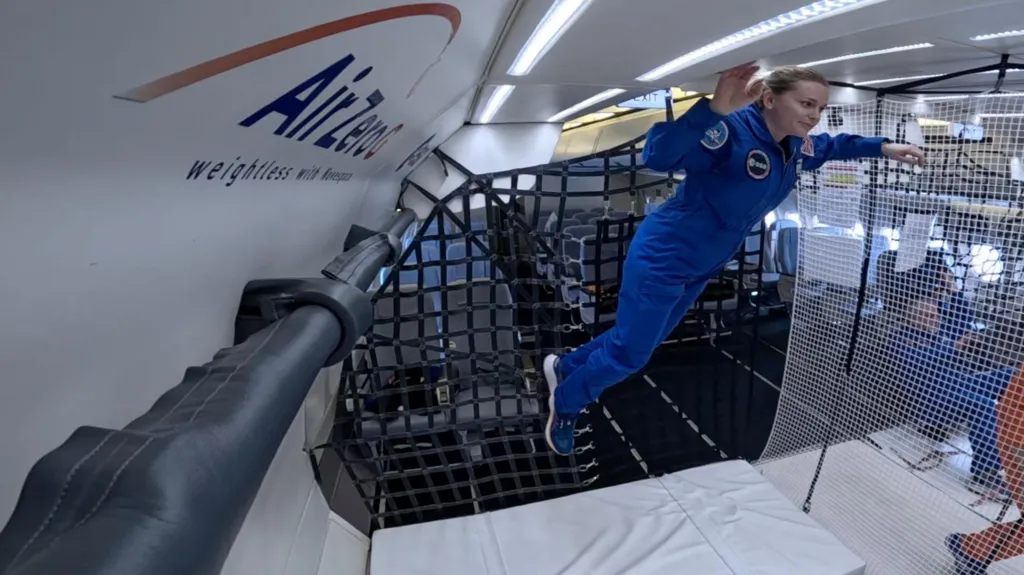 This image features Dr Meganne Christian, a reserve astronaut for ESA, who helped test the equipment on the parabolic flight. Credit: ESA/Novespace
In the absence of gravity, the human body can experience rapid physical deterioration. That’s why astronauts must work hard to maintain muscle mass and bone density in space.
“In space we don’t experience any forces, our muscles, our bones immediately start to diminish because we don’t load our body with those forces,” explained Dr Dan Cleather, professor of strength and conditioning at St Mary’s University and member of the HIFIm development team.
Without regular exercise, astronauts also lose coordination and cardiovascular fitness. This would reduce their ability to carry out functional tasks required during missions. Current equipment on the ISS demands significant time commitments that limit opportunities for scientific research and experiments.
International Development Race
ESA, NASA, the Canadian Space Agency, and the UK Space Agency have all contributed to the equipment’s development and testing. ESA supported the project by providing parabolic flight tests. Dr Meganne Christian, a reserve astronaut for ESA and Senior Exploration Manager at the UK Space Agency, noted that reducing exercise time “frees up more time for astronauts to do science and experiments, which could cause a whole range of breakthroughs.”
HIFIm is not the only device currently in development. The Danish Aerospace Company is also developing the European Enhanced Exploration Exercise Device (E4D) for ESA. The system includes four exercise modes: resistive training, cycling, rowing, and rope pulling. It also features motion-capture technology for performance tracking. The recent Artemis II mission also carried a specially developed flywheel exercise device.
British Innovation and Design
HIFIm originated from a competition between three European consortia to create exercise equipment for the Gateway Space Station, an orbital station planned for the Moon. Although Gateway has been sidelined by NASA, Christian emphasised that “we are at a really exciting moment in space exploration.” He added that these devices can be used for new space stations and lunar surface operations with Artemis missions.
The device was invented by John Kennett, a former aircraft engineer and pilates studio owner, who made the connection between bone density rehabilitation and space fitness needs. He believes the ISS was “missing a trick” with current exercise approaches.
Kennett’s small device can reportedly handle 300 different exercises, works without electrical power, and can isolate vibrations so they don’t interfere with fragile experiments or vessel structural integrity. The equipment was manufactured at Pinewood Studios by special effects engineers who have worked on Star Wars, James Bond, Mission Impossible, and won an Oscar for 1917.
Testing in Extreme Conditions
The latest parabolic flight tests focused on the rowing attachment. Notably, researchers could not properly evaluate it on Earth. Wells, who won bronze at the Beijing Olympics, described the experience as “off the chart” and “the most outrageous” of his many post-Olympic physical challenges.
Kennett described parabolic flight tests as “extreme conditions” for conducting science, with researchers having only 22 seconds of weightlessness during each manoeuvre to gather data before the cycle repeats.