

Listen to this article
Estimated 4 minutes
The audio version of this article is generated by AI-based technology. Mispronunciations can occur. We are working with our partners to continually review and improve the results.
Siloam Mission is parting ways with its CEO just three months after she was hired as the Christian humanitarian organization struggles to get out of a multi-million dollar hole through cuts and calls for more donations.
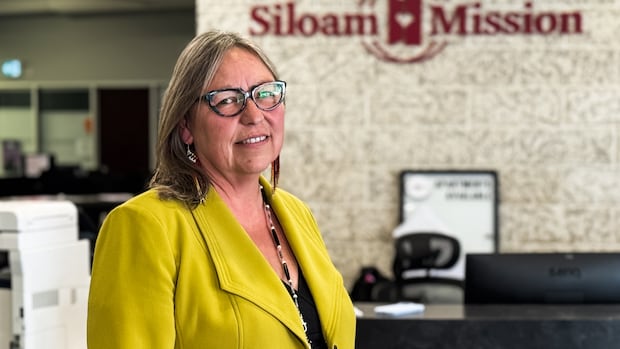
Sonia Prevost-Derbecker was announced as the organization’s new head in mid-February. On Monday, the Winnipeg homeless shelter issued a news release saying Prevost-Derbecker “will step down as CEO as the organization moves to the next phase” of an organizational support plan, leadership transition and financial review to stay afloat.
“Since COVID, our general donations have not been keeping pace with the increase in cost,” Tracey Silagy, chair of the board for Siloam Mission, told CBC News Monday.
“The gap between our revenue and our expenses on those programs that are funded through private donations has been expanding.”
Silagy said Prevost-Derbecker was brought to Siloam at a challenging time and she helped advance critical operational and funding efforts. Her replacement will mark the organization’s fourth CEO in just five years.
Under Prevost-Derbecker short tenure, the organization reduced services and made several layoffs that take were to effect June 1 — including cutting evening hours at the Siloam drop-in dining space and clothing store in an effort to tackle a $4.4-million deficit.
Plans to shutter the drop-in for four hours daily was a “necessity” that brought Siloam’s recalculated deficit to just under $2 million, Silagy said.
“That’s not a decision that we take lightly and it’s not a decision that we want to have to hold to. It’s a necessity to try and reduce some of that deficit in a large way quickly,” said Silagy.
 Siloam Mission is the largest shelter in Winnipeg with up to 600 people using its meal services every day. (Radjaa Abdelsadok/Radio-Canada)
Prevost-Derbecker faced criticism during the organization’s annual Easter lunch when she told staff members that no members of the media would be allowed at the meal without approval because of recent coverage which Prevost-Derbecker said painted the organization “less than positively,” according to a Free Press article.
Those articles pointed to internal tensions within the organization.
Silagy suggested the board is of the mind that the CEO job held by Prevost-Derbecker entailed too much work for one person.
She also said on Monday that Siloam has seen an unexpected uptick in donations recently that will enable it to keep the drop-in open for its regular hours through June after all.
If the private donations don’t keep flowing, Siloam may again be in a position come July where it needs to reduce evening drop-in hours and staffing, she said.
“It’s a really important part of what Siloam does, it’s just a part of what we do that is almost completely funded by private donations and it’s very manpower heavy,” she said.
“We are looking for people to step up and help us to keep that drop-in open over the next number of months, and in the meantime we’re also looking at more sustainable funding sources.”
Many charities across Canada are navigating rising costs, declining donations and increasing service demands in an extremely challenging fundraising environment, Silagy said.
As a result, the board is implementing a “temporary organizational support plan” that includes enhanced financial oversight, structural and fundraising reviews, fundraising capacity, governance review, and leadership transition measures designed to strengthen long-term sustainability while protecting core front-line services, shelter operations, and housing supports.
The board was aware some of those changes were needed before Prevost-Derbecker took the job in February, Silagy said.
Next week, Siloam is bringing in a temporary local executive support team with expertise in organizational transition, financial oversight, operations, governance, and charitable revenue development.
The support team will work with leadership over the next six months.
“We really want to ensure that the sustainability of the organization remains strong,” Silagy said. “We really want to ensure that our direct services, our community that we serve, the staff that we employ, are well supported.”
Mayor Scott Gillingham said in a statement that Winnipeg “needs Siloam to be strong, stable and focused on its mission.”
Manitoba Homelessness Minister Bernadette Smith called Siloam a “key” front-line support that her department will work with through its transition.