
Listen to this article
Estimated 4 minutes
The audio version of this article is generated by AI-based technology. Mispronunciations can occur. We are working with our partners to continually review and improve the results.
The City of Dawson Creek is relaxing some water restrictions as spring runoff buoys the city’s water supply.
But officials say residents shouldn’t get complacent as the possibility of another summer of drought threatens the Kiskatinaw River in northeast B.C., and the city’s long-term water security.
City councillors voted Monday to end Stage 3 conservation measures enacted last September to prevent a winter water shortage.
“Bearhole is still flowing, the river’s still flowing, reservoirs are full,” Chief Administrative Officer Kevin Henderson said, referring to Bearhole Lake, the rain and snow-fed headwaters of the city’s only source of drinking water.
“If the weather doesn’t change, we’ll be back [to restrictions], but in the meantime, I think we as a community need to be able to carry on.”
WATCH | Dawson Creek eyeing $100M pipeline:
Dawson Creek eyes $100M water pipeline as deepening drought threatens drinking supply
Dawson Creek is facing a severe water shortage due to four years of drought. To secure its water supply for the next 50 to 100 years, the city plans to build a $100 million pipeline to the Peace River, located 55 kilometres north. As Matt Preprost reports, the city is seeking provincial funding and wants to fast-track the environmental review process, which could take up to five years, in order to get shovels in the ground sooner
The move means residents can once again fill swimming pools and hot tubs, and use a sprinkler to water their lawn.
Industrial users are allowed to haul bulk water for fracking or filling dugouts.
The city is returning to Stage 1 measures, which outline certain days and times when residents can water their yards.
Henderson says city reservoirs can store more than 170 days’ worth of water.
“There’s a reason we built the reservoirs and store the water we do,” Henderson said.
“Those reservoirs give us a lot of lead time in order to make decisions so we’re able to do this.”
Drought concerns remain
However, the city has yet to see much spring rain.
According to Environment Canada data, just one millimetre of rain had been recorded at the Dawson Creek airport weather station throughout 2026, as of May 24.
By comparison, nearby Fort St. John has recorded 16.4 millimetres.
Meteorologist Derek Lee says while more rain may have fallen in the area, it has either been trace amounts that aren’t measurable, or very localized.
“We are entering the wet season for the B.C. Peace,” Lee said. “Sometimes we get moisture brought in back from Alberta, that brings us some prolonged rainfall.”
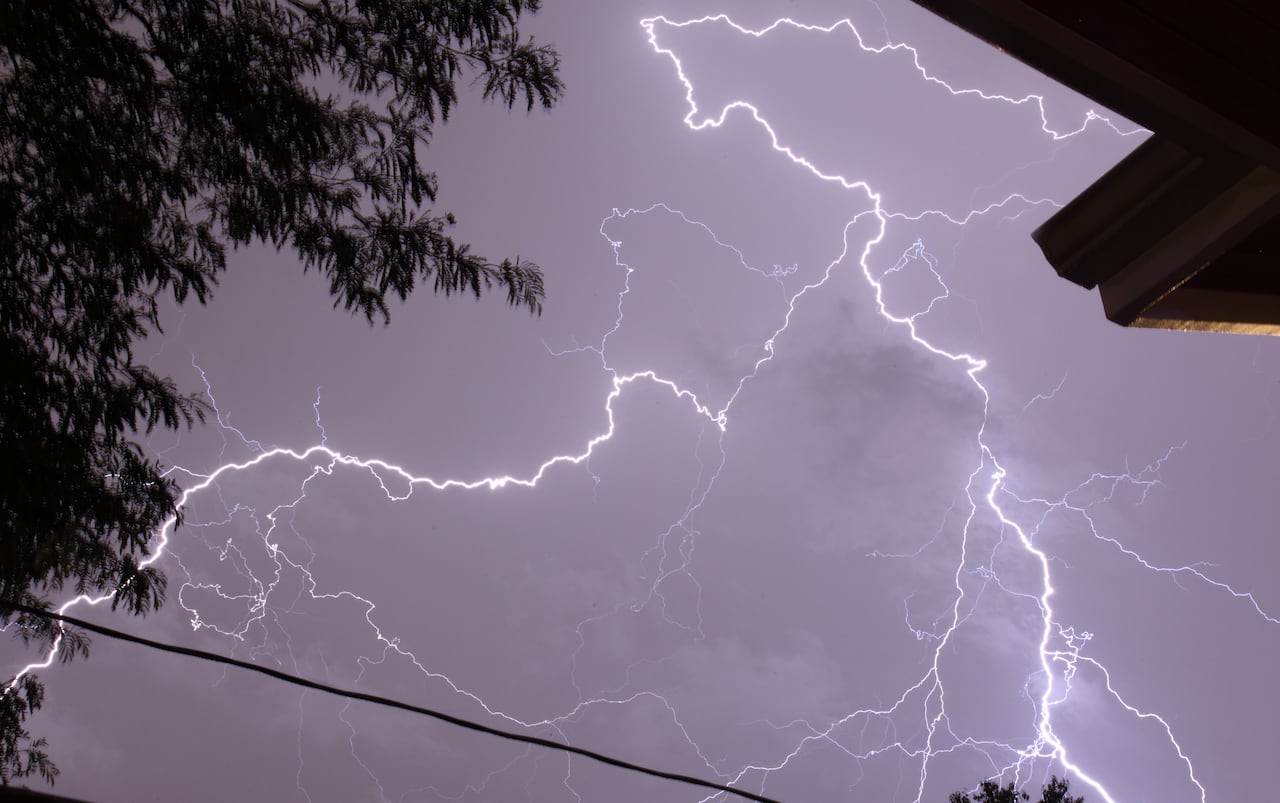 A meteorologist says that rain only falls in small pockets during localized thunderstorms across the Peace region. (Eric Foss/CBC)
But rain mostly falls in very small pockets during localized thunderstorms across the Peace region, he said.
“It won’t be a widespread rain event,” Lee said.
“That’s how we get our wet season in for the northeast.”
Coun. Charlie Parlsow says several years of drought have affected the region’s water supply, and climate trends suggest those conditions may continue.
He said he remains concerned over a “strong complacency culture that exists” in the region.
“If you believe in science, and climate science is pretty sophisticated, this pattern of drought is not a one-year, two-year [thing]. It’s been a three- or four-year thing here, maybe five years,” he said.
“It’s going to continue, so we mustn’t take our foot off the pedal in getting a secure water system.”
Dawson Creek has been studying a new source of water supply, including the possibility of tapping into the Peace River, about 50 kilometres north of the city.
Henderson says council will get an update on that work in June, with more details on options and costs expected later this summer.
He says that information will support talks with the provincial and federal governments about finalizing and funding a long-term solution.
“Anybody who thinks that the Kiskatinaw is a secure water system in our present time, and immediate future, is bonkers,” Parslow said.
Subscribe to CBC’s Fort St. John Weekly for a roundup of the best news and stories from B.C.’s Peace and Northern Rockies.