
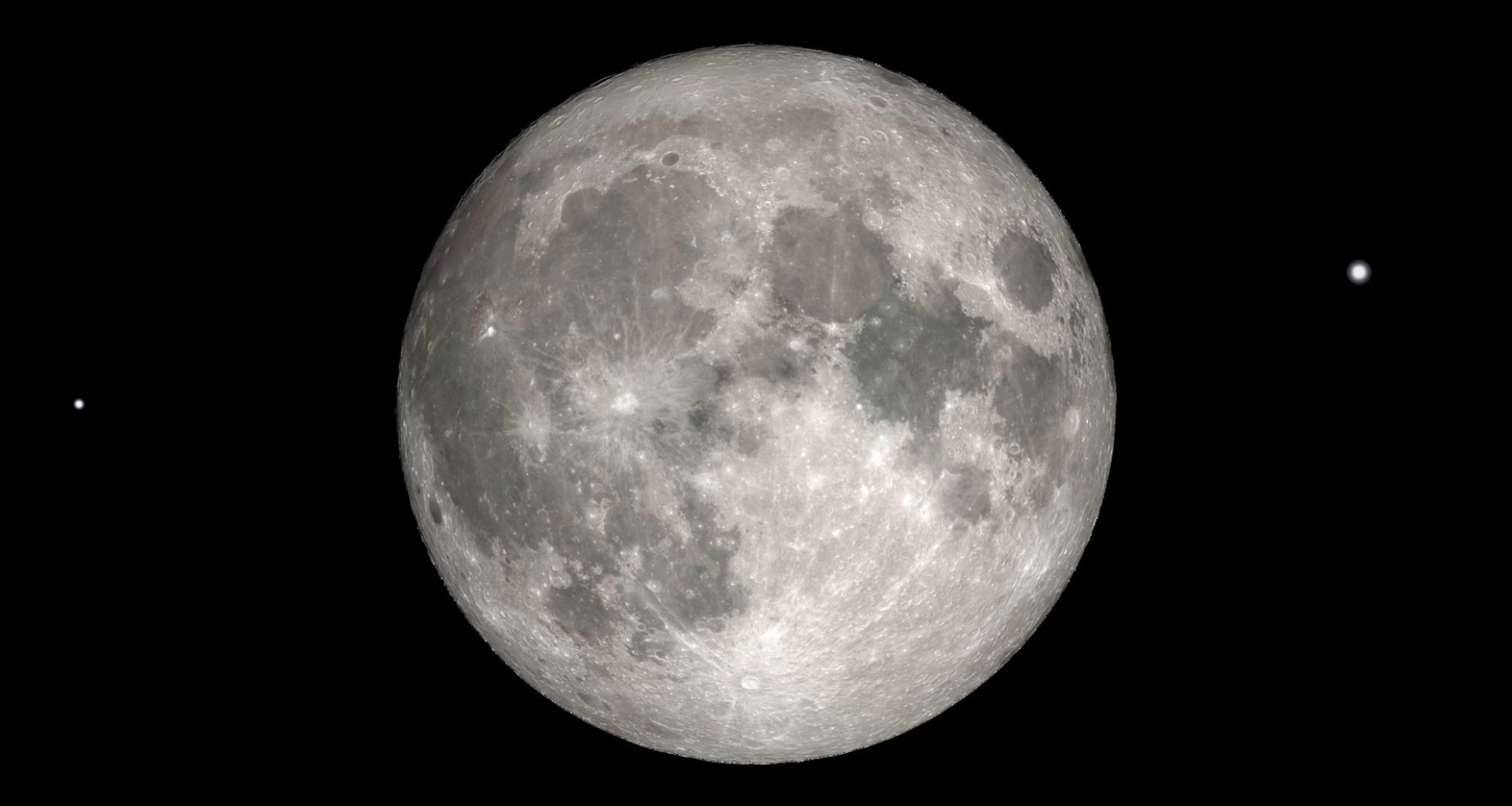
The third of those four Full Moons in the season is the Blue Moon, with “Blue” being added to its usual name. Thus, 2024’s August 19 Full Moon — the third of four Full Moons for the summer season — was the Blue Sturgeon Moon. Also, 2027’s May 20 Full Moon — the third of four for that spring — will be the Blue Flower Moon.
Like with calendar Blue Moons, seasonal Blue Moons also happen once every two-and-a-half to three years. However, the two types are usually offset from each other by a year or so, with rare instances where you will see both in a single year. For example: 2048 has a calendar Blue Moon on January 31, and then a seasonal Blue Moon on November 20.
Why is this one so special?
There’s nothing about Blue Moons that make them particularly distinct. They are uncommon, for sure, but hold no significance, other than being an excellent reminder of the variability of lunar cycles.
What sets this specific Blue Moon apart from others is its distance from Earth.
The timing of the Moon’s phases isn’t the only thing that changes from orbit to orbit. The exact shape of the Moon’s elliptical orbit around Earth also shifts, due to the gravitational interaction between the Moon and Earth, the Sun, and the other planets in the solar system. The result is that each time there is a Full Moon, it will be at a slightly different distance from us than any other Full Moon.
This follows a pattern, so that every 13th or 14th Full Moon is a Perigee Supermoon — occurring when the Moon is closest to us in its orbit, and is thus the largest and brightest Full Moon of the cycle. The Full Moon that occurs nearest to the middle of that cycle happens when the Moon is at its farthest distance from Earth in its orbit. That makes it the smallest and dimmest Full Moon of the cycle, which is known as the Apogee Micromoon.