
Prime Tire Newsletter | This is The Athletic’s F1 newsletter. Sign up here to receive Prime Tire directly in your inbox twice a week during the season and weekly in the offseason.
Welcome back to Prime Tire, where we now know that even the track marshals at the Canadian Grand Prix act like groundhogs:

The championship seems like it turned last weekend. Or it just got started. I’m Patrick, and Luke Smith will be along shortly. Let’s talk about it.
George Russell vs. racing gods
After winning the Canadian GP on Sunday, Kimi Antonelli leads the Formula 1 championship by 43 points over second-place teammate George Russell. But strip away three specific moments of misfortune, and the standings would look quite different.
As Madeline Coleman noted in her story, China, Japan and Canada handed Antonelli some gifts. Let’s dive into all three and map out exactly what this title fight would look like if the racing gods were just a little kinder to the preseason favorite (Russell):
China: The qualifying breakdown
After reporting a loss of power and battery in Q3, Russell managed to limp back to the pits in first gear. The team got him back out with seconds to spare, but he only had one shot. He ended up second, just 0.222 seconds behind Antonelli, who dominated from the start to claim his first Grand Prix victory.
Alternate ending: Russell starts from pole with a car that actually works, and wins. Russell gains at least 14 points on Antonelli and keeps the championship lead.
Japan: The one-lap safety car
Brutal timing. Russell pitted moments before Oliver Bearman crashed, bringing out a safety car. Antonelli, yet to pit, gained a cheap stop and the lead, jumping Russell and winning. Russell later remarked that the safety car cost him by appearing just one lap too early.
Alternate ending: Without that safety car, Russell wins and Antonelli finishes fourth. Russell’s lead extends again.
Canada: The engine failure
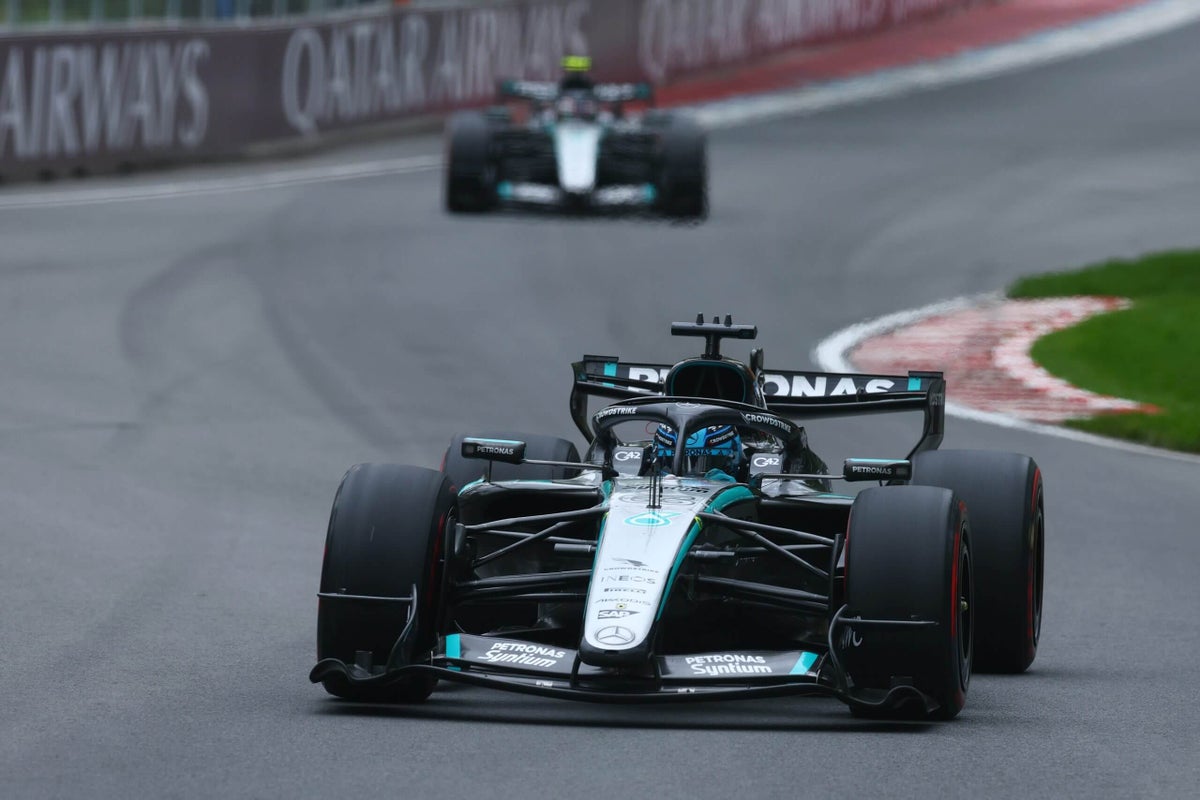
Russell was right in the thick of it, locked in a proper scrap for the lead with Antonelli, until his Mercedes gave up the ghost. A power unit failure on Lap 30 forced him to pull over. The final scorecard: 25 points for Antonelli, and a big fat zero for Russell.
Alternate ending: Russell’s engine holds together for the win, and Antonelli either crosses the line in second, leading to a 25-18 points split, or — as his racing vibes last weekend suggest — crashes his car trying to take the lead. Russell gains between seven and 25 points on his teammate.
The bottom line: Add it all up and you get something like a 72-point swing in Russell’s favor across three races, if the cards fell his way. Russell could be leading by more than 20 points heading into the Monaco GP next weekend, comfortably in the driver’s seat of a championship race most expected him to dominate.
It “feels like the gods don’t want me to be in this fight,” Russell said.
Yeah. It kinda does. Read more from Madeline on the fickle nature of F1 deities here.
Reckoning with what is
The good news for Russell fans: Sebastian Vettel once stared down a 39-point deficit to Fernando Alonso with only seven rounds remaining and won the title by three points. Then there was Max Verstappen’s charge last year, closing a 104-point gap with half a season left, and against faster cars.
By comparison, Russell’s math looks positively manageable.
The bad news for Russell fans: Russell is sitting in the exact same car as Antonelli, which makes it very hard to claw points back without bad weekends from Antonelli. And beyond that brutal 43-point gap, the mental game is starting to look even tougher.
The 19-year-old essentially forced Russell into making mistake after mistake in Montreal, and after the race, Russell sounded more resigned than determined.
For a driver trying to keep a maturing talent in his mirrors, that psychological distance might actually be bigger than the scoreboard deficit.
Canadian GP vs. regulations
Our mailbag comes out tomorrow, but here’s one question that didn’t make the cut:
“It seems to me like the current (and controversial) engine rules were fewer important in the outcome of the race this weekend. Am I right? And did it have something to do with the layout of the Gilles-Villeneuve circuit?”
Respectfully, nope. The layout of Circuit Gilles-Villeneuve sort of did the opposite.
F1’s new engines split output 50/50 between the ICE and electrical deployment. The problem: drivers must constantly recharge the battery mid-lap. One of the best places to do this is under heavy braking.
The Canadian GP’s Circuit Gilles-Villeneuve looks like the perfect fix on paper. The front half of the lap has more heavy braking zones, making harvesting easier. But the back half (the run down to the hairpin, the long Casino Straight, the Wall of Champions chicane) demands massive electrical deployment with almost nowhere to recharge. Drivers who deploy too aggressively in the first half of the lap arrive at the final straight with a drained battery, losing top speed exactly where it matters most.
These problems had already forced the FIA’s hand at the Miami GP in early May, when they introduced a package of rule changes, and sparked the agreement in principle to shift toward a 60/40 split in 2027.
You’re onto something about the vibe, though — you got lots of noise from drivers at the Japanese GP, and seemingly less headlines about it last weekend in Canada. But the engine rules were still a major factor, bothering the drivers, whether they were noticeable on the broadcast or not.
Inside the Paddock with Luke Smith
I’ve been covering my first Indy 500 in the last few days. Still, yesterday, I saw F1 world champion Lando Norris.
Norris flew to Indianapolis on Sunday night, spending the evening with Conor Daly and former teammate Daniel Ricciardo, before then going to Indianapolis Motor Speedway the following day.
I got the chance to follow Norris through his day, which started with a tour of the IMS Museum with Roger Penske, the legendary owner of the track and IndyCar.
He then played a bit of golf — yes, there’s a full 18-hole course inside the track — before getting his first laps of the circuit in a Chevrolet sports car next to Tony Kanaan, McLaren’s IndyCar team principal. After that, he was shown around McLaren’s IndyCar shop by one of its drivers, Pato O’Ward.
Could it tempt Norris to attempt the Indy 500 someday? “You never know,” Norris said. “I don’t want to say no.”
Norris was careful to make clear it wasn’t something he was actively pursuing right now, with Le Mans being a more likely event in his future.
The trip certainly increased the odds, but even if he never races at the Indy 500, Norris’ trip helped open his eyes to the magic of the event, with his appreciation clear to see throughout the day.
More Indy 500
Greatest race ever?
Congratulations to Felix Rosenqvist for winning the best Indy 500 ever.
But a big congratulations to our own Luke Smith, who finally completed his own personal Triple Crown (covering Indy, Monaco and Le Mans) last week!
His verdict? Nothing in the racing world could have prepared him for the Indy 500. Read his dispatch here.
My favorite stories we wrote from the Indy 500, presented without context:
Remembering Kyle Busch
Kyle Busch was never my favorite driver. In fact, I’ll go so far as to say that as a fan watching on race days, I did not like Busch. I also wasn’t a fan of Tony Stewart or Brad Keselowski. Aggressive, short-fused, polarizing. That kind of driver just wasn’t my favorite.
Busch died last Thursday due to a sudden illness. Everywhere you looked, at the Coca-Cola 600, at Indy and in Montreal, the news rippled through the motorsports world.
I missed out on Kyle Busch. Not on appreciating his greatness — that was apparent, impossible to deny. But on taking time to learn who he was beyond the track. I think it’s easy for fans to see a sports villain and assume they’re like that behind the scenes.
But from Daniel Suarez, who won the Coca-Cola 600 on Sunday, to Bubba Wallace, I was most struck this weekend by the drivers whom Busch advocated for, mentored, helped climb the ladder or simply expressed belief in when they needed it most. His on-track rivals respect him, of course, but it’s the ones he shepherded I hadn’t thought to look for.
Maybe I assumed there’d always be time later to pay closer attention. To come back around and appreciate Busch, in his entirety, at the end of his career.
When I found out Busch died, I was driving past Texas Motor Speedway. I saw him race there last year. I didn’t think it would be the last time, especially for someone who felt so woven into the sport’s fabric. But that was the last time.
You take for granted two things about people: How long they’ll be around and how much you think you know them.
Take it from me: Don’t.
More on Busch’s impact:
Outside the Points
🏎️ The cycle of pain continues for McLaren at the Indy 500.
🪧 More than 100 sex workers and allies marched through the streets of Montreal during qualifying on Saturday, striking against bar fees and an inequitable club model.
🍰 Andrea Stella is staying at McLaren, and he’d very much like you to know.
📫 Love Prime Tire? Check out The Athletic’s other newsletters.