
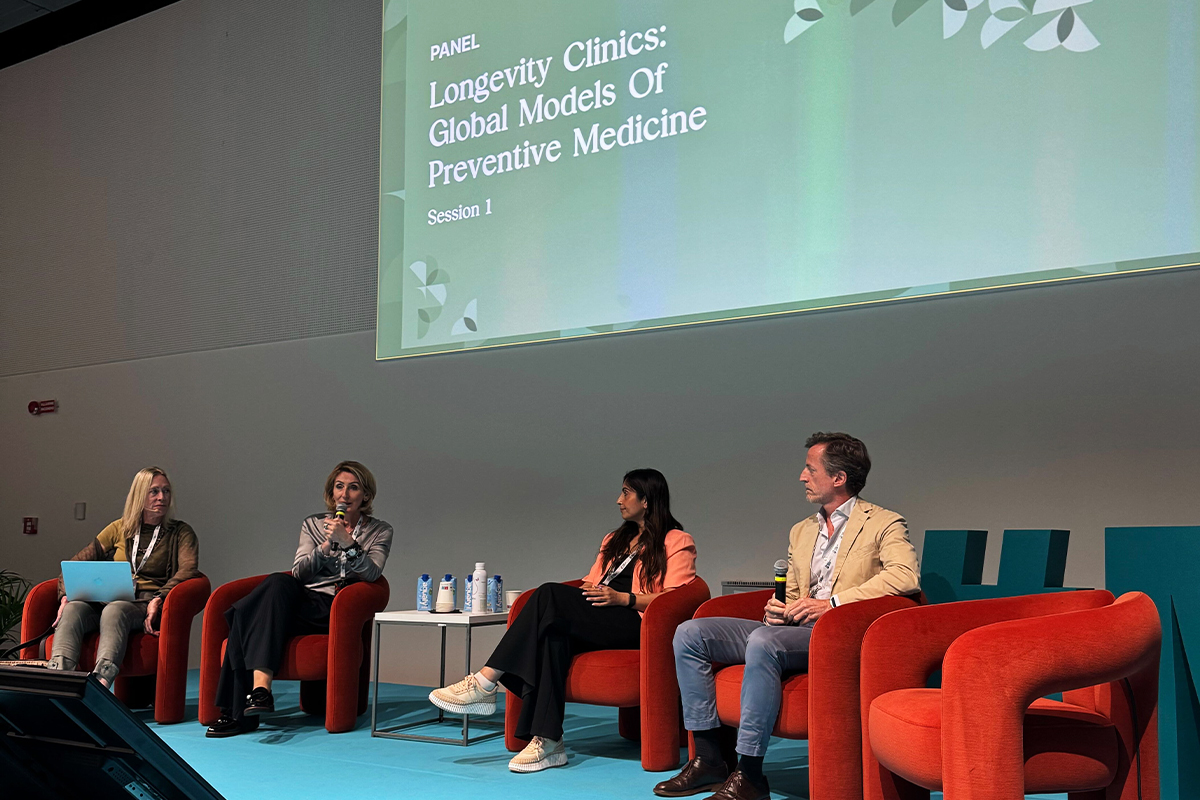
Milan panel explores how longevity medicine is shifting from wellness trend to accountable preventive healthcare.
At the Milan Longevity Summit 2026 last week, a panel on the future of longevity clinics suggested the sector is entering a more serious phase – one increasingly focused on credibility, continuity and measurable outcomes.
Hosted by Tina Woods of the International Institute of Longevity, the discussion brought together Joanna Bensz, founder and CEO of Longevity Center, Manjit Sareen, Head of Longevity Clinics World, and Javier Ramirez Sabau of Clinica Nevela in Madrid. Across diagnostics, consumer behavior, hospitality and preventive medicine, the conversation repeatedly returned to a central theme: longevity medicine is evolving beyond the biohacking-adjacent enthusiasm of its early years and toward something closer to an accountable healthcare model.
Longevity.Technology: Longevity clinics are approaching an awkward but necessary transition; having spent years trading in promise, the sector is now being asked to demonstrate coherence. It’s a shift that matters. Preventive medicine cannot mature on aspiration alone, however beautifully packaged the IV lounge or however snazzy the methylation clock; it needs standards, longitudinal data, clinical judgment, interoperability and the rather less glamorous business of continuity of care. The real challenge for longevity clinics will not be attracting health-conscious early adopters – that part has largely already happened – but proving they can convert fragmented diagnostics, wearable metrics and lifestyle enthusiasm into something resembling accountable healthcare rather than an expensive collage of optimization rituals.
There is also a larger systems story emerging beneath the biomarker panels and executive health packages. As healthcare systems struggle with chronic disease, aging populations and rising economic strain, longevity medicine is increasingly positioning itself not as an adjunct to medicine but as a prototype for what future preventive care may eventually look like; personalized, data-rich, behaviorally informed and increasingly continuous rather than episodic. The tension, of course, is that a field built around individual variability must now find ways to become scientifically comparable at scale. That may prove to be longevity medicine’s defining decade-long challenge; not persuading people that healthy aging matters – most already know that – but determining whether the sector can evolve from a highly marketable concept into a credible clinical discipline with enough rigor to survive contact with mainstream healthcare.
A sector defining itself
One of the strongest themes to emerge from the session was the need to clarify what longevity medicine actually is – and what it is not.
 L–R: Panel members Joanna Bensz, Tina Woods, Manjit Sareen and Javier Ramirez Sabau
The panel agreed that the field is fundamentally centered on extending healthspan rather than lifespan alone; reducing chronic disease risk, maintaining function and helping people remain healthier for longer through preventive and personalized care.
Joanna Bensz was direct on the question of standards: “There has to be a minimum standard. If a clinic is only offering IV drips without diagnostics, measurements, or medical oversight, that is not longevity medicine.”
The distinction matters as longevity clinics proliferate globally, ranging from medically led preventive-health centers to wellness-heavy optimization businesses built around supplements, infusions and aesthetics. A broad church. Sometimes very broad.
Beyond diagnostics
The discussion also reflected how rapidly consumer expectations are changing. Patients entering longevity clinics today are increasingly informed, skeptical and proactive about their own health trajectories.
“Consumers are becoming much more educated and much more empowered,” said Manjit Sareen, who heads up Longevity.Technology’s Clinics division. “They want to know why something is being recommended, whether it’s evidence-based, how it will be tracked and whether the clinic can support them on a long-term journey.”
Sareen said this is also shaping how clinics themselves evolve. “People are not just looking for data anymore,” she told us. “They want guidance, accountability and continuity. The clinics that can genuinely support behavior change over time are likely to be the ones that will stand out.”
She also pointed to ongoing collaboration between Longevity Clinics World and the Healthy Longevity Medicine Society around clinical benchmarking and best-practice frameworks for the sector, including development of a structured assessment grid evaluating clinics across diagnostics, interventions and patient support systems.
“There is still a real need for greater clarity and consistency across the sector,” Sareen said. “Part of what we are trying to do with HLMS is help create better standards, better awareness and more transparency for both clinics and consumers.”
Biomarkers, imaging, wearables and metabolic testing remain central to the longevity-clinic model, but increasingly they appear to function less as endpoints and more as inputs into long-term health management. As Bensz later wrote on LinkedIn following the summit: “Outcomes, interventions and follow up, not just diagnostics or data collection are becoming the true differentiator.” Data alone is cheap; sustained adherence is not.
The personalization paradox
Javier Ramirez Sabau emphasized that longevity interventions must be tailored not only to biomarkers and risk factors, but also to lifestyle, family history and individual goals.
“We personalize not only the interventions, but even the diagnostics themselves,” he explained.
Yet personalization brings its own complications. The more individualized the system becomes, the harder it becomes to compare outcomes, establish standards and build interoperable models of care. Longevity medicine now faces an unusual balancing act – attempting to standardize enough to achieve scientific credibility while remaining flexible enough to account for biological individuality.
Clinics are also seeing younger demographics entering the space. Consumers in their twenties and thirties are increasingly seeking support around stress resilience, sleep, recovery and metabolic health long before overt disease appears. Prevention, once considered vaguely dutiful, is becoming aspirational.
Hotels, healthspan and the new ecosystem
One of the more interesting discussions centered on hospitality’s growing convergence with longevity medicine. Hotels, resorts and destination wellness brands are increasingly integrating diagnostics, recovery technologies and sleep optimization into consumer experiences – reflecting a broader shift in which health optimization becomes embedded into daily environments rather than confined to clinics.
“Health is becoming an asset,” Bensz observed during the panel discussion. “People now expect wellness and longevity support to be part of their daily lives.”
From niche to infrastructure
The Milan discussion reflected a sector beginning to think more systemically about its future. As Bensz observed after the event, longevity medicine is evolving into “a new operating system for proactive healthcare and healthy aging” – one increasingly built around interconnected ecosystems spanning medicine, technology, hospitality and patient engagement.
Whether the field can scale responsibly remains an open question. Yet the conversation in Milan suggested that longevity medicine is beginning to orient itself toward the harder disciplines of evidence, accountability and long-term care.