
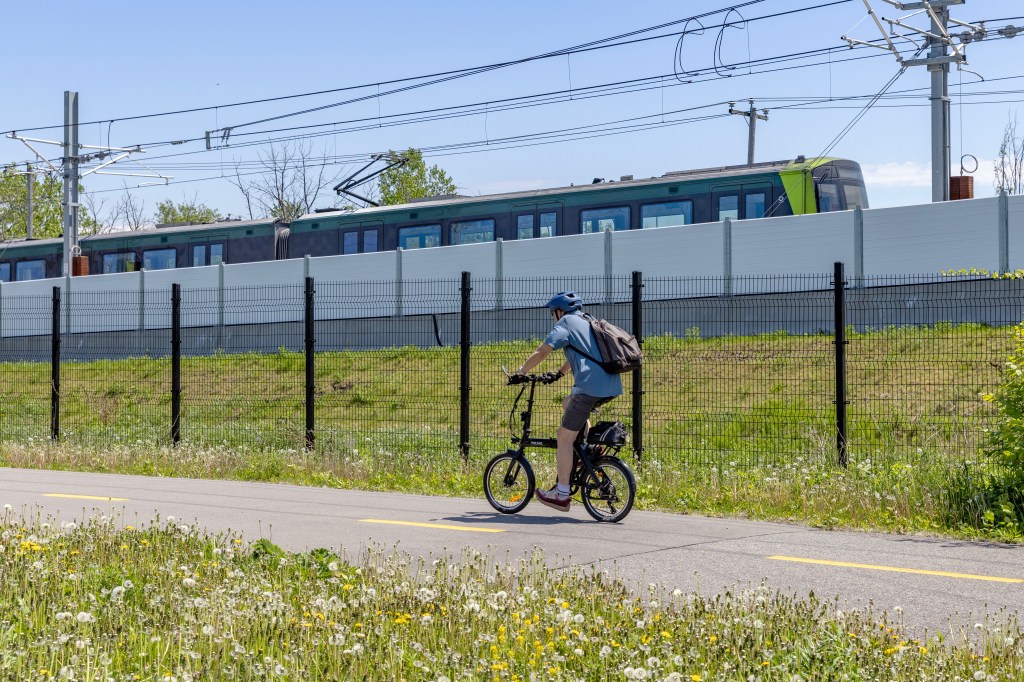
The city of Montreal has come to terms with the owner of the REM light-rail network to build a regional bike path that will connect most of the stations north of the Mount Royal Tunnel.
It calls for a véloroute to be built within the slipstream of the REM, which connects to 16 stations linking Montreal, Laval, the North Shore and the West Island.
It would span at least 38 kilometres and link to existing bike paths as well as industrial parks and nature parks, like Cap St-Jacques, les Bois-de-l’Île Bizard and the future Grand parc de l’Ouest.
The project is the realization of a dream first brought forward in 2012 by Alan DeSousa. As borough mayor of St-Laurent, DeSousa hoped to entice local municipalities to work together to build a bike path that would run alongside the tracks of the old Deux-Montagnes train line.
With the REM in place, DeSousa is hoping to link as many stations as possible to the new route, which would allow it to reach Ste-Anne-de-Bellevue on the western extremity of the island, and even the airport. Now the Martinez-Ferrada administration’s point person on transportation, DeSousa has come up with an agreement with CDPQ-Infra, which owns the REM, to build the new route. The deal allows the city to put forward proposals for different sections of the path, which the REM’s owners will analyze in order to come up with the best options.
Editor’s Picks
“We won’t be able to put it all in place with one wave of a magic wand,” DeSousa said. “It will be phased in and prioritized and pieces will be built along the way with the intent of building up connectivity and continuity.”
He said the city will put forward the portions of the path that will be easiest to complete. It will take longer to plan and build the portions of the route that can’t run parallel to the tracks. Among the examples of where the route will probably have to deviate from the tracks is where the tracks cross over Highway 40 in Pointe-Claire.
“Some of the trajectories will also need to go on the road or on a Hydro corridor, so we will have to negotiate those pieces,” DeSousa said.
Within 30 days of signing the framework, the city will submit proposals to CDPQ-Infra so it can study different portions of the path in the coming months. It’s up to the agglomeration of Montreal to build the paths and then maintain them, DeSousa said.
He added the REM path will improve mobility for cyclists throughout the region and will allow the city to build bike paths without facing opposition from those who tend to complain about bike paths being built on the city’s streets.
“This project doesn’t take anything away from cars or pedestrians because, for the most part, the paths are going to be built right next to the tracks,” he said.
DeSousa didn’t have an estimated price tag for the project, but the Plante administration approved a $90-million borrowing bylaw in 2024 to begin the studies on the project. DeSousa said that while the Plante administration had hoped to get the project off the ground during its mandate, the REM’s builders were only in a position to sign an agreement after the Anse-à-l’Orme branch was commissioned last week.
The news of the deal was greeted with optimism by cycling lobby group Vélo Québec.
“It’s excellent news,” said Vélo Québec CEO Jean-François Rheault. “This will create an access that allows us to develop a really interesting cycling network. It also improves access to the stations because it’s currently not so easy to get there by bus or by car. Combining bike and REM will really give people a chance to beat the transit time by car, and it gives people more options.”
Rheault said his group had asked REM builders to put together such a network in 2017 when the project was in its consultation phase.
Vélo Québec is also asking builders of the Alto high-speed rail network to build a similar network, which would allow the cities of Montreal and Ottawa to be linked with a regional bike path.
Speaking for CDPQ-Infra, Francis Labbé said the REM’s builders plan to work with the city to bring the project forward as quickly as possible.
“This initiative aligns with our priority of providing multimodal accessibility, whether through active transportation, public transit or by car,” Labbé wrote in a statement. “It also reflects the close collaboration between the REM project and the city of Montréal to better integrate the REM into its surroundings and maximize its use for the benefit of users. With respect to other municipalities served by the REM, discussions are ongoing with municipal partners, but it is too early to provide further details.”

You’ll often see Jason Magder donning a hard hat and florescent vest at a local construction site. As The Gazette’s transportation reporter for more than a decade, he has seen the new Champlain Bridge built, the old one demolished and followed the ups and downs of the city’s transit system. He has been covering news in Montreal for 25 years.
jmagder@postmedia.com