
Formula 1 is now a $3.87 billion business, and food is no longer an afterthought in that equation
Hilton
McLaren won the 2025 Formula 1 World Championship. While the drivers get the glory and the engineers get the credit, there’s a quieter player in the paddock that’s had a front-row seat to both titles, and that’s Hilton.
Formula 1 is now a $3.8 billion business, and food is no longer an afterthought in that equation. Three-day hospitality packages across the 2025 F1 calendar ranged from $1,500 for basic circuit access to over $15,000 for Paddock Club passes and that’s before you’ve checked into your hotel. The fans filling those packages are a specific kind of traveller. According to Hilton’s own research, 60% of luxury travellers prioritize staying at hotels with great restaurants, and 86% say they value experiences over material things.
Formula 1 has become one of the most demanding tests of what hospitality can actually deliver. Hilton’s F1 partnership puts its properties at the center of that test. Across the race calendar, from a trackside hotel at Silverstone to a luxury address on the Singapore Marina Bay Street Circuit, the work happening inside the kitchens is as choreographed and as high-stakes as anything happening on the track.
The real differentiator, race weekend after race weekend, is what happens in the kitchen.
Hilton
The properties themselves are part of the story. Hilton Garden Inn Silverstone is the first trackside hotel at the legendary British Grand Prix circuit. In Baku, the Hilton overlooks the Azerbaijan Grand Prix’s city circuit from its Sky Grill Rooftop and 360 Bar, and in Las Vegas, the Waldorf Astoria sits a short walk from the Strip Circuit. Each property is positioned to make the race weekend seamless, with proximity ranking as the top consideration for accommodation among F1 travellers (according to Hilton’s Asia Pacific research).
But proximity is only part of it. The real differentiator, race weekend after race weekend, is what happens in the kitchen.
Nobody knows that better than Executive Chef Thomas Jakobi, who runs F&B operations at Conrad Singapore Marina Bay. Jakobi has worked Grand Prix weekends across Qatar, Dubai and Japan, and describes the Singapore race as uniquely demanding because it’s a night race. “We’re flipping the day,” he says in a phone interview. “Breakfast runs at noon. The afternoon meal comes at 4 or 5 pm. The main meal? Two o’clock in the morning, so we have to change the time of working. Last race weekend, the kitchen did 150 covers at 3 am. Not a quiet late-night service but rather a full kitchen, full team, cooking to order. I came here in the morning, and all the people were sitting there. Chefs were cooking. You turn everything around.”
The same mentality runs across every Hilton property in the partnership
Hilton
That kind of operation doesn’t happen by accident. Jakobi starts planning five months out. Special menus are written and signed off with F1 team nutritionists and performance managers who arrive months in advance to go through everything. “For breakfast, the drivers will typically have avocado with egg. For the afternoon, only a little corn, rice and chicken. And when they’re coming back in the night, something more, a little heavier food.”
During race weekend itself, he runs his standard team of 120 kitchen staff plus a minimum of 80 additional casuals, each trained four or five times before the weekend, all of them assigned a specific role. He’s also running catering at Turn 6 on the circuit, which does 2,500 covers a day, every day of race weekend. “It is not only food,” Jakobi says. “It is also the quality of what the guests are expecting. They’re paying a certain amount of money. They’re expecting a certain quality.”
That balance of comfort and ambition is something Hilton’s own data reflects. According to its 2026 Trends Report, 79% of travellers say familiar menu items bring comfort on the road, yet 72% still go out of their way to seek out local food and drink traditions. Race weekend guests want both. They want the reliability of a world-class hotel kitchen and the specificity of where they actually are. Jakobi’s menus are built to deliver exactly that.
The same mentality runs across every Hilton property in the partnership. At Conrad Fort Lauderdale Beach Resort, General Manager Robert Lacle describes the Miami Grand Prix weekend as a total transformation of the property. “It is an electrically charged weekend in South Florida, and we are delighted to be a part of it,” he says in an email interview. “It is important to generate excitement and keep the energy high.”
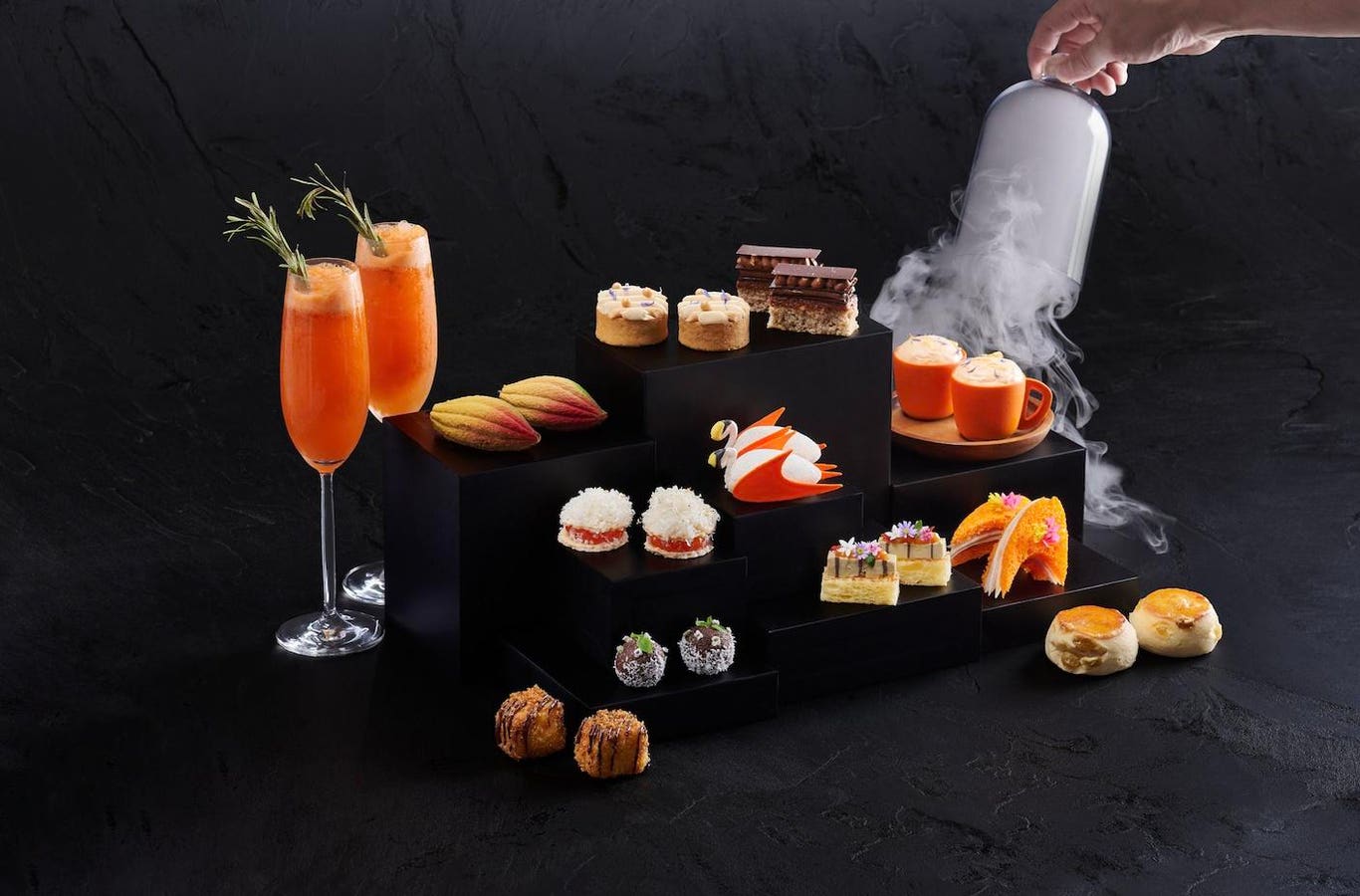
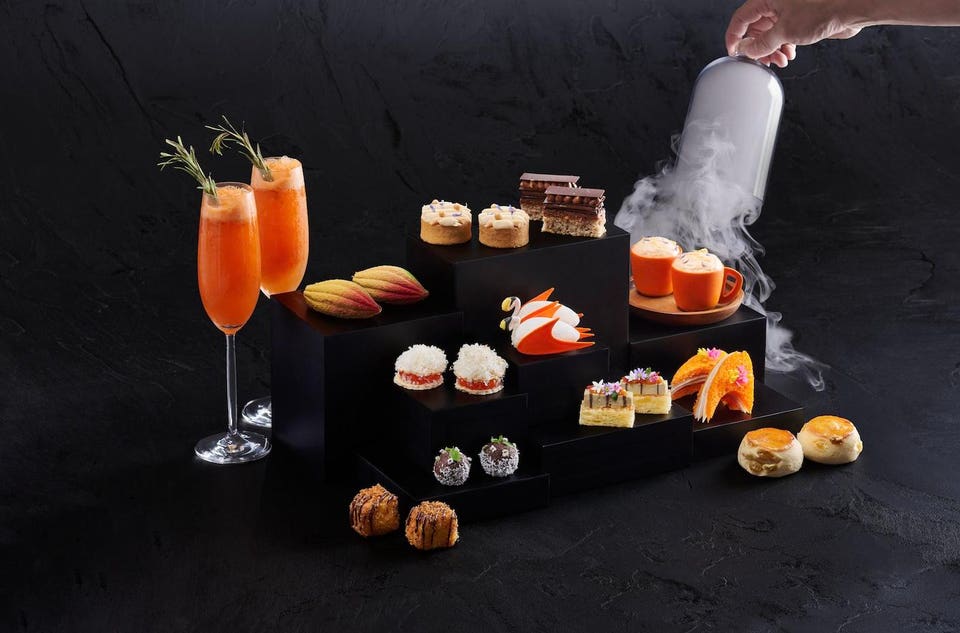
The culinary team, which works alongside restaurant partners Takato and Vitolo, builds welcome amenities in honor of the race. Last race, they created madeleines coated in white chocolate accented with orange, milk chocolate Formula 1 vehicles on a white chocolate Grand Prix course display. Encouraging words embroidered on pillowcases in VIP suites and McLaren orange are woven into staff uniforms and hotel accents throughout. “Creating the ambiance starts the minute guests arrive,” he says.
At Hilton Yas Island in Abu Dhabi, Cluster General Manager Nader Halim frames the F&B philosophy with an analogy that captures the whole operation neatly. “Race weekends are all about energy and precision, and that extends to our kitchens,” he says in an email interview. “We run our food and beverage operations like a pit crew, fast, focused and ready to keep fans and teams refueled. From quick bites to full meals, everything is designed to help guests recharge so they can stay in the heart of the action.”
The F1 Paddock Club generates consistent high-margin revenue across all 24 races on the calendar, with waiting lists at several events. It’s only proof that for a growing slice of the F1 audience, the hospitality experience is as much of a draw as the race itself. Hotels hosting that audience can’t afford to treat food and experience as secondary.
What Hilton has understood, across all of the properties and race weekends, is that hospitality and motorsports have always had more in common than it seems. Both are built on logistics and flawless execution under pressure. Jakobi puts it simply: “You have to be organized, you have to have the quality, you have to have planned everything.”
F1 generated $3.9 billion in revenue in 2025. As it continues expanding into new markets and new audiences, the pressure on host properties to deliver something beyond a comfortable bed will only intensify. Hilton, with a white chocolate race car on the welcome tray and a full kitchen running at 3 am, seems to have figured out what that looks like.