


Listen to this article
Estimated 5 minutes
The audio version of this article is generated by AI-based technology. Mispronunciations can occur. We are working with our partners to continually review and improve the results.
The number of hate-motivated crimes reported in Winnipeg more than doubled last year — an increase being labelled by police as significant compared historical norms but some targeted groups say the numbers are still an underrepresentation of a growing problem.
In 2025, there were 112 hate-motivated crimes reported in the city compared to 44 the year before, a 154-per-cent jump coming after what police said were steady numbers of incidents since 2019.
The data was released on Wednesday as part of the Winnipeg Police Service’s 2025 annual statistical report. It shows 49 of the reports — or about 43 per cent — were associated with race and ethnicity, with Black people being targeted in 23 incidents.
Out of 37 hate-crime reports related to religion, 32 of them involved Jews — an alarming proportion for Gustavo Zentner, vice-president for the Centre for Israel and Jewish Affairs, who said incidents of antisemitism have spiked.
“It’s hard to put into perspective unless you start thinking of the individuals — how would they react if they, themselves, were singled out … that’s what we’re confronted with,” he said.
 Gustavo Zentner, vice-president of the Centre for Israel and Jewish Affairs, says more efforts on prevention are needed to reverse the growing trend of hate-motivated crimes in Winnipeg. (CBC)
Graffiti depicting swastikas in public spaces, the use of racial slurs, including in school settings, and threats dealt to families outside synagogues are among the examples of intimidation targeting Jews in Winnipeg.
The number of hate-motivated crimes directed at this group has not been isolated to Winnipeg. Around 70 per cent of police-reported incidents targeting religion in the country during 2024 involved Jews, according to information from Statistics Canada released in March,
“While Jews may be the target today, what extremists are aiming at is something bigger. It’s our Canadian way of life,” Zentner said.
Security at places of worship and the prosecution of hate-motivated crimes are important but Zentner said more prevention is needed to reverse the current trend — and it starts with education.
Noris Zeid, a vice-chair at the Manitoba Islamic Association, agrees.
He said police presence is important to improve the sense of safety, but change is tied with understanding marginalized groups as part of society and debunking harmful stereotypes that could lead to harassment.
Last year, three hate-motivated crimes reported to police involved Muslims, a number Zeid said is “undervalued” compared to the sheer extent of harassment faced by his community, who default to not reporting because they are afraid of interactions with authorities.
But Zeid said there’s also the perception that even if reported, there’s not going to be substantive change, as Muslims continuously face verbal and physical aggressions.
Hate has also escalated into instances of vandalism at mosques and businesses frequented by Muslims in the city, Zeid said.
“Sometimes they won’t go to certain places or they’ll be fearing for their kids and they won’t go out as much,” he said. “Nobody should feel fearful in the city. That’s not what we grew up [with] here in Canada.”
Changes in reporting
According to the data from police, 82 or around 73 per cent of hate-motivated crimes reported in the city last year involved mischief. Nine incidents were classified as criminal harassment, seven as uttering threats and six others as assault of Level 1.
The dramatic rise of reports from 2024 to 2025 reflects “a real material increase” in the number of hate crimes, said David Bowman, a data analysis specialist who serves as the police service’s director of organizational development and support.
Chief Gene Bowers said world events have driven the increase of reported hate crimes.
But he said the spike also came as the police service made changes to its online reporting system last year, including adding the ability to report hate-motivated graffiti, which accounted for one in five hate-motivated incidents in 2025.
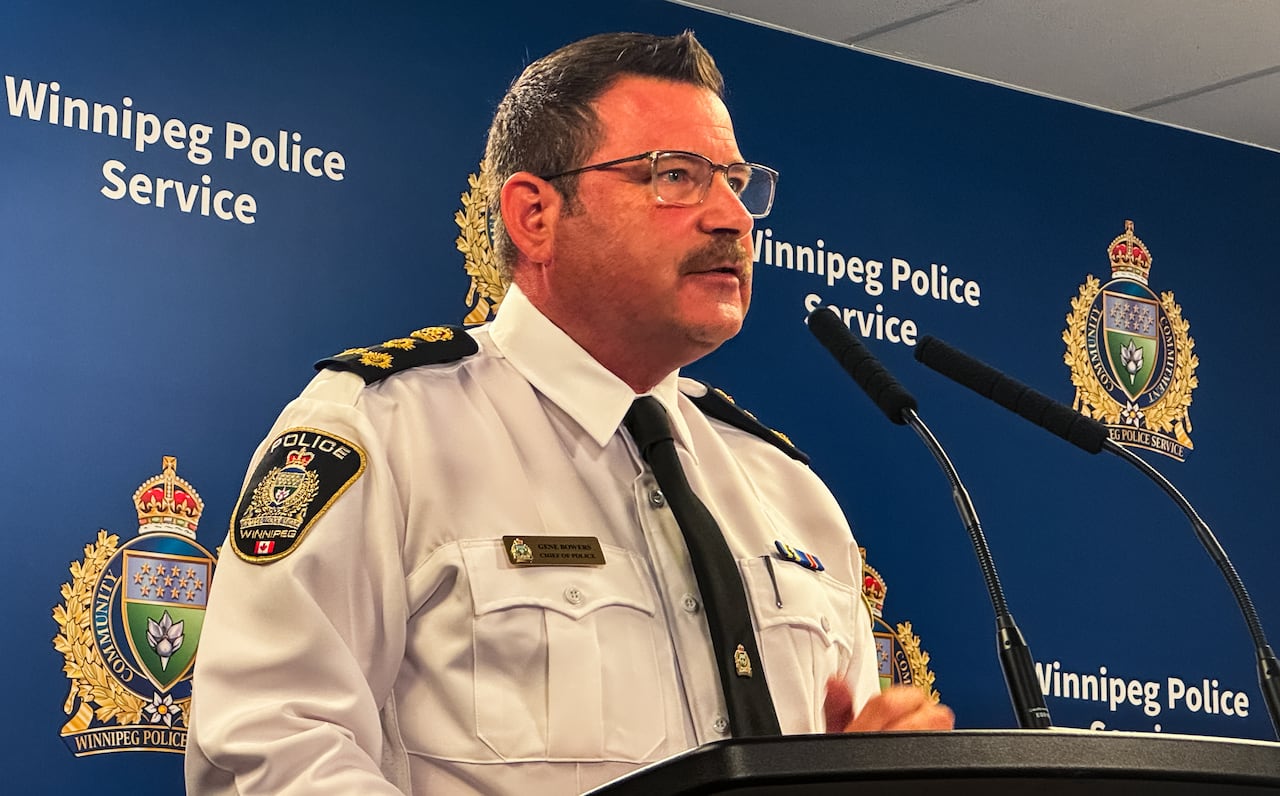 Winnipeg police Chief Gene Bowers says world events are partly behind the rise in hate-motivated crimes, but so were changes to the online reporting system introduced last year. (Prabhjot Singh Lotey/CBC)
Police said there’s also been more consistent identification and classification of hate-motivated incidents from improvements to the review process conducted by the force.
Still, Charlie Eau, the executive director of Trans Manitoba, said the picture in this year’s report is an underrepresentation of hate crimes targeting the 2SLGBTQ+ community in the city that has worsened in recent years.
“It’s part of the day-to-day, the experience of many queer people in Winnipeg, to be harassed and to experience queer-phobia,” they said.
In 2025, 10 reported hate crimes were related to a sexual orientation and two involved gender.
Eau said there’s underreporting of hate crimes in their community and it stems in-part because of distrust in police to protect 2SLGBTQ+ people.
“If going to the police produced results that increased our safety, we would,” they said.
Incidents of harassment, derogatory comments and discrimination against the 2SLGBTQ+ have increased in numbers in Winnipeg, Eau said, especially since U.S. President Donald Trump took office last year.
“It has had an enormous impact,” they said.
“There’s a huge gap in a sense of belonging and safety as a queer people still don’t universally feel safer [and] accepted in Winnipeg.”