
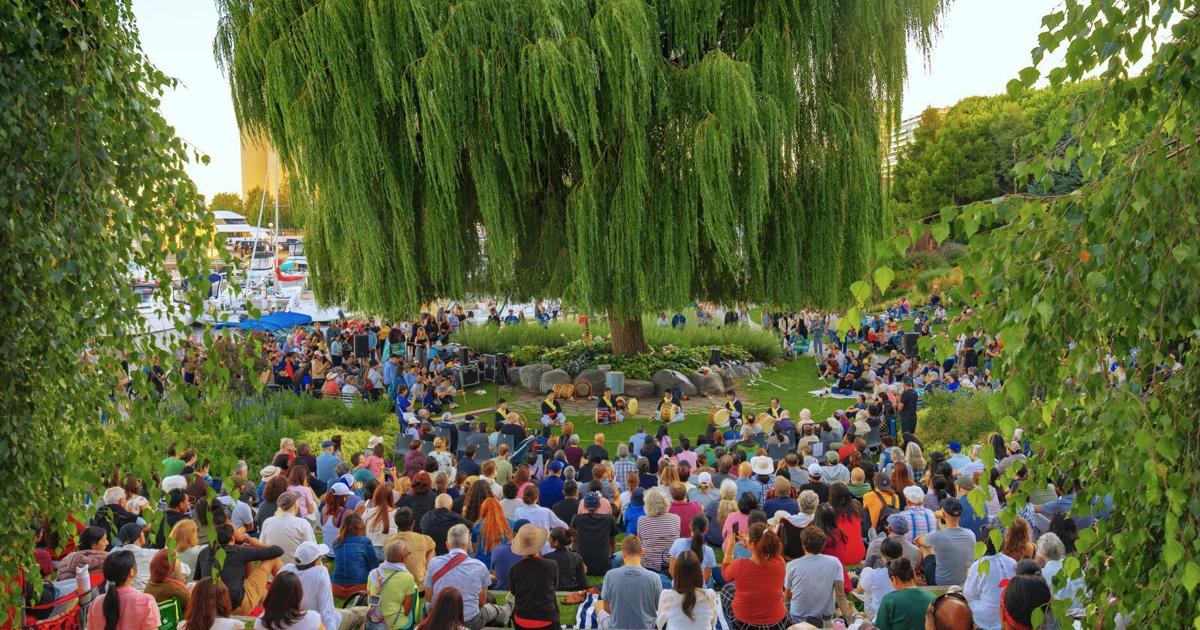
Along Toronto’s waterfront on a summer night, serene melodies can be heard from beneath a weeping willow as part of a free outdoor concert series.
From June 21 until Aug. 27, the Summer Music in the Garden concert series will take over the Toronto Music Garden at 479 Queens Quay W. on select evenings.
This year, the series enters its 25th season, featuring a lineup of diverse musicians who will perform in the heart of this lush, green oasis that has been described as a “space beyond words.”
“We can talk about things, words get us so far, but sometimes hearing a song from a different area that we have never heard before helps us connect in a way that we can’t manage with words,” Gregroy Oh, Curator at Summer Music in the Garden, tells Toronto.com.
Oh said that it’s a space where you can surround yourself with other people and “have your soul fed” by the music.
A classical genesis from Bach to the waterfront
Landscape architect Julie Moir Messervy designed the Toronto Music Garden with legendary cellist Yo-Yo Ma in six different sections, based on the six movements of Bach’s first cello suite.
According to The City of Toronto, Messervy and Ma first approached the city of Boston, Massachusetts to build the garden, but when the plan didn’t work, Toronto accepted the project.
The garden comes from a “classical genesis,” according to Oh, who added that the music is always going to have a link to Western classical music.
But that doesn’t mean that is all you would hear there.
“We’ve tried to also reflect other classical traditions,” Oh explains. “As the city evolves, we try to show the different faces that we see in the crowd, the different faces we see at school, and at work.”
As a musician, Oh has been curating the series for six years, reflecting other classical traditions into the concerts. He has also taken an interest in musicians that have “a compelling story to tell that only they can tell.”
Among Oh’s selected artists is an Iranian vocalist, Neda Mohamadpour, who focuses on traditional Maqam music. She found the Toronto Music Garden while passing by, and recognized a Persian folk song that was playing.
For two years, Mohamadpour has been a performer in the Garden series, and will be part of the 25th season.
“I can represent the music from my country. And it’s not only giving back to my community, but I think it is giving back to the world,” Mohamadpour says.
Finding ‘a little part of home’ in the garden

Audience members and performers alike connect in the Toronto Music Garden.
Toronto Harbourfront Centre
Besides the music that contributed to the growth of the garden, the space has also been a form of connection.
“Some people can find something that is a part of their past, find a little part of their home, and then other people can find something that they’ve never ever found before,” Oh says.
Two years ago, when a Pan-Balka, Middle Eastern band called Opa Yallah performed songs from many regions, Oh said there were different groups of people who got up and danced, forming a connection to the music.
“It was such a magical thing because each person has a different sense of what home is,” Oh says. “But I think for that moment, people who have a more complicated understanding of what home is were able to say; this is part of my home. Here in Toronto, I can find my home.”
Like some of the concertgoers, Mohamadpour feels a connection to the music and the space, stating that during a performance a couple of years ago, she had a “cute” experience getting to know audience members.
“This audience engagement was very pure, genuine, and authentic.” After the show, she met other Iranians, who have become close friends now.
Toronto interconnecting with the world through music
As the series carries on for its big anniversary, Summer Music in the Garden will continue to evolve. Oh compares its growth to airline flight paths that show the world map with lines to every destination.
“Toronto is like that in a way, if you imagine where everyone else has been, and you draw a line, it would be this massive structure of lines interconnecting, webbing everywhere all over the globe,” he says.
“The spaces that we come from around the world, we get so much from these lines that we don’t always appreciate. And so I hope that the garden continues to reflect the very complicated community that is Toronto.”