
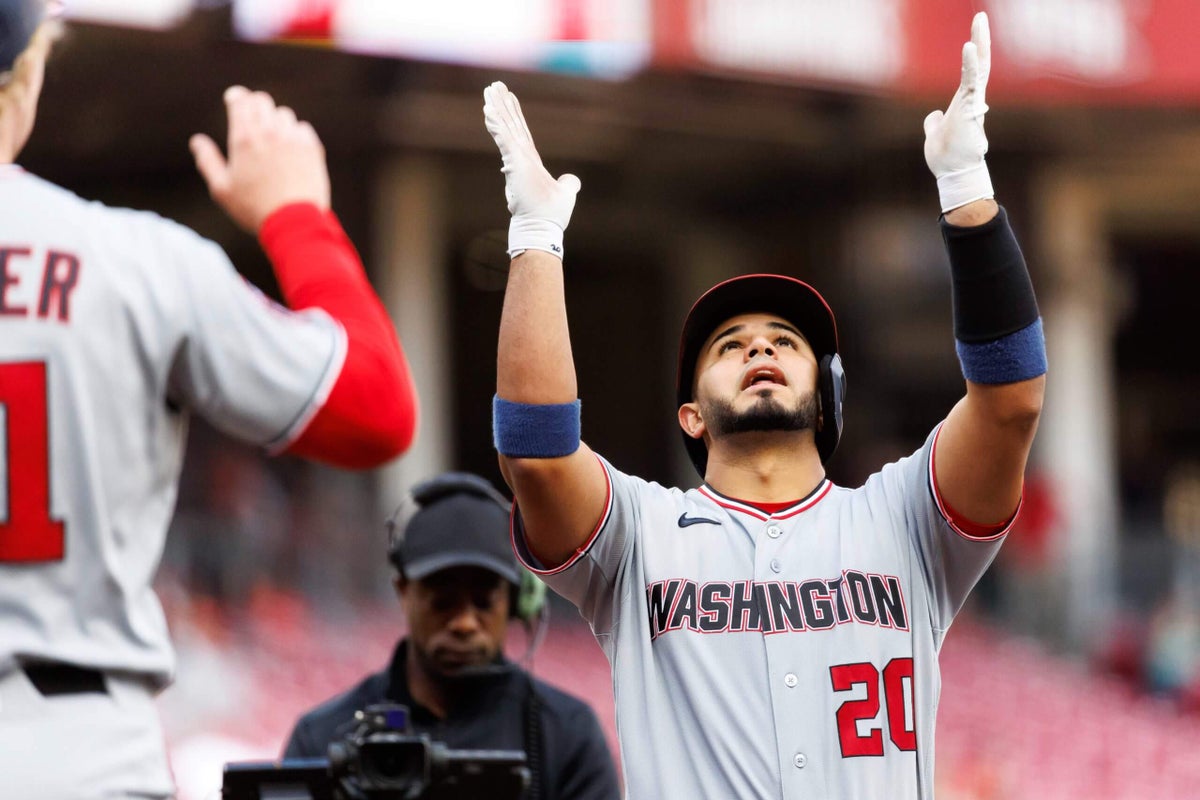
CLEVELAND — Three weeks before the Washington Nationals secured a series win over the best team in the American League Central, more than a dozen coaches, trainers and executives gathered in a room with catcher Keibert Ruiz.
With close to a 20-to-1 teacher-to-student ratio, the meeting began with commendations about Ruiz’s defensive strides and devoted work ethic. It included metrics, which identified a handful of issues that had led to a .182 batting average and .506 OPS.
And then, when the evaluations were out of the way, the support group offered hope.
Ruiz’s diligence in pre-game work, they said, put him on the precipice of his breakout. If he embraced a couple of modern philosophies — swinging harder and pulling the ball in the air — he could become a productive player at the geriatric (by Nationals standards) age of 27.
In his first at-bat after the meeting, Ruiz pulled a double into right field. In his next at-bat, he did it again. His next time up, he swung harder than he had in almost any at-bat this season. He pulled a home run inside the foul pole in right field.
His OPS jumped 127 points in one day. Over the next three weeks, it spiked another 130 point and sits at .763.
Since the meeting, Ruiz has been the most productive offensive catcher in baseball.
In many ways, Ruiz has been the poster child for the Nationals’ surprising ascent. James Wood and CJ Abrams look like All-Stars again, but the Nats wouldn’t boast the best offense in baseball without players like Ruiz.
On Opening Day, president of baseball operations Paul Toboni — the man who helped hire many of the new coaches who have supported Ruiz’s re-emergence — said one of his top priorities for the year was “lifting the floor of our major league group.”
This is what he meant.
“The past couple of years have been a little bit tough for me,” Ruiz said. “But (the coaches) have been helping me to bring my confidence back and be the player I know I can be, if I work hard and put my mind where it needs to be.”
‘I feel like I didn’t work hard enough’
As Ruiz sat in the visitor’s dugout at Progressive Field on Tuesday, he attempted to outline exactly what had gotten him off track. He had arrived in 2021 as one of the highly-touted prospects in the mega-deal that sent Trea Turner and Max Scherzer to the Los Angeles Dodgers. He was productive in 2022, signed an eight-year, $50 million contract extension, then was productive again in 2023.
In the two seasons that followed, he posted a .610 OPS and dealt with a range of ailments beyond his control, including the flu and multiple concussions. Between 2024 and 2025, he graded out as a below-replacement level player, casting doubt that he would live up to the hype that had followed him.
As Ruiz wracked his brain, he did not blame his lack of productivity on those aches and pains. For reasons he could not explain, he has always been insecure about his own work ethic. No matter how many hours he puts in, he has sought affirmation that he is doing enough.
“I feel like I didn’t work hard enough to prepare,” Ruiz said. “And it wasn’t because of the coaches (who were here before) — it was myself. And I’m not trying to look for (sympathy) or whatever. It’s always been my fault if I fail.
“I’m old enough to think about it and be better every single day. I’ve just got to control what I can control, and keep working hard. Obviously, it’s a lot of new things that (the new coaches) have brought to me, so I’m just working and trying to get better.”
In that meeting, the coaching staff praised Ruiz’s dedication and drive. Then, they talked about how he could use it to evolve as a hitter.
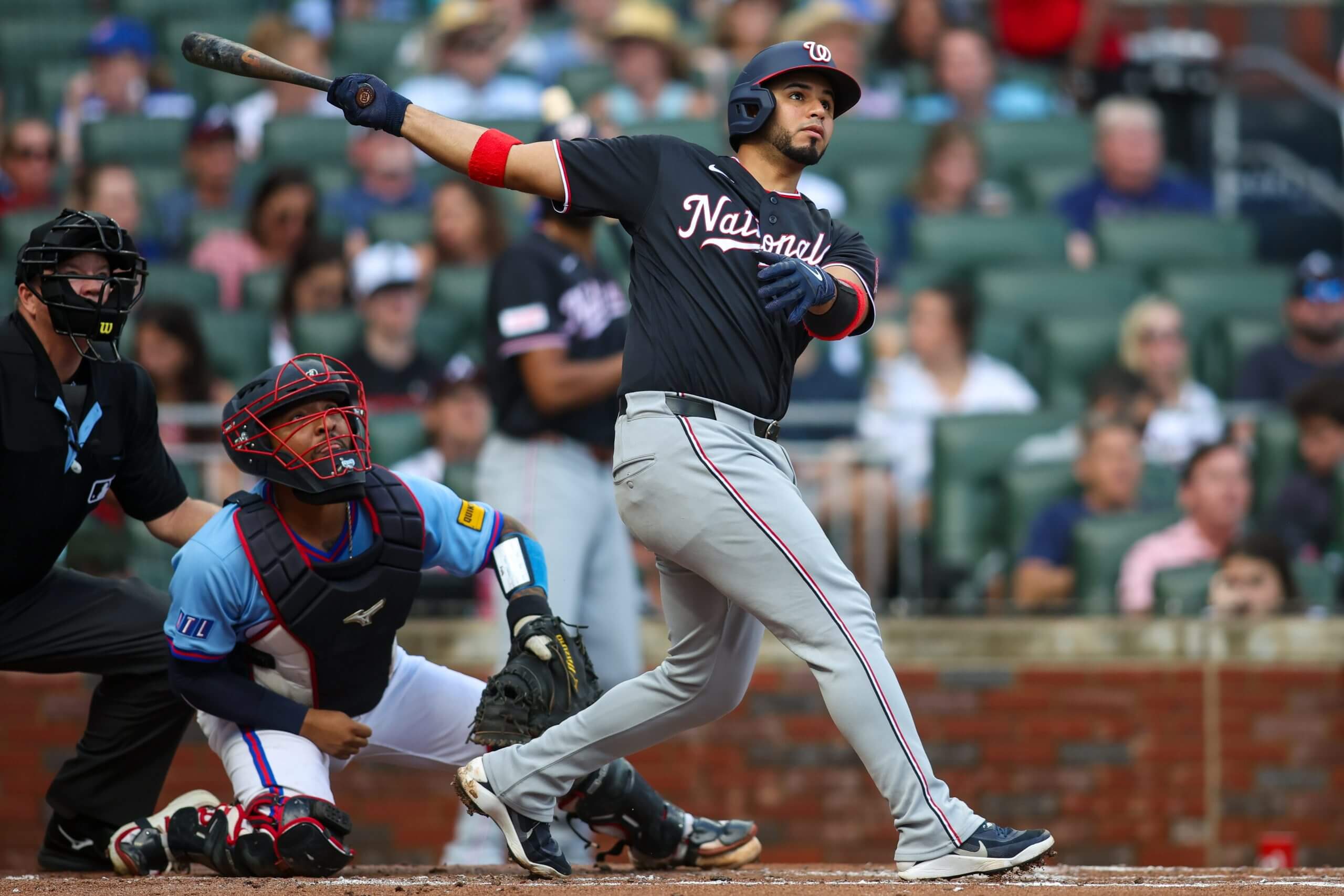
Entering Thursday, Keibert Ruiz had a 1.045 OPS for the month of May.
Take his preternatural bat-to-ball skills. On one hand, those abilities created the propensity to chase pitches outside of the zone. On the other, they led to opportunity.
In previous years, the team often discusssed Ruiz’s chase rate. The new coaches have continued to work with Ruiz on his swing decisions, but focused on a few factors that were easier for him to change.
Ruiz entered the season with one of MLB’s slowest bat speeds, which helped him make a lot of contact but restricted his ability to hit for power. He also possessed the ability to pull the ball in the air — an ever-important trait in the modern game, especially for players who do not possess exceptional power — but had gotten away from that in 2025.
Over the weeks that followed the meeting, the Nationals had him spend time in the cage generating more power from his backside and taking more swings before the game with the team’s new underweight and overweight bats, tools that have helped improve a number of their hitters’ bat speeds.
“Generally speaking, we’d be okay with super high-contact guys whiffing a little bit more, if it meant increasing their bat velo more,” manager Blake Butera said recently. “Obviously, we don’t want to increase the whiff a ton, but I think there’s like some runway there to maybe increase it a little bit for the guys that are really good with bat-to-ball skills.”
When Ruiz went up to the plate, he said, the Nats wanted him to think of two words: “Do damage.”
So how did this all work out?
Before the meeting, swing speed from the left side: 66.7 mph. After? 68.9 mph.
Before the meeting, percentage of batted ball events pulled in the air: 25 percent, or 70th in MLB. After? 58.3 percent, the highest rate in MLB.
Before the meeting, one extra-base every 11 at-bats. After? One extra-base hit every 4.1 at-bats.
This is what Toboni meant on Opening Day. Establish the right principles, deliver it with the right language and methods, and all tides will rise.
The many, many meetings
During a two-day stretch in early May, 25 players went through the same ordeal as Ruiz.
This season, the Nationals have started to implement “player plan” meetings, an individual gathering with every member of the roster every six weeks. First, they tell players how they’re being evaluated by the organization. Then, they talk through a plan to tweak their routines accordingly.
“You go on these different sites, FanGraphs, Baseball Savant, whatever it might be — you see all these different numbers and letters,” Butera said. “We wanted to show our players, since a lot of us are new in this organization, what we value. So it’s educating the players on what we care about, and then showing how they’re doing at those things that we care about.
“It’s really hard because you hear all the outside noise or you go on social media and you see this stat about a player, that stat about a player, and then I think players can … get confused. ‘Well, what should I be doing well, what should I be caring about?’”
The first round of meetings were held during spring training, with information that ranged from the type of swings they take to the nutritional habits they track.
This necessitated chairs for… Butera, Toboni, general manager Anirudh Kilambi, farm director Devin Pearson, bench coach Michael Johns, strength coach Brett Henry, head trainer Dale Gilbert, dietitian Logan Aitken and — depending on which player was in the room — some mix of hitting coach Matt Borgschulte, pitching coach Simon Mathews, field coordinator Tyler Smarslok, first base coach Corey Ray, third base coach Victor Estévez and catching coach Bobby Wilson.
“It’s a good check in,” reliever Brad Lord said. “Kind of just see where you’re at, look at the big picture every now and then. I like it.”
This is the first year that the Nationals have engaged in formal meetings like these. Ruiz is far from the only one to benefit.
Jacob Young (another beneficiary of bat speed and pulled fly balls) has as many homers over the past three weeks as he had across his first three seasons in the majors. Curtis Mead (a beneficiary of consistent playing time and consistent mechanics) arrived in Washington with a .617 OPS across three seasons; he has an .824 OPS this year. José Tena and Luis García Jr. (who also sold out for more bat speed) have seen their metrics improve.
The Nationals are also having Ruiz catch from a lower stance, which has helped him go from one of the worst receiving catchers in MLB to one of the best. The adjustment has also protected his head from foul balls after he suffered multiple concussions on foul tips last year.
“The one thing I know I can do is just work,” Ruiz said. “That’s it. That’s the only thing that I can control.”
The coaching staff will handle the rest.