
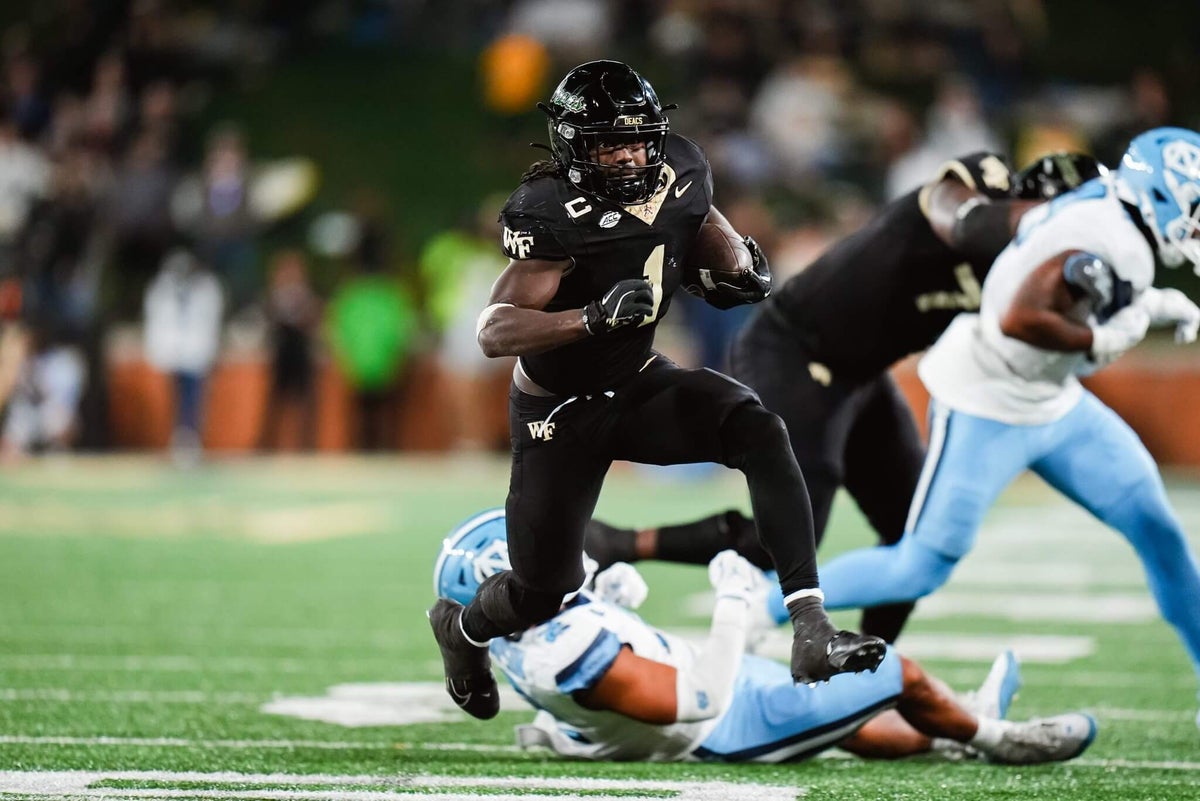
His signature move comes early in almost every run. The space shrinks. Tacklers lunge at him from all angles, speeds and directions. Demond Claiborne looks trapped. Then, in a flash, he snaps his body sideways with controlled violence. It’s the closest thing you’ll find to real-life teleportation.
Youth coaches struggled to describe Claiborne’s move. A hop-step didn’t do justice to the dynamism. Pilfering the “Cha Cha Slide” from DJ Casper felt sacrilegious. Nothing came to mind. So, instead, they came up with a nickname for Claiborne.
Every time he sprinkled his secret sauce, every time the sideline erupted in a frenzy, one coach would holler to another: “There he goes again. Lightning struck.”
“That’s what everyone called him growing up, ‘Lightning,’” Maurice Newbill, a real estate agent who began mentoring Claiborne in middle school, said. “Because when he touched it, it was always electric.”
Claiborne’s burst mesmerized the small rural town of Aylett, Va., northeast of Richmond. His agility captured the attention of college coaches. In the lead-up to the 2026 NFL Draft, this same horsepower captivated the Minnesota Vikings, who plotted when and where to select him.
The sixth-round pick now brings his electricity to Minnesota. His arrival highlights an example of nurturing that helps to explain how he crafted his signature in the first place.
They met inside a classroom at Hamilton-Holmes Middle School, well before Newbill knew anything about Claiborne’s football abilities. Claiborne walked in with a hoodie pulled tight over his head. Newbill could barely make out Claiborne’s eyes.
The school’s principal had designed this introduction as a different way for the school to reach kids who needed additional guidance. Some of the kids fell asleep in class. Others misbehaved. Many of them seemed distant or lost, navigating conflict at home that clouded their spirits.
Newbill, who had attended the school and had a similar experience growing up in Aylett, signed up to help.
“I saw a need,” Newbill said. “Some kids, when they’re at that stage of life, they need someone to be a big brother, a sounding board, somebody they could sit and talk to.”
Claiborne cherished his relationship with his mother, who crisscrossed town working multiple jobs to support him and his four brothers. He embraced his fatherly role in the household, cooking and washing dishes, but he lacked a male figure he could trust and confide in.
At first, Newbill’s attempts to build a bridge failed. Claiborne mumbled his responses to questions. He refrained from sharing his feelings, emotions and problems. Still, Newbill kept the faith. Twice a week, he returned to Hamilton-Holmes for additional sessions. Eventually, their shared love of football shattered Claiborne’s facade.
Newbill played defensive back at the University of Richmond, which caught Claiborne’s attention. The boy asked questions. He listened with wide eyes, his smile beginning to curl. Over time, stories of games and plays and stadiums segued into bigger conversations and weightier subjects.
They talked about Claiborne’s family dynamic and how he felt burdened by caring for his brothers. They discussed responses to classroom situations, such as speaking up for another student who had been bullied. Newbill tried to explain to Claiborne that his emotions — feeling frustrated, sad, insignificant — made sense.
“It was one of those things where I just had to give him time and space to be there for him,” Newbill said. “Some people at the school saw him as the kid with his hoodie pulled up, looking like he’s angry at the world. Then you peel back the layers and realize he’s just a young man trying to figure out his way, and what was on his plate, mentally and with his family, most adults couldn’t handle. He just needed time.”
Their relationship continued as Claiborne progressed to King William High School, where Newbill’s wife, Kami, was a guidance counselor. Claiborne stopped by her office almost daily. These touchpoints clued her in to his intense love of football.
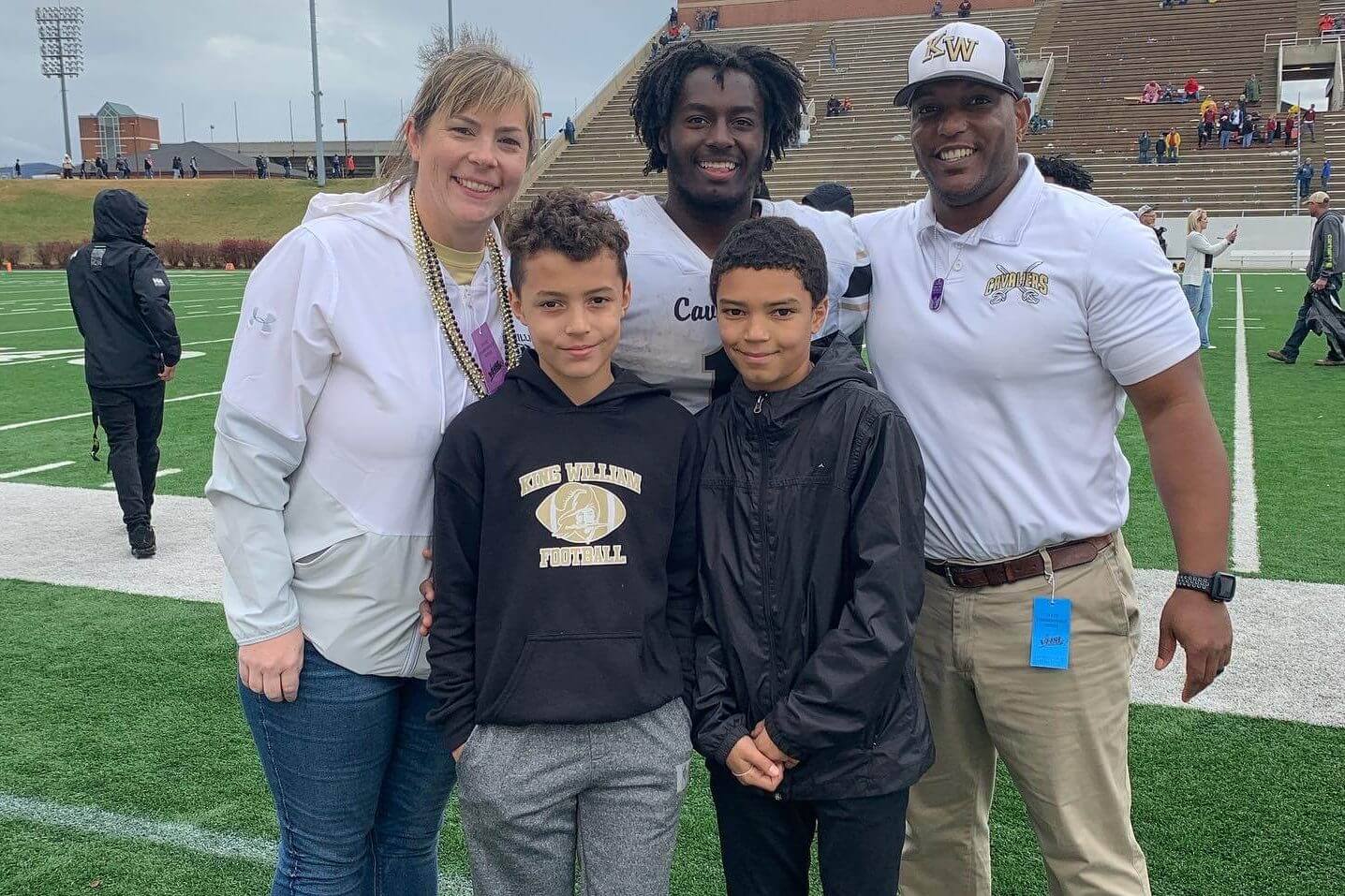
Claiborne, center, standing with the Newbill family. (Courtesy of Kami Newbill)
Claiborne lived near the school and ran sprints alone at night under the lights. He gathered teammates for offseason workouts. In games, he darted between defenders like a Formula One car, weaving in and out of pockets of space that didn’t appear available from afar.
“You could tell how much the game just brought him joy,” Kami Newbill said. “He wasn’t the most physical. Sure, he was speedy, but his talent was playing. My husband would always say, ‘He had an eye for it.’ Somehow, some way, he found openings.”
Coaches noticed. First, Central Michigan joined the party with an offer. Then, Wake Forest running backs coach John Hunter watched his tape and expressed interest. Then the floodgates opened. SEC coaches loaded his inbox. Former Penn State head coach James Franklin descended on one of Claiborne’s playoff games in a helicopter.
Some wanted Claiborne to chase the big time. Others suggested he select a smaller school, the type of place that would ensure he knew he was valued.
He chose Winston-Salem, N.C., for that reason. He played sparingly as a freshman but transitioned into a fundamental offensive piece who tallied more than 2,300 all-purpose yards and 23 touchdowns over his final two college seasons.
The Newbills attended a game during Claiborne’s sophomore season against Virginia Tech, and Lightning struck. Claiborne, back to return a kickoff, sent a pulse through the stadium, weaving his way past hopeful defenders. Kami recorded the touchdown from her seat high above the field. They still marvel at the video, at Claiborne’s foresight, his intuition.
“I almost think of him back there as an artist,” Maurice said. “Growing up, everything else went haywire. Football, he could control. It was the one place in his life where he could control the outcome based on his input. It allowed him to be free. It allowed him to be human.”
Before Claiborne flew to Minneapolis for rookie minicamp, King William High School hosted an event to celebrate his graduation to the NFL. Students stood in line to meet him. He signed autographs. His mother posed for pictures with him, and his brothers soaked in the praise for their sibling who had long looked after them.
At one point, family members skirted the line. Claiborne spotted them.
Rather than making a scene, Claiborne quietly asked his mother and Kami if they’d ask them to line up like everyone else. Claiborne’s calm validated all of the afternoon discussions in Kami’s office and all of the time her husband had put into trying to build a bond.
“Back in the day, he would have probably turned around to them and said what he had to say,” Kami said. “To see him now handle something like that and respect everyone else’s commitment, that was a big deal.”
In many ways, the Vikings bet on Claiborne’s continued growth arc as a person as much as anything else. Katie Bason, Wake Forest’s director of player personnel, said that the Vikings put more effort into their evaluation of Claiborne than any other team. Linebackers coach Mike Siravo attended Claiborne’s pro day. Running backs coach Curtis Modkins spent extensive time with him during his top-30 visit.
But the ties run even deeper than that. Sean Gustus, a national scout for the Vikings, played in college at Richmond alongside Maurice Newbill. Gustus knew about the Newbill connection. The team also employs former Wake Forest offensive lineman Michael Jurgens and former Wake Forest performance staffer Chad Bari. Each offered their perspectives on Claiborne’s potential.
A couple of draft trades paved the way for his selection with the 198th pick.
“This is awesome, man,” Claiborne said a few weeks ago. “I come from the middle of nowhere. Single mom. She has five boys, including me. I’m the first out of my county to do all of this. Being able to be an ear, the voice for my community and family, is amazing to me.”
His short-term NFL impact will hinge on his ability to master the system and his reliability in pass protection. In the long haul, the Vikings project a potentially game-breaking role.
Come training camp, videos of Claiborne side-stepping defenders will likely circulate. With every run and every one of his signature crossovers, he will be painting a meaningful portrait — the image of the hooded teen who developed into a man because the right people believed in him.