
It is a tiny component, in truth, a series of toothed metal cogs which connect to the chain on any bike’s back wheel.
So why does a dispute over the size of a rear sprocket — and the gear ratio that provides — have the potential to change the face of global sport regulation? Just like a bike, where that ratio has the potential to massively increase a rider’s speed, the rear sprocket has an outsized importance.
Over recent weeks, cycling’s governing body, the Union Cycliste Internationale (UCI) have been fighting in court against Chicago-based equipment manufacturer SRAM.
SRAM argued that the UCI’s decision to create a maximum gear ratio — ostensibly on safety grounds, although that is debated between cycling’s various stakeholders — hurts innovation, breaks competition law, and unfairly tilts the playing field. Last week, the Belgian Competition Authority (BCA) agreed with them.
The decision sets a precedent — that companies have a voice in establishing the regulations of sporting governing bodies, a judgement with implications far wider than cycling.
Potential areas that could now be affected include super shoes in athletics, club and ball design in golf, and engine manufacturing in motorsport — effectively, any sport in which equipment is regulated due to its central role in performance.
For some, this finally brings sport into line with international law. Others feel private companies should not wield the power to influence regulation. This is what unfolded in court — and, from the view of the debate’s central figures, why its result could be so important.
“The implication reaches well beyond cycling,” SRAM CEO Ken Lousberg tells The Athletic. “Any international sports federation that sets technical rules with commercial consequences for its stakeholders, including athletes, teams, and their suppliers, is now working with a clear benchmark from the courts in how they make those rules.”
What is a maximum gear ratio restriction, and why did the UCI propose it?
From the UCI’s perspective, this was a safety issue. Apologies in advance for the technical digression.
In summary, gear ratio refers to the relationship between the front sprocket (also known as a chainring, and attached to the pedals via the cranks) and the rear sprocket (attached to the back wheel, which the chain shifts around when changing gears).
This relationship governs speed. For going fast on the flat or downhill, riders will use a large front sprocket and a small rear sprocket, which makes pedalling harder, but which produces more distance per pedal stroke. This is known as a high gear ratio.
In contrast, for example, anyone going uphill will want a low gear ratio — small chainring and large rear sprocket — to make pedalling easier on steeper slopes.
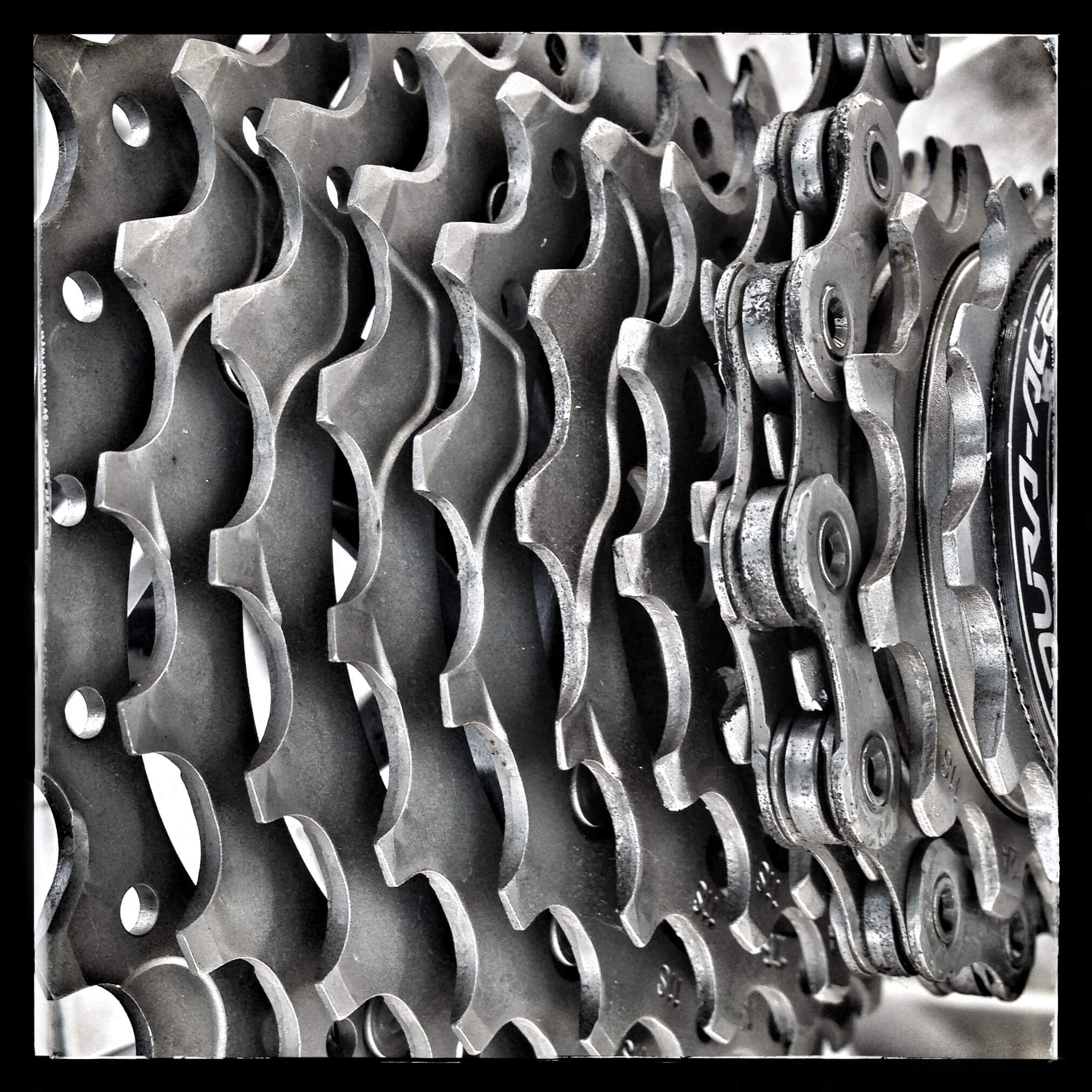
A rear sprocket on a road bike — modern machines have 12-speed systems (JOEL SAGET/AFP via Getty Images)
Searching for ways to improve cycling’s safety, the UCI and their safety advisory body (SafeR) felt that speeds were getting too high in the WorldTour peloton. Gear restrictions have been part of the sport for years — predominantly at younger levels, to encourage developing riders to cycle at a high cadence, rather than risk injury by pushing huge gears. The UCI decided to apply a similar concept to professional racing.
The governing body announced in June 2025 that they planned to impose a maximum gear ratio restriction across the peloton, beginning with a trial at the 2025 Tour of Guangxi. This capped bikes at a gear ratio of 54×11 (a 54-tooth front sprocket, and an 11-tooth rear sprocket). In practice, this amounts to a distance of 10.46 metres per revolution of the pedals on a 28mm tire.
“The maximum gear ratio limitation aims to limit the speed reached in competition,” the UCI said in their announcement. “It has been proven that the very high speeds reached by riders today are a risk factor for their safety.”
Some riders had advocated for a version of this rule. “It makes for an interesting debate among the riders, just like cycling is getting faster. Limiting the number of gears would make the sport a lot safer, in my opinion,” Visma-Lease a Bike’s Wout Van Aert said in January 2025.
“Other riders don’t think so. Yet I am convinced: if you are on that descent with a gear limit, no one can move up. Now the gears are so big that you still think about overtaking.”
But as Van Aert alluded to, this view was not unanimous. Dan Bigham, Red Bull’s head of engineering, led a presentation arguing that gear ratio limits would make cycling less safe, arguing that “restricting gear ratios simply distracts from making meaningful changes to rider safety… from my analysis, we need to presume professionals would adhere to unrealistic cadence limits that aren’t supported by the literature.”
Tom Pidcock was in agreement. “Limiting gears will only make everything more dangerous,” he said. “If we’re all going at the same top speed, we’ll be closer together, and on descents, that means we’ll take up more of the road.”
According to UCI data, later quoted in court, of 287 professional cyclists consulted, 56 per cent were in favour of imposing a gear ratio limit, while 44 per cent were against.
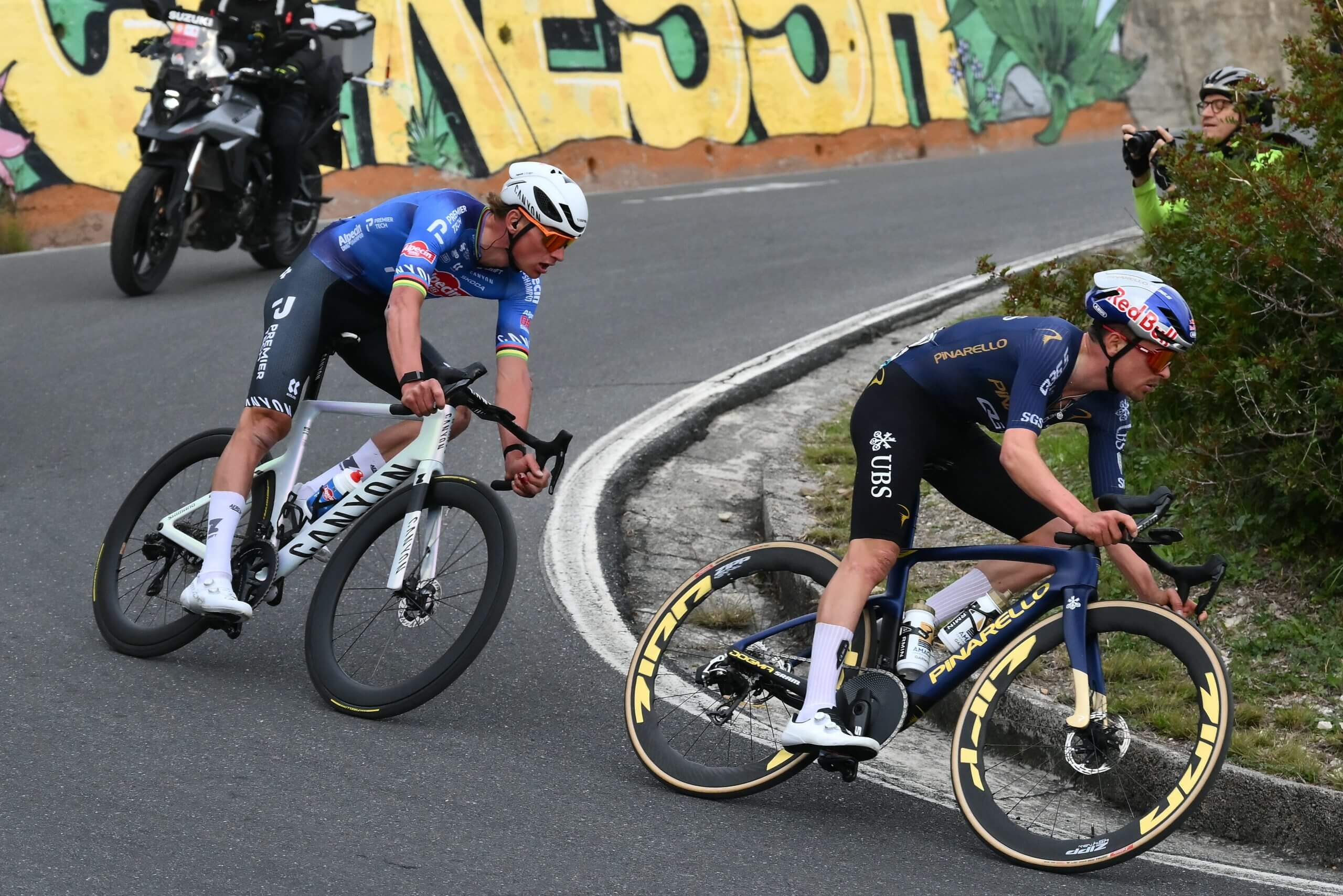
Tom Pidcock (on a SRAM-equipped bike) competing with Mathieu van der Poel (on Shimano) at the 2026 edition of Milan-Sanremo (Marco BERTORELLO / AFP via Getty Images)
How did this impact SRAM?
SRAM, alongside Japanese company Shimano, are one of the peloton’s major component manufacturers — particularly when it comes to drivetrains, which, in cycling, refers to the mechanical system that actually makes the bike move.
As of 2026, the American manufacturer has eight affiliated men’s WorldTour teams and five women’s — including Visma-Lease a Bike, Red Bull-BORA-hansgrohe, Lidl-Trek, EF Education-EasyPost, and Decathlon CMA CGM — just shy of longtime UCI sponsor Shimano, who have 10 men’s teams and four women’s teams.
After the UCI’s ruling, SRAM now faced a major issue. Their top rear sprocket had been, since 2019, manufactured with 10 teeth — which now sat outside the UCI’s restriction. In simple terms, for the Tour of Guangxi, and possibly going forward — it was illegal.
By contrast, their competitors, such as Shimano and Italian firm Campagnolo, operated with an 11-tooth rear sprocket as their smallest cog.
“From the moment we learned about it, we tried to engage,” says Lousberg. “Meetings with UCI staff. Letters from us, letters from the WFSGI to UCI leadership. Conversations with the team principals we work with. Some of them knew before we did, which was disappointing.
“Over the summer, we developed our own accident analysis from the 2025 Tour de France and offered the data to the UCI. The correspondence is all in the appeal record. There was no meaningful engagement on their side.”
SRAM swiftly realised the implications for their own business. They believed that the restriction placed their affiliated teams at a disadvantage, by forcing them back onto an older SRAM drivetrain system — while also having a huge detrimental impact on their own wider business, by effectively implying their sprockets were illegal.
“The cassette is machined from a single block of steel, and thousands of hours of testing went into getting it right,” explains Lousberg. “The protocol asked us to block access to it, to race with what amounts to an 11-speed drivetrain in a 12-speed sport, putting our athletes and teams at a disadvantage.
“It isn’t a level playing field if one supplier’s product is limited and the others are not. Regarding the chilling effect on innovation, think of it this way. If you’re an engineer, you need a predictable, data-driven rule-making environment. How do you design new systems with confidence if something proven safe in races for years can be deemed unsafe overnight, without real data?”
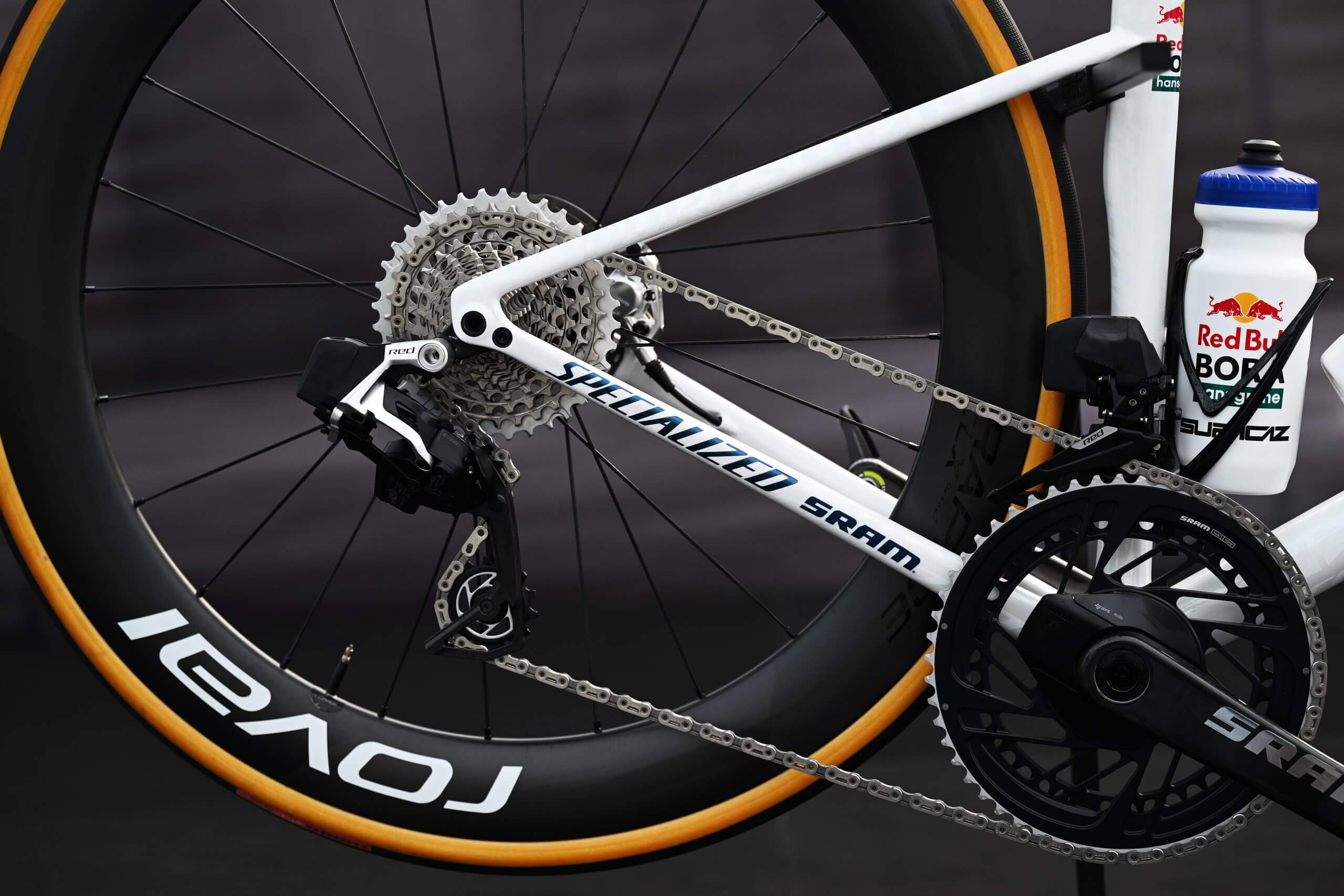
SRAM sponsor several WorldTour teams (Getty Images)
What unfolded in court?
Initially, SRAM complained to the Belgian competition regulator last September, with nine professional cycling teams intervening in proceedings on SRAM’s side.
One month later, the panel found in the manufacturer’s favour — ruling that there was a lack of evidence linking 10-tooth cogs with safety risks, that the UCI had to suspend their planned test, and that they could not impose gear ratio limits on 10-tooth cogs at any road cycling event. The ruling was limited to road cycling.
Later that year, the UCI subsequently announced their intent to appeal. As first reported by Cyclingnews in February, the governing body ringfenced €300,000 from the budget of SafeR, professional cycling’s safety advisory board, in order to fund the proceedings.
One team boss indicated their displeasure to The Athletic over the UCI for using SafeR funds for this purpose. They pointed out that the SafeR budget contained contributions from teams, almost half of whom were affiliated with SRAM, but who were not consulted over whether they agreed with the budget being used in this way.
They also asked whether the €300,000 could have been better served pursuing further safety improvements, rather than fighting a court case, pointing out the certainty of the initial judgement, which they felt rendered the appeal’s success unlikely.
That team boss was proved right. On May 20, midway through the Giro d’Italia, the BCA released their appeal verdict.
The initial decision had been upheld in full — with the appeal court concluding that the UCI had failed to consult SRAM and other manufacturers in advance of setting the gear ratio restriction, as well as never properly documenting why a 54×11 limit was chosen. They were ordered to pay over €2000 in court costs.
It was a major victory for SRAM — but in this case, unlike the first hearing, the appeal had implications outside cycling.
Interestingly, a key section of the decision relied on another high-profile sporting ruling from the European Court of Justice to justify their decision — a December 2023 decision which found FIFA and UEFA had broken competition law surrounding monopolies when ruling the proposed European Super League illegal.
The European Super League was a planned breakaway league made up of an initial 12 founding clubs, including the most high-profile teams in Europe, who sought to create their own competition to provide “higher quality matches and additional financial resources”. It eventually failed after widespread fan protests led to several clubs withdrawing.
The UCI had attempted to argue that, by acting purely as a sports regulator, they should sit outside European competition law frameworks. However, the Super League decision found that this was not the case when regulations had a material impact on the economic activities of those involved.
The appeal court appealed the same logic to the UCI — and taking it a step forward, by dictating that this principle also stood “regardless of a conflict of interest”. In layman’s terms, just because the UCI themselves were not going to be economically impacted, they still had to ensure that third-party manufacturers were not unfairly affected by any rulings.
What are the implications of that decision?
Still with us? The appeal court’s decision means that what started as a technical dispute over rear sprocket size has ballooned to impact global sport.
Most regulators do not have a direct financial interest in the sports they oversee — for example, the IOC does not make money from the manufacturers who provide equipment to Olympic sports.
Now, however, any regulation they pass which potentially outlaws equipment or technical innovation has to ensure that it complies with wider competition law — that no companies are unfairly affected by their decision.
The court effectively has given every governing body three rules:
The criteria behind any decision must be published in advance
Affected parties must be consulted
If any party is disproportionately affected, that must be objectively explained
This opens the door to a huge number of manufacturers in technical sports to retrospectively argue their cases — as well as potentially influence future regulation.
Athletics is one example — where numerous companies are rapidly developing their own lines of carbon-plated ‘super shoes’. World Athletics and the IOC, in turn, are attempting to keep up with development by overhauling the sport’s regulations in a bid to ensure the balance between human skill and technical innovation does not tilt in the latter’s balance.
But now, in theory, should a new rule hypothetically impact a Nike shoe more than Adidas’ version, or vice versa, the affected company could seek to overturn the regulation. Like SRAM, they could argue that restrictions impact their product lines — of which there will be thousands on the start line on any major city marathon.
Similar proceedings could unfold in sports such as swimming, whose own supersuit era was highly controversial in the late 2000s, as well as in motorsport, the most high-tech sport in the world. Golf, which is both highly regulated and which has an armada of manufacturers also selling to grassroots players, could also be heavily impacted.
It is likely to rapidly increase the power of the World Federation of the Sporting Goods Industry (WFSGI), the union dedicated to representing manufacturers’ interests, who are now effectively legislated into every regulatory discussion.
Before, manufacturers have never had the power to directly impact the laws of a governing body — the number of teeth on a rear sprocket has caused that to change.
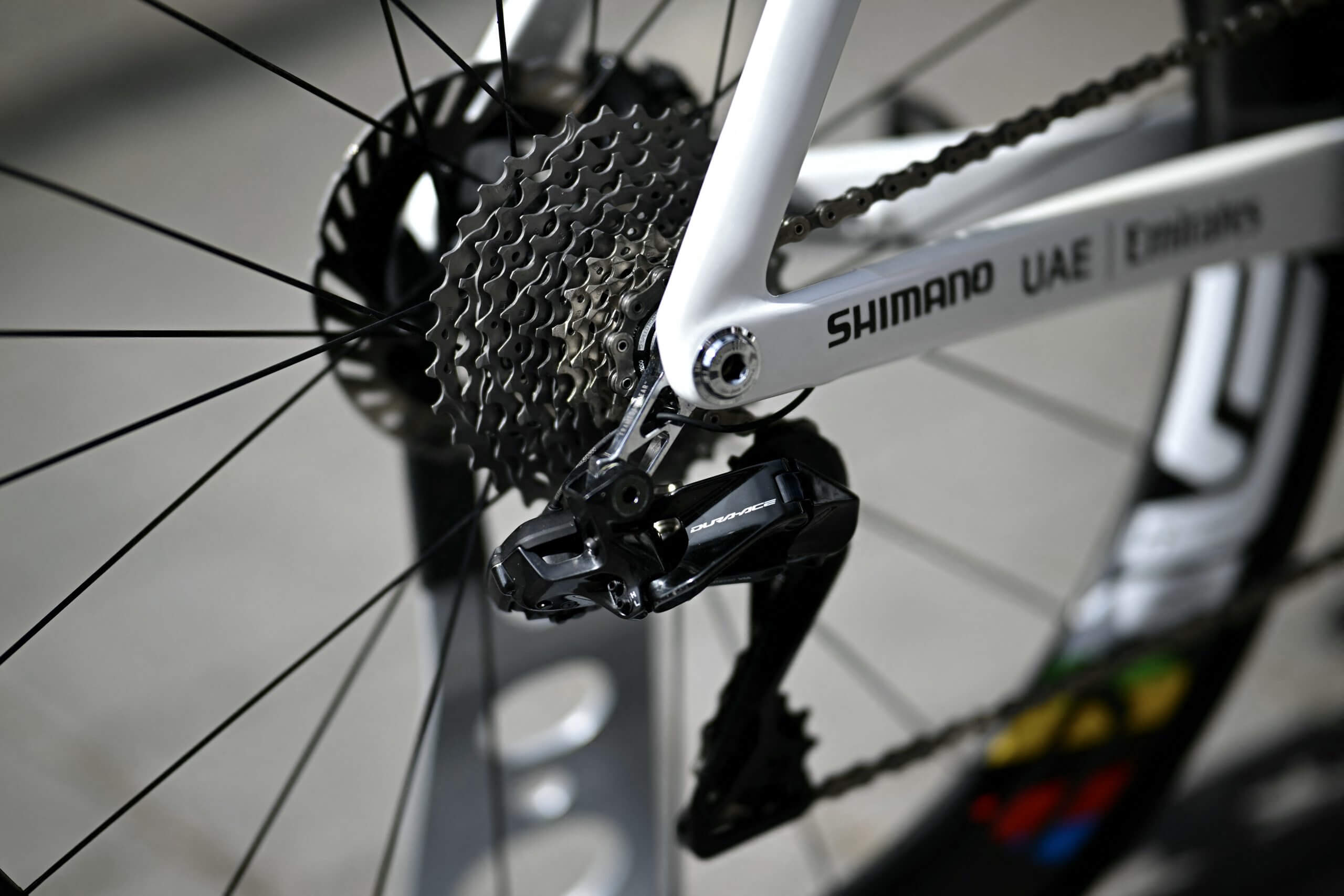
The rear sprocket now seems to have an outsized importance in sporting terms (Loic VENANCE / AFP via Getty Images)
What should the limits of companies’ influence on regulations be?
For many, a gut reaction might be to find the implications of the judgement concerning — in simple terms, it feels unnatural that a commercial agent (the equipment manufacturer) can influence a non-commercial regulator (the governing body), particularly when the regulator’s decision has been made on safety grounds.
From the other perspective, governing bodies are still empowered to control their own safety decisions — provided there is a fair consultation process, and that they can objectively justify the reasons behind their decision.
The team boss spoken to by The Athletic argued that having more stakeholders involved in safety decisions will improve cycling’s risk, rather than damage it — citing the UCI’s unilateral decision to limit handlebar widths last year, which was swiftly reversed after it disproportionately affected the women’s peloton.
“It’s a fair concern,” Lousberg admitted, when asked by The Athletic what the limits of the manufacturer-federation relationship should be, and what companies should not be able to influence.
“Sports governance shouldn’t be captured by any single set of interests, and that includes companies, teams, race organizers, and so on. We’re not asking for control. We’re asking to be part of the conversation, a seat at the table as a stakeholder represented by the WFSGI.
“We want to work with the UCI. We’ve wanted that throughout. The case happened because the work wasn’t possible inside the old framework. The question now is how a new framework lets us get there together.”
The UCI have not released any public statement since losing the appeal. The Athletic reached out to the UCI for comment, but they declined.