

Make better investment decisions with Simply Wall St’s easy, visual tools that give you a competitive edge.
Investors may be wondering whether Microsoft stock still offers good value at current levels, or if most of the potential upside is already reflected in the price.
The stock last closed at US$426.99, with returns of 1.9% over the past week, a small decline of 0.5% over the past month, a larger decline of 9.7% year to date, a decline of 6.2% over the past year, and gains of 31.4% and 81.1% over the past 3 and 5 years respectively.
Recent coverage has focused on how Microsoft fits into long term themes such as artificial intelligence, cloud adoption, and productivity software. This helps explain why the stock has stayed in focus even as short term returns have been mixed, and it also shapes how investors weigh growth expectations against the current share price.
On Simply Wall St’s valuation checklist, Microsoft scores a 6 out of 6. This sets up a closer look at how different methods value the stock and leads into a potentially more useful way to think about valuation at the end of this article.
Approach 1: Microsoft Discounted Cash Flow (DCF) Analysis
A Discounted Cash Flow, or DCF, model estimates what a stock could be worth by projecting future cash flows and discounting them back to today using a required rate of return. It focuses on the cash the company could generate for shareholders rather than reported earnings.
For Microsoft, the model uses a 2 Stage Free Cash Flow to Equity approach based on cash flow projections. The latest twelve month free cash flow is about US$93.7b. Analyst inputs and extrapolated estimates suggest projected free cash flow of US$181.1b in 2030, with a full set of annual projections feeding into the model out to 2035. Simply Wall St uses analyst estimates where available through 2029, then extrapolates further growth beyond that.
On this basis, the DCF model indicates an estimated intrinsic value of about US$569.80 per share. Compared with the recent share price of US$426.99, this implies the stock is trading at roughly a 25.1% discount to the modelled value. This suggests Microsoft stock appears undervalued under these assumptions.
Result: UNDERVALUED
Our Discounted Cash Flow (DCF) analysis suggests Microsoft is undervalued by 25.1%. Track this in your watchlist or portfolio, or discover 46 more high quality undervalued stocks.
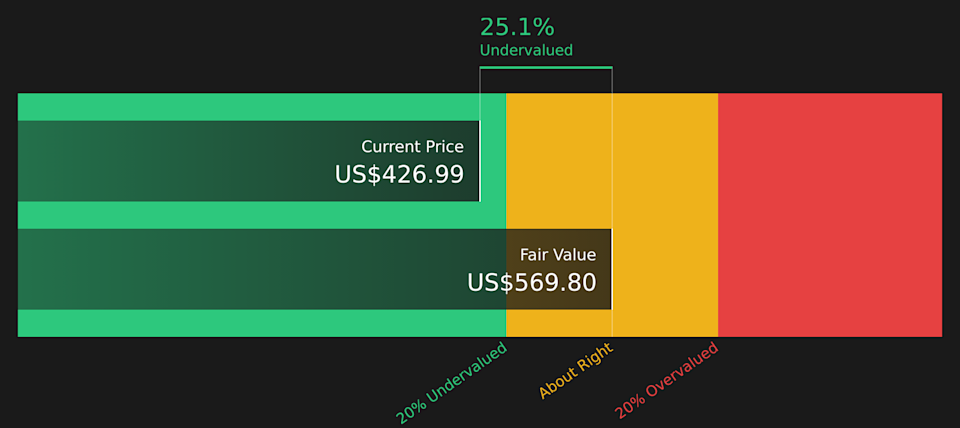 MSFT Discounted Cash Flow as at May 2026
Approach 2: Microsoft Price vs Earnings
For profitable companies, the P/E ratio is a useful way to think about value because it links what you pay for each share to the earnings that the company is currently generating. It also reflects what the market is willing to pay for those earnings given expectations about the future and the perceived risk of those earnings.
Higher growth expectations or lower perceived risk usually support a higher P/E, while slower expected growth or higher risk tend to justify a lower multiple. Microsoft currently trades on a P/E of 25.33x, compared with the broader Software industry average of 28.50x and a peer average of 31.50x, so the stock is priced below those benchmarks.
Simply Wall St’s Fair Ratio for Microsoft is 40.77x. This is a proprietary estimate of what the P/E might be given factors such as the company’s earnings growth profile, profit margins, industry, market cap and risk characteristics. That makes it more tailored than a simple comparison with peers or the industry, which treats very different companies as if they were the same. Since the Fair Ratio of 40.77x is higher than the current P/E of 25.33x, the multiple based approach suggests that Microsoft may be undervalued on these inputs.
Result: UNDERVALUED
 NasdaqGS:MSFT P/E Ratio as at May 2026
P/E ratios tell one story, but what if the real opportunity lies elsewhere? Start investing in legacies, not executives. Discover our 21 top founder-led companies.
Upgrade Your Decision Making: Choose your Microsoft Narrative
Earlier sections showed how DCFs and P/E ratios frame Microsoft’s value. Narratives go a step further by letting you attach a clear story, your assumptions about future revenue, earnings and margins, and a Fair Value estimate to the stock, then compare that directly with today’s US$426.99 share price so you can see whether your view suggests an opportunity or not.
A Narrative on Simply Wall St is essentially your Microsoft storyline written in numbers. It links what you think will happen to Azure, Copilot, gaming or AI infrastructure to a full forecast and valuation that updates automatically when new earnings, news, or analyst estimates arrive, so you are not working off stale data.
On the Community page, you can see Narratives that treat Microsoft as a durable cash flow compounder with a Fair Value around US$359.78 at one end of the spectrum, and others that lean on heavier AI driven growth with Fair Values above US$550 at the other end. This shows how different investors can look at the same company, plug in different growth, margin and discount rate assumptions, and reach very different conclusions about whether it looks expensive or cheap relative to the current price.
For Microsoft, however, we’ll make it really easy for you with previews of two leading Microsoft Narratives:
The first is a bullish, undervalued view that leans heavily on cash generation, balance sheet strength and the AI infrastructure build out. The second is a more cautious, higher priced path that still expects solid fundamentals but treats the current valuation as full.
Here is how those two Microsoft Narratives line up if you prefer to compare the numbers side by side.
Fair Value: US$466.00 per share
Implied discount vs current price: about 8.4% below this fair value
Revenue growth assumption: 9.8%
Focuses on Microsoft as a cash generator, highlighting high operating margins, substantial free cash flow and a net cash position supported by sizeable cash and short term investments.
Views recent heavy capital expenditure on data centers and AI infrastructure as a signal of strong cloud and AI demand, tied to Azure, Copilot and the OpenAI partnership.
Flags regulatory investigations and potential licensing changes as real risks, but frames them against a wide competitive moat built on switching costs, scale and integrated AI services.
Fair Value: US$333.48 per share
Implied premium vs current price: about 28.0% above this fair value
Revenue growth assumption: 9.5%
Sees Microsoft as a high quality business with meaningful AI and cloud opportunities, but argues that investors may be paying ahead of the cash flows that AI projects are expected to generate.
Builds a case around strong expected revenue and margin outcomes from Azure, Microsoft 365, Teams and LinkedIn, while assuming steady buybacks that lift earnings per share.
Highlights risks such as cloud competition, possible antitrust pressure, user experience concerns in core apps and the challenge of expanding profits from an already large earnings base.
Taken together, these Narratives show how two investors looking at the same Microsoft cash flows, AI exposure and regulatory backdrop can reasonably land on very different fair values. It is a useful reminder to anchor your own view of Microsoft on numbers, time horizon and risk tolerance, then use community Narratives as a cross check rather than a script.
Do you think there’s more to the story for Microsoft? Head over to our Community to see what others are saying!
NasdaqGS:MSFT 1-Year Stock Price Chart
This article by Simply Wall St is general in nature. We provide commentary based on historical data and analyst forecasts only using an unbiased methodology and our articles are not intended to be financial advice. It does not constitute a recommendation to buy or sell any stock, and does not take account of your objectives, or your financial situation. We aim to bring you long-term focused analysis driven by fundamental data. Note that our analysis may not factor in the latest price-sensitive company announcements or qualitative material. Simply Wall St has no position in any stocks mentioned.
Companies discussed in this article include MSFT.
Have feedback on this article? Concerned about the content? Get in touch with us directly. Alternatively, email editorial-team@simplywallst.com