
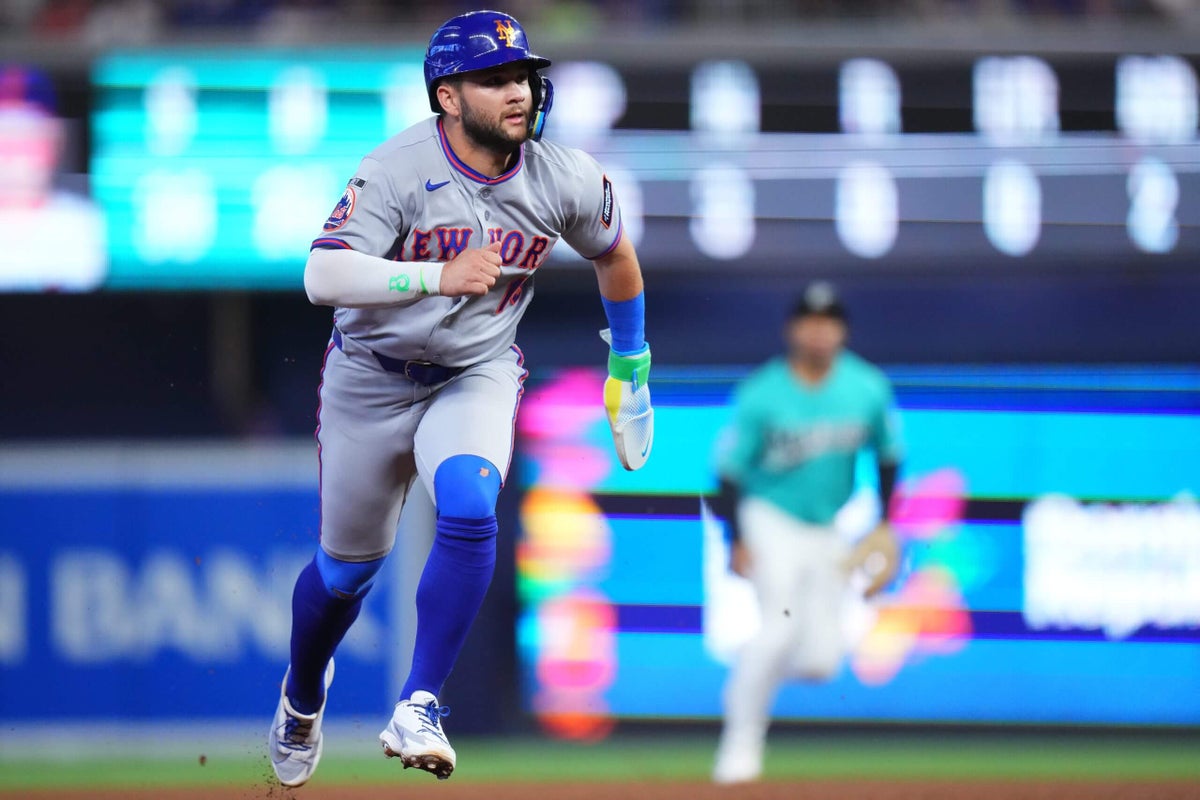
NEW YORK — The New York Mets on Wednesday were dangerously close to falling to a new low under president of baseball operations David Stearns.
They held on to a 4-2 win over the Cincinnati Reds to avoid dropping to 12 games below .500. The Reds stranded a season-high 17 runners. Since Stearns’ first season in 2024, the worst the Mets have ever been is 11 games under .500.
The Mets’ win also snapped a five-game losing streak. Earlier in the season, the Mets, now 23-33, lost 12 in a row. Multiple Mets veterans said the more recent skid was worse. That’s because New York had played much better for a stretch earlier in the month, but the poor play lately ruined all that work.
How’d the Mets, with their $355 million payroll, get here? Injuries have played a major role. But the Mets’ problems extend beyond such absences.
The Mets’ start to the 2026 season has revealed long-term concerns.
The Mets’ offseason strategy of emphasizing contact has backfired
New York ranks in the middle of the pack in contact rate. In most other offensive categories, however, they linger at the bottom.
The Mets may have the least powerful lineup in MLB. Their .350 slugging percentage ranks No. 30 among the 30 teams. Their .124 ISO is No. 29, better than only that of the Milwaukee Brewers, a small-market team averaging 4.89 runs per game compared with the Mets’ 3.82.
Juan Soto is responsible for 12 of the Mets’ 50 home runs. No one else in New York’s lineup has hit more than six. Only Mark Vientos and Bo Bichette have hit at least five.
“The biggest thing is our ability to drive the ball out of the ballpark,” manager Carlos Mendoza said this week about New York’s putrid offense. “It’s hard to score three or four (runs) on just singles. You’ve got to be able to drive the ball, and right now we’re having a hard time doing that.”
What the Mets lost in slugging by moving on from Pete Alonso and Brandon Nimmo, they hoped to make up for with better clutch hitting and contact, plus enough power in the aggregate of their lineup. So much for that.
To be fair, these two months may ultimately represent an aberration. Bichette is off to a brutal start, Francisco Lindor’s spring hamate injury may have affected his power even before his calf strain knocked him out for the last month, and Jorge Polanco has barely been on the field. The Mets’ starting lineup on Opening Day this season combined to hit 176 home runs last season. That same group is on pace for 97 long balls this year. The Mets shouldn’t be this bad at slugging all year.
As New York looks forward, however, what are reasonable power expectations for Lindor, Bichette and Polanco, and for Marcus Semien, whose home run totals have dropped from 29 to 23 to 15 to a pace for 12 this year? (Semien’s overall decline might push the Mets into deciding on his long-term playing time well before his contract expires after the 2028 season.) Carson Benge and A.J. Ewing are promising young players, but neither projects as a 30-homer hitter. Ryan Clifford would be the next man up in the minors from a power standpoint, but his on-base percentage is below .300 in Triple A and he’s striking out more than 35 percent of the time.
Development is stalling at the major-league level
Brett Baty, Francisco Alvarez and Vientos made their major-league debuts in the span of six weeks late in the 2022 season. Four years later, the Mets are still trying to figure out exactly what they have in each.
That’s been one of the main disappointments of this season. The length of the Mets’ lineup always depended on their young players. None of them are panning out on offense as hoped, even when given added opportunities.
Alvarez’s .710 OPS is the best of the bunch, but it hasn’t represented the step forward many expected after his strong second half in 2025. Further, a meniscus tear put him on the injured list and has limited him to 37 games. Injuries have disrupted each of Alvarez’s four seasons in the major leagues. Since 2024, his framing and blocking numbers have significantly regressed. After a demotion last season because of poor overall performance, Alvarez returned from the minor leagues as a better all-around catcher after working with J.P. Arencibia, who is now the Mets’ catching coach.
Baty has also failed to replicate his second-half numbers from last season. Over 187 plate appearances this season, he holds a .652 OPS and an 88 OPS-plus. Those figures represent the norm for Baty, 26. He became a top prospect soon after the Mets drafted him in the first round in 2019. Through 1,221 plate appearances in the majors, he has a .664 OPS and an 87 OPS-plus. Defensively, however, Baty has adapted well to multiple positions.
Vientos has failed to build off his breakout 2024 season, when he hit 27 home runs with an .837 OPS. Since then, he has played in 169 games (643 plate appearances) and has hit 23 home runs with a .684 OPS. Injuries forced Vientos into a larger role than the Mets penciled him in for at the start of the season. Instead of working as a bench bat to mostly hit against left-handed pitchers, Vientos occupies an everyday spot in the heart of the batting order.
Over the last few seasons, the Mets have become notably better at developing talent in their minor-league system. But for whatever reason, that process has stagnated in the bigs.
Stearns’ preferred reliance on short-term arrangements has proven unreliable
Let’s be clear: Every team prefers short-term arrangements. In Stearns’ three offseasons with the Mets, however, he has been stricter in drawing lines in the sand about long-term contracts than most organizations in big markets (as long as it’s not for a 25-year-old superstar on the open market). Soto’s glaring 15-year contract aside, Stearns has not signed any player to a deal longer than three years. His predecessor, Billy Eppler, signed five contracts longer than three years in just two winters with the Mets.
In general, Stearns’ strategy is a wise one. It limits long-term risk, it wields New York’s financial advantage in a different way, and it locks in a higher percentage of prime years for each player than long-term deals do.
Those deals haven’t worked out as well as the Mets had hoped. Mostly, that can be attributed to taking on injury risk. In the last two seasons, Frankie Montas, Jesse Winker, A.J. Minter and Polanco have missed significant time – not entirely unexpected given their injury histories.
Stearns has said the team will reassess how it factors in injury histories.
“We absolutely have to look at our risk assessment on injured players, or players who get injured once they’re here,” Stearns said earlier this month. “Certainly, we know we’re taking a level of risk when we bring players in with injury histories. We’re feeling that risk right now.”
More anecdotally, it’s worth wondering whether relying on short-term arrangements can work as well in New York as it would in a less pressurized environment. There is no shortage of examples of star players arriving in Queens only to struggle for several months or a full season before finding their stride as Mets.