

Listen to this article
Estimated 4 minutes
The audio version of this article is generated by AI-based technology. Mispronunciations can occur. We are working with our partners to continually review and improve the results.
Following a winter with a strong mountain snowpack and several spring snowstorms, early water supply forecasts are offering promising news for Alberta farmers, but one irrigation district says effective management remains crucial to meeting demand heading into the summer.
The Alberta government’s May Water Supply Outlook is forecasting “above normal to much above normal” river volumes for the North Saskatchewan, Red Deer and Bow River basins, and most parts of the Oldman River basin, through September.
Strong snowpack conditions in the Rocky Mountains are the main driver behind the higher river volumes, the outlook said. Ninety-two per cent of mountain sites surveyed had conditions above or well above normal, with 15 per cent of those having the highest snowpack conditions on record.
“It allows us to start irrigating in a normal fashion,” said Gerard Oosterhuis, a dryland and irrigation farmer near Bow Island, Alta.
“Everybody’s kind of treating it as normal and hoping that we get some moisture from above that will supplement.”
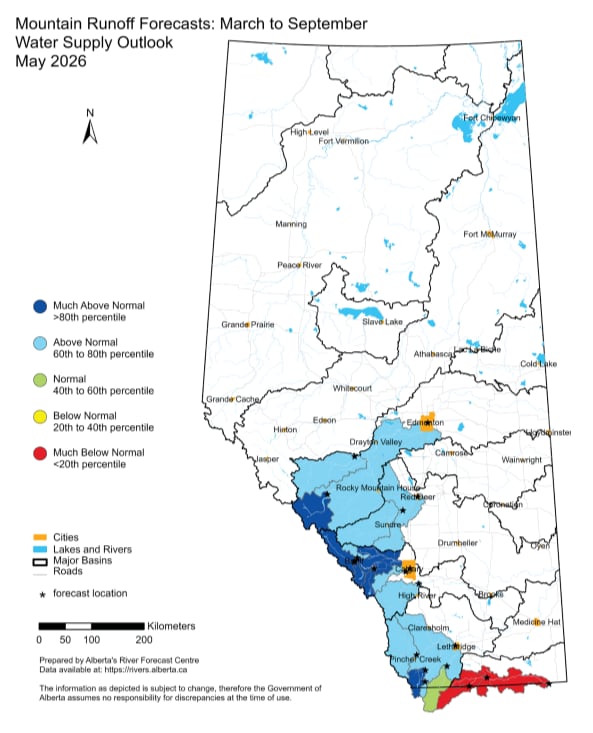 According to the outlook, 92 per cent of mountain sites surveyed in May had conditions above or well above normal, with 15 per cent of those having the highest snowpack conditions on record. (Government of Alberta)
Alberta has 11 irrigation districts that manage how water stored in reservoirs is allocated to irrigation farmers throughout the province.
Oosterhuis said last year his region, which is overseen by the St. Mary River Irrigation District, started at an allocation of 25.5 centimetres, which eventually became 30.5. This year, the initial allocation is 35.5 centimetres.
“I feel very, very optimistic now,” he said.
Reservoirs off to a good start, too
Reservoirs in the areas predicted to have higher river flows are starting in an “excellent” position, with most being nearly or completely full, said Richard Phillips, chair of the Alberta Irrigation Districts Association.
The group represents the organized irrigation districts in Alberta, accounting for roughly 80 per cent of all irrigation in the province, Phillips said. The remaining 20 per cent is managed under private irrigation licences.
Although the southern areas of the province, such as those around the Oldman River basin, had less snowpack than areas up north, Phillips said reservoirs in that region are still in good shape, in part because of the rain the area received later in the winter than usual.
 Richard Phillips is the chair of the Alberta Irrigation Districts Association. He says even if the summer is dry, provincial irrigation districts are in ‘good shape’ to have enough water throughout the summer. (Monty Kruger/CBC)
“Although the snowpack wasn’t as good there, the water came and the water’s been captured in those on-stream reservoirs,” he said.
It is important to have the reservoirs filled in May or June, Phillips said, so they are ready for peak demand season in July, when farmers most need water for their crops.
“With a little bit of rain, we’ll have a great year,” he said. “If it ends up being really dry here, we’re still going to have a good year based on the good start to the season we’ve got here with water supply.”
There is one exception.
The Milk River basin is forecasted to see volumes below normal, as snow-melt entered the basin’s rivers earlier than usual or was absorbed into dry soil, according to the outlook.
There is also an irrigation shutdown in the area for now due to the Canada-U.S. Boundary Waters Treaty, which governs water sharing for the basin between the two countries.
Cautiously optimistic
Even though the summer outlook is generally positive, one district irrigator isn’t getting too excited yet.
Chris Gallagher, the general manager of the Lethbridge Northern Irrigation District, said the district is taking a “hoping for the best, preparing for the worst” approach to the season, despite the high water levels in its primary reservoir.
The district consists of nearly 81,000 irrigation hectares of land on the north side of the Oldman River between Fort Macleod and Turin. It gets its water from the Oldman River Dam, Gallagher said.
Right now, he said, the dam is approximately 97 per cent full.
“This is all preliminary and we’re talking about a May water supply measurement, but a lot can happen through the season,” Gallagher said.
The district is taking lessons from 2023 and 2024, he said, when a lack of rain contributed to severe drought and a high demand for water.
“We’re all in a good situation this year, but we’re just keeping that conservation mindset,” he said.