
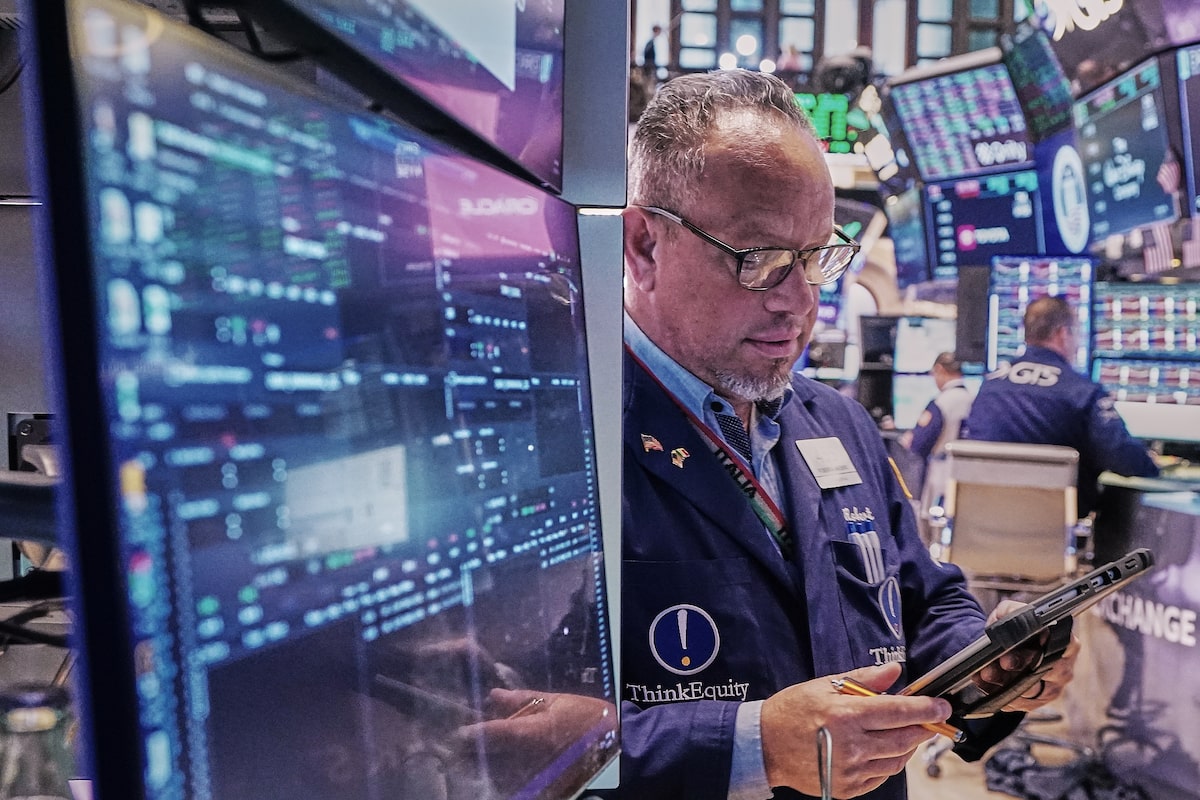
Canada’s main stock index fell on Monday, bogged down by losses in heavyweight financials and mining stocks, as signs of escalation in the Middle East conflict hit risk appetite and sent oil prices surging.
At 11:03 a.m. ET, the Toronto Stock Exchange’s S&P/TSX Composite Index was down 233.88 points, or 0.67 per cent, at 34,535.26, down about 0.5 per cent from its all-time high seen last week.
Materials dropped 3.4 per cent, with gold miners including IAMGOLD and Equinox Gold leading losses as bullion prices dropped more than 1 per cent.
Financials shed 0.3 per cent; Canadian Imperial Bank of Commerce fell 1.9 per cent after Scotiabank downgraded its rating to “sector perform” from “sector outperform.”
Information technology jumped 2.8 per cent, with software-related firm Coveo leading gains, in line with a rally of software stocks on Wall Street.
Energy climbed 3 per cent, as crude oil prices jumped after Iran and the U.S. traded strikes and Israel ordered troops to move further into Lebanon in its battle with the Tehran-backed Hezbollah militant group.
Risk sentiment remained shaky as Iran’s Tasnim news agency said Tehran’s negotiating team is stopping exchanges of messages with the U.S. through mediators due to the attacks on Lebanon.
“Markets had been trading on optimism that an agreement would be reached by the end of last week,” John Canavan, lead analyst at Oxford Economics, said in a note.
The benchmark TSX clocked a second straight monthly gain in May, with the index hovering near its all-time highs despite Monday’s losses.
Meanwhile, data showed Canada’s manufacturing sector expanded for a second straight month in May as the potential for higher prices and product shortages due to the Middle East war likely boosted client demand.
Oil prices are rising Monday following the latest fighting to threaten the U.S.-Iran ceasefire, but Wall Street isn’t very worried, and U.S. stocks are hanging near their records .
The S&P 500 was virtually unchanged from its all-time high set on Friday. The Dow Jones Industrial Average was down 102 points, or 0.2 per cent, and the Nasdaq composite was flat. Both are also coming off records.
Some of the sharpest losses hit companies with big fuel bills hurt by the rise in oil prices. United Airlines lost 2.9 per cent, and cruise-operator Carnival fell 2.7 per cent after the price for a barrel of Brent crude oil climbed 6.7 per cent to US$97.22. That clawed back a chunk of its loss from last week and means it’s still well above its price of roughly US$70 from before the war.
Expensive oil has already sent inflation around the world higher, which not only increases bills for households but also pushes up bond yields. High yields worldwide recently have threatened to slow economies and undercut prices for stocks and all kinds of other investments.
Some of the hardest hit by high interest rates are smaller companies, which have a tougher time borrowing to grow when loans are more expensive to repay. The Russell 2000 index of the smallest U.S. stocks sank 1 per cent, much more than the rest of the market.
But hope seems to be remaining on Wall Street that the United States and Iran will ultimately reach an agreement to reopen the Strait of Hormuz, allow deliveries of oil to resume from the Persian Gulf and ease the upward pressure on inflation.
Strength from several market heavyweights also helped to overshadow such fears.
Nvidia was the strongest force pushing upward the market and rose 4.8 per cent after CEO Jensen Huang announced several product updates at a conference. Among them, he said the company’s next- generation artificial-intelligence platform, Vera Rubin, is ramping into full production. That helped calm some investor concerns about potential delays, analysts said.
What Nvidia does matters immensely for the U.S. stock market because it’s the biggest in terms of overall market value. That means the movements for its stock carry more weight on the S&P 500 than any other’s.
And Wall Street’s biggest companies have been growing so much that they’re dominating the market. The top 10 stocks control nearly half the S&P 500’s total market value, a 40-year high, according to Thomas Carroll, equity market strategist at Stifel.
That worked well as those Big Tech companies shot higher thanks to exuberance around AI. But it could also weigh on the index if the market’s leadership broadens, Carroll warns. Even if most stocks end up rising in such a rotation, stagnation or declines for Big Tech heavyweights could drag on S&P 500 index funds.
And a key indicator Carroll follows about market breadth “is signaling a rotation is coming,” he wrote in a report.
Elsewhere on Wall Street, Science Applications International Corp. jumped 12.8 per cent after becoming the latest U.S. company to report bigger profit for the latest quarter than analysts expected. SAIC also raised forecasts for upcoming financial results after winning several contracts from the U.S. Department of Homeland Security, army and other agencies.
A cavalcade of such profit reports has helped the U.S. stock market push to records despite the war with Iran.
Berkshire Hathaway slipped 0.4 per cent after it said it would buy Taylor Morrison Home for US$6.8 billion. It’s one of the first big acquisitions announced by the company under Greg Abel’s leadership following famed investor Warren Buffett. Taylor Morrison Home jumped 22.5 per cent.
In the bond market, Treasury yields rose with oil prices and after a report said growth in U.S. manufacturing accelerated by more last month than economists expected. The yield for the 10-year Treasury climbed to 4.50 per cent from 4.45 per cent late Friday.
High yields have already forced the average long-term U.S. mortgage rate to its most expensive level in nine months , and they could curtail companies’ borrowing to build the AI data centers that have supported the U.S. economy’s growth recently.
In stock markets abroad, indexes fell in Europe following a stronger finish in Asia.
Japan’s Nikkei 225 rose 0.9 per cent, and South Korea’s Kospi jumped 3.7 per cent to hit records led by technology-related stocks, as investors continued to see growth in AI and other advanced technologies.
In South Korea, the Kospi index jumped 3.7 per cent to a record. Samsung Electronics, its biggest company, soared 10.1 per cent. Official data on Monday showed that South Korea’s exports surged 53 per cent year-on-year in May, buoyed by global demand for semiconductors.
Reuters and The Associated Press