
Quebec not only needs to overhaul its method of maintaining roads, but also needs a contingency fund to preserve the network, a new group composed of industry players and experts said Tuesday.
The Coalition for Better Roads in Quebec — which includes the Association des constructeurs de routes et grands travaux du Québec (ACRGTQ), the Conseil du patronat du Québec, CAA-Quebec, several construction companies and a construction engineering academic — is making its appeal ahead of the October election.
The coalition says 50 per cent of Quebec’s roads are in poor condition and the road infrastructure maintenance deficit is nearing $30 billion. It is calling on the next provincial government to adopt “more sustainable, innovative and cost-effective interventions for taxpayers.”
“What we want to bring to the table, different from the other groups that have emerged so far, is to have a strong coalition to bring together diverse expertise and experts to answer the questions. The timing is right,” ACRGTQ director general Caroline Amireault told reporters gathered in downtown Montreal.
“We’re also in a period of our societal life in Quebec where our infrastructure is aging,” she said. “It was built in the ’50s, ’60s and ’70s. And now, as a society, we’re faced with a stock of road, hospital and school infrastructure, some of which is reaching the end of its lifespan.”
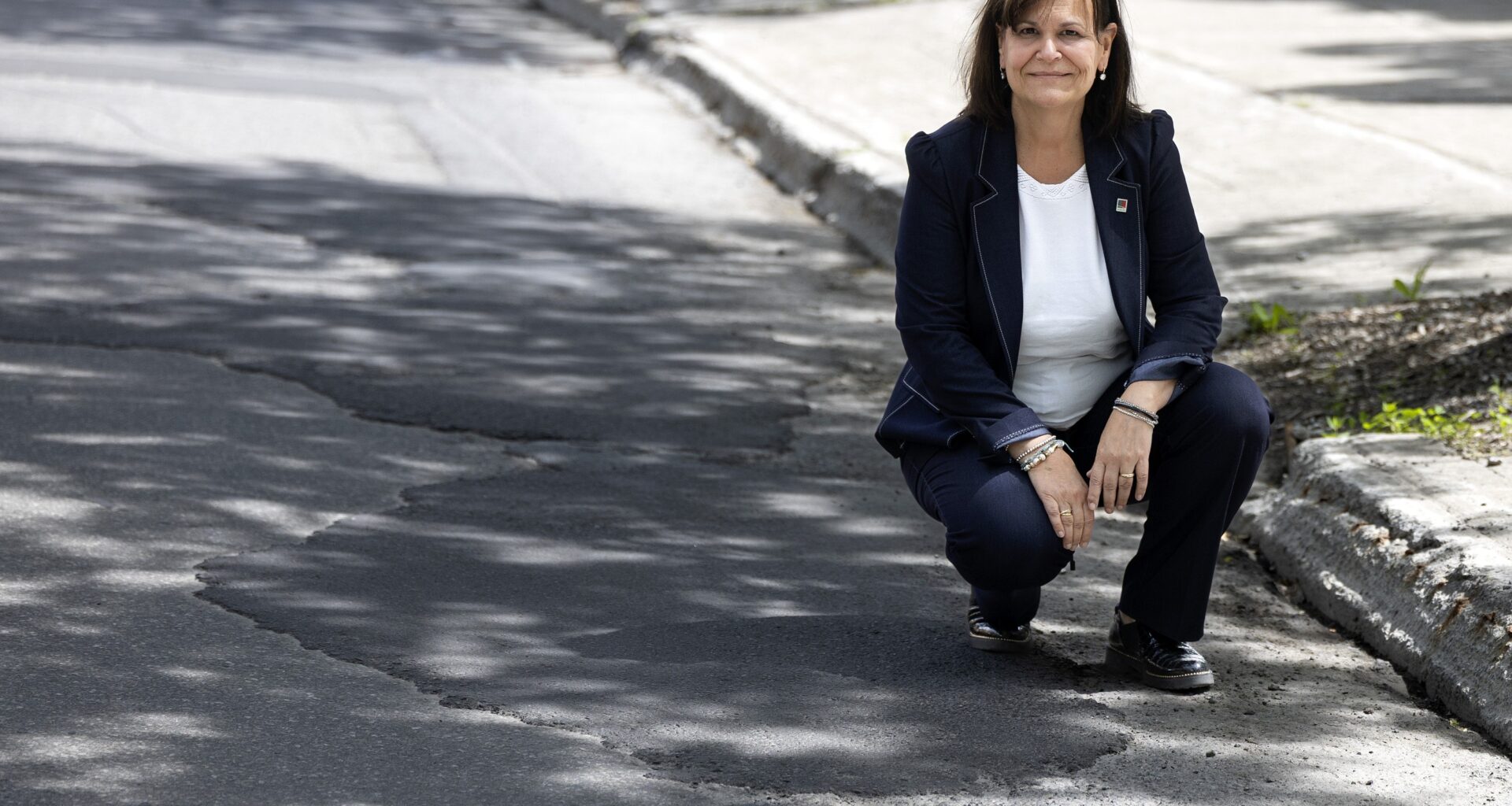
 Caroline Amireault, director general of the Association des constructeurs de routes et grands travaux du Québec, next to a series of pothole repair patches done over time on Viger St. in Montreal, on Tuesday, June 2, 2026. Allen McInnis / Montreal Gazette
The government must “adopt a new model and intervene earlier” to prevent roads from degrading “to the point where costly major reconstruction” is needed, the coalition said.
The group put forth five recommendations:
Protect preventive maintenance budgets and create a contingency fund for preserving the road network.
Speed up the adoption of innovative technologies and materials.
Increase the recycling of road construction materials.
Make road infrastructure standards and practices uniform across the province.
Strengthen knowledge transfers between government, industry and universities.
Marc Joncas, president of construction company Eurovia Québec, stressed the coalition “didn’t want to be there just as contractors who want more money, who want businesses to work more.”
“We’re really a little … not hopeless, but angry about the current situation,” he told The Gazette. “People say the roads are in bad condition, contractors aren’t doing good work and all that, when we’re more about responding to customer demand.”
The Quebec government “asks us to carry out roadwork using pre-established methods,” Joncas said, but he believes “we can do better.”
“We can’t innovate,” he said of the current structures in place. “We really have to follow the specifications. We think that hinders innovation.”
Asked which of the recommendations should be prioritized, Joncas pointed to budgeting for the road network and creating a contingency fund, saying that “regardless of which political party comes to power, I think it has to be separate from politics.”
“It’s not that the Ministry of Transport isn’t doing things right. There is a clear lack of budget in certain areas with everything that needs to be done in Quebec,” he said.
Éric Lachance-Tremblay, professor of construction engineering at École de technologie supérieure, also emphasized the importance of having a reserve fund for emergencies, saying the province needs to manage money like a family does for rainy days.
“I will put some money aside so when my car needs to be repaired, I have the money ready,” he said. “It’s the same thing with roads. This money needs to be put aside and protected.”
The coalition is looking at the issue by combining different points of view, he added, saying that “if we don’t talk to each other, I might be developing the best material in my lab, but it might not be feasible in the field.”
Lachance-Tremblay also pointed to his colleagues in Brazil, Italy and France, where there is “more emphasis on diagnosis” when it comes to fixing roads.
“We don’t do enough of that in Quebec,” he said.
“When you go to a doctor with a medical problem, he talks to you. He does some tests and then he decides what’s the best treatment for your problem. We should do this with our roads more.”
Noting recent emergency work, Joncas warned “this isn’t going to stop in the coming years” as Quebec’s infrastructure continues to age.
“The status quo isn’t a solution,” he said. “We have to work differently.”
Asked about the recommendations, the office of Quebec Transport Minister Benoit Charette said in a statement that “our government has invested enormous sums over the past eight years.”
“Under the Coalition (Avenir Québec) government, planned investments in road maintenance have almost doubled, rising from $16.3 billion in 2018 to $31.6 billion in 2026. We are continuing to catch up. That is why, over the next 10 years, 88 per cent of the Quebec Infrastructure Plan’s funding for the road network will be allocated to its maintenance,” the statement reads.
The office also noted Premier Christine Fréchette has tasked Infrastructure Minister Eric Girard with presenting a maintenance policy, saying the government is “committed to catching up on the backlog in maintaining our infrastructure.”
Editor’s Picks