
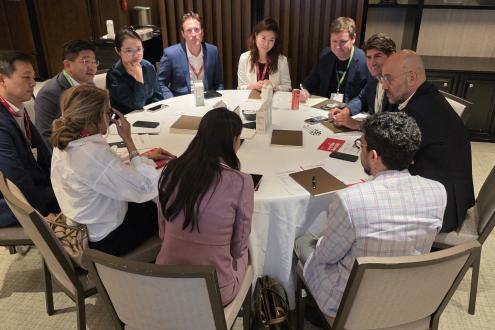
At WealthTHINK Singapore 2026, an interactive discussion hosted by Damien Piper, Executive Director – Growth at Unique AI, and Manuel Grenacher, CEO of Unique AI, examined how artificial intelligence is moving from isolated experimentation into practical deployment across wealth management.
Bringing together participants from private banks, external asset managers, wealth platforms and advisory firms, the session explored how AI is already changing everyday work, from content production and investment research to KYC, AML, source-of-wealth review and internal policy analysis.
The discussion did not treat AI as a distant innovation theme. Participants were already using tools such as Claude, Copilot, Otter and Replit, and several described live use cases that have moved beyond summarisation into workflow execution. The central question was, therefore, less whether AI matters, and more how wealth firms can deploy it safely, explainably, and at scale.
AI usage has moved beyond novelty: Participants described AI as part of daily work, with Claude widely used for document analysis, report creation and structured output.
Office work is being redesigned: Presentations, microsites, emails and research outputs can increasingly be created and iterated through prompting rather than traditional software workflows.
KYC and AML are among the most advanced use cases: AI can gather, compare, summarise and monitor client information, but governance and auditability remain critical.
Human oversight remains essential: AI can identify issues faster, but humans remain responsible for judgement, accountability and regulatory explanation.
Data protection shapes deployment choices: Public tools may be inadequate for client-sensitive workflows, pushing banks towards private, single-tenant, on-premise or controlled enterprise environments.
The next phase is agentic execution: The most valuable use cases are no longer only about insight generation, but about AI completing defined tasks within approved workflows.
Setting the Scene: From AI Enthusiasm to Operational Reality
The session opened with a practical indicator of how quickly AI habits have changed. When participants were asked to name their preferred tools, Claude featured prominently, while ChatGPT appeared far less dominant than it might have only a year earlier. Copilot remained relevant because of its integration into Microsoft environments, but several participants suggested that its role may become less central as AI-native workflows develop.
The point was not a beauty contest between models. It was a signal that wealth professionals are already becoming more selective. They are comparing structure, memory, document handling, output quality, hallucination risk and the ability to work across projects. One participant said they had moved away from ChatGPT because of drift and weaker report production when working from a set of documents.
Another observed that the shift towards Claude reflected a broader move from simple prompting to project-based work. Used well, AI tools are no longer just answering questions. They are remembering context, shaping recurring outputs and supporting repeatable workflows.
Office Work Is Being Rewired
One of the strongest themes was the speed at which AI is changing the mechanics of office work. Participants described using AI to generate presentations, marketing materials, microsites and client-facing content with far less reliance on traditional manual processes.
In one example, a participant described building an ‘About Hubbis’ page by feeding in positioning, brand material and images, then asking the model to turn the output into a live microsite and later a PowerPoint presentation. The workflow still required human review and clean-up, but the first draft could be created in a fraction of the time previously required.
That prompted a wider discussion about whether Microsoft Office tools are becoming less central to the production process. As one participant put it, users may increasingly create and refine content by prompting, rather than opening PowerPoint or Word first.
“Office work is changing,” one participant said, noting that the tools used to produce content may matter less than the AI layer that assembles, edits and iterates the output.
AI as a Virtual Employee, Not Just a Search Tool
The table then moved from basic productivity into more substantive workflow execution. Participants agreed that many firms are already using AI for information retrieval, summarisation and drafting. The more important question is whether they are using it to do work that would otherwise be delegated to an employee.
One participant described building an AI agent for AML and KYC review. The process involved loading client documents into a closed environment, instructing the agent to gather relevant information, and generating a detailed report. The participant then compared the in-house AI-generated report with a third-party report purchased externally and found the AI-assisted version materially stronger.
The use case then extended into ongoing monitoring. The same agent could scan the web daily, identify new adverse news or relevant updates, produce a report at a set time, and archive links as PDFs so that evidence remained available even if web pages later disappeared.
“That is a real, live use case,” one participant said. “It is work you would typically get somebody to do, and you do not need them to do it in the same way.”
KYC, Source of Wealth and the Compliance Opportunity
KYC and source-of-wealth review emerged as some of the clearest areas for AI application. Participants described tools that can compare relationship manager input against external information, identify discrepancies, read financial statements, and flag issues that might otherwise pass through manual review.
One example involved a client stating a level of income that did not align with available industry benchmarks or company financials. Another involved the need to identify US nexus, such as a green card, where the client or relationship manager may not fully appreciate the compliance implications. In those cases, AI can help surface inconsistencies earlier and prompt further investigation.
Several participants stressed that this does not remove the RM or compliance function. Rather, it changes their role. AI can accelerate the gathering, comparison and initial analysis of information, while humans remain responsible for review, judgement and sign-off.
For private wealth firms facing rising documentation standards and regulatory scrutiny, the productivity gain could be significant. The question is how to capture that gain without creating new risks around accuracy, reliance or accountability.
The Governance Problem Has Not Been Solved
The discussion was clear that the hardest AI issues in wealth management are not purely technical. They are regulatory, evidential and operational.
One concern was explainability. Firms cannot simply tell regulators that a KYC file or source-of-wealth assessment was produced by AI. They need to show how the information was collected, which sources were used, what was excluded, and why the final judgement was reasonable.
Another concern was source reliability. AI can gather large amounts of information, but not all information is relevant, accurate or appropriate for a regulated file. Participants noted that AI may treat weak associations as meaningful or include details that add noise rather than context. For example, whether a client once met a politically sensitive figure may or may not be relevant depending on the nature of the relationship, the business context and the risk framework.
That creates a practical challenge. If AI gathers more information than a human would have found manually, the firm may now be deemed to know more. If something relevant appears in the collected material but is not reflected in the final write-up, the bank may need to explain why.
“In the end, the human is responsible,” one participant said. The AI can support the process, but the accountable person still needs to understand and defend the conclusion.
Controlled Infrastructure Is Becoming Essential
Data protection and deployment architecture were also major themes. Participants distinguished between casual use of public tools and regulated use of AI within controlled environments. The latter is essential when client data, confidential documents or personally identifiable information are involved.
Several participants discussed enterprise or private deployments, where data remains within the institution’s environment while the AI system can retrieve approved external information. Unique AI described its model as using frontier and open-source models within industry-specific infrastructure, allowing banks to deploy AI in single-tenant, private cloud or on-premise environments depending on client requirements.
The issue is not only security. It is also control. Wealth firms need to manage model choice, data access, workflow integration, audit trails and vendor risk. As one participant noted, model preference can change quickly: one year firms may favour ChatGPT, the next Claude, and later another model. If a bank builds all integrations directly around one provider, switching becomes difficult.
That is why platform thinking matters. For larger institutions, the strategic question is not simply which model is best today. It is how to build an AI architecture that can evolve without rebuilding the entire stack each time model performance shifts.
Productivity Gains Are Already Visible
Participants also described practical uses beyond compliance. One private bank participant said AI is being used to review internal licensing and regulatory questions before formal legal review. The tool provides an initial view on whether a proposed direction appears feasible, helping the team frame better questions for legal or compliance colleagues.
Another example came from credit framework review. When internal second-line teams raised objections to a proposed Asia-specific credit approach, one participant used AI to analyse both sides of the reasoning, test for bias and identify arguments that could support a more factual internal discussion.
Investment teams are also seeing gains. Participants referred to quant managers using AI to modify API connections in minutes rather than spending a full day on coding changes. Others described automated monitoring of exchange disclosures or threshold filings, allowing managers to process information faster and potentially act sooner.
These examples suggest that AI is not only a cost-saving tool. It can shorten feedback loops, improve internal preparation and allow specialists to spend less time on repetitive technical tasks.
Capacity Multiplier or Expectation Accelerator?
The table also considered what productivity gains will mean for headcount and workload. AI may allow firms to serve more clients with the same number of staff, but it may also raise expectations. If an adviser can produce more emails, reports, briefs or monitoring outputs each day, firms may expect higher volumes rather than lighter workloads.
One participant framed this as a temporary sweet spot: AI may initially free up time, but as adoption becomes normal, productivity expectations will rise accordingly. Another noted that if an adviser once replied manually to 30 emails per day, the new benchmark may quickly become 120.
This is a critical management issue. If AI is treated only as a way to push more volume through the same people, it may amplify stress. If used more deliberately, it can improve quality, shorten response times and redirect human effort towards client engagement, judgement and business development.
The Human Adviser Still Has a Defensible Role
Despite the enthusiasm, participants did not suggest that AI will replace the human adviser in complex wealth management. The more credible view was that AI will change the division of labour.
AI is strong at gathering, structuring, summarising, comparing and generating. It can support KYC, investment narratives, portfolio commentary, internal policy review and workflow preparation. But it still lacks human context, client intuition and the ability to sense when something feels wrong.
This distinction matters in private wealth. Many decisions involve incomplete information, family dynamics, risk appetite, regulatory nuance and trust. In those situations, AI may provide a stronger evidence base, but the adviser still needs to apply judgement.
The same logic applies to core banking systems. Participants discussed whether AI could eventually replace core infrastructure. The answer was largely no. AI may help design workflows, prepare transactions and explain outputs, but the system of record still matters for ledger integrity, database scale and transaction control.
Strategic Summary: AI Is Becoming an Operating Layer
The discussion made clear that AI in wealth management has moved beyond experimentation. Participants were already using it to draft, analyse, code, monitor, compare documents, build agents and support regulated workflows.
The next phase will be harder. Firms need to move from individual usage to controlled deployment, from isolated tools to integrated workflows, and from enthusiasm to governance. KYC, AML, source-of-wealth analysis, investment communication and internal policy review all offer clear productivity gains, but only if the supporting architecture is secure, auditable and explainable.
For private banks, EAMs, MFOs and wealth platforms, the opportunity is not simply to cut cost. It is to expand advisory capacity, improve consistency and allow human teams to focus on the work that still requires judgement.
At WealthTHINK Singapore 2026, the table’s message was clear: AI is no longer just a research tool or drafting assistant. It is becoming an operating layer for the wealth management business.