
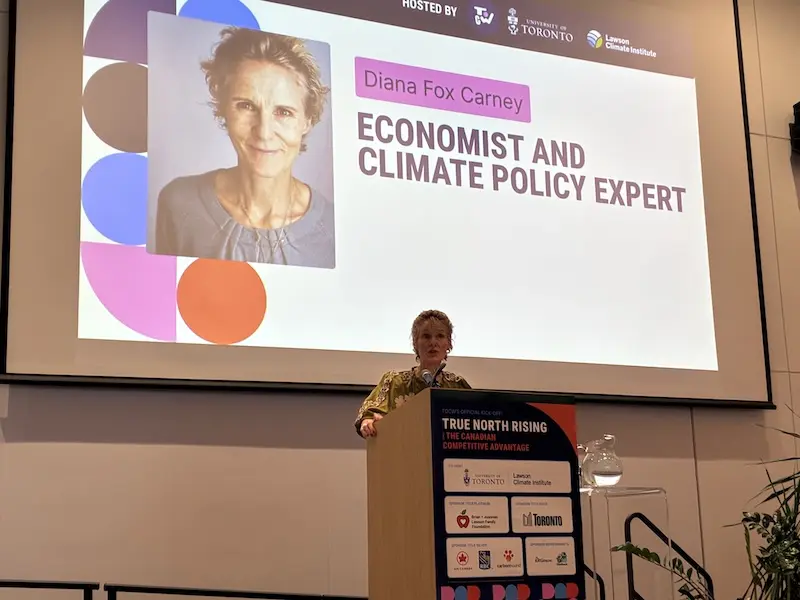
The global energy transition is a moment of opportunity “for countries that are prepared to step up,” and Canada has “so much of what is required to lead,” economist and climate policy specialist Diana Fox Carney told the opening session of Toronto Climate Week June 1.
“The question is not whether change is coming, it already is. The question is whether Canada will lead that change or react to it,” declared Fox Carney, who said she would “leave it to members of the government” to speak for the policies that government has enacted since her husband became prime minister just over a year ago. “Now we need buy-in, we need practical and targeted action, we need investors and businesses to accelerate, we need people to believe in the pathway forward.”
Outside the University of Toronto building where Fox Carney delivered her keynote address, climate activists circulated leaflets decrying rollbacks in past federal climate policies and urging Prime Minister Mark Carney to deliver on his Budget 2025 pledge to invest $40 million in a Youth Climate Corps pilot project. One of the leaflets included suggested questions for Climate Week panelists, but the session format Monday (as several panelists mentioned onsite) did not include time for Q&As.
Youth Climate Corps organizer Minh-Ly De Reboul said the new budget commitment would only be enough to cover about 350 jobs, and even those funds have been delayed. The bigger vision for the Corps and for the government was “supposed to be [about] nation-building, doing big, bold things, building Canada,” she added. But Ottawa’s recent policies are “not building Canada. This is not making us sovereign against the U.S. It’s bringing us back to extractive fossil fuel pipelines.”
In the session hall, Fox Carney traced a career that brought her from a degree in agricultural economics to rural development projects in parts of Africa dealing with a “deeply precarious environment”. After seeing Western countries send grant money for development projects “while simultaneously contributing to a degree of climate change that was simply unmanageable,” she said she shifted her focus to “what actually moves the needle” on climate change and sustainability. Today, she advises investors on climate impact, governance, and risk.
The first lesson learned from that career trajectory is that “real progress now is worth more than idealized answers or aspirational targets for the future,” in a moment when “moral arguments do not get us to where we need to be,” Fox Carney told participants. “In a more volatile and uncertain world where affordability and now security are the dominant concerns, climate action often falls off or fails to reach the list of priorities.”
To reverse those losses and increase the momentum already building for the energy transition, “what’s important is to meet people and pools of money where they are, not where we wish they were,” she added. “We need solutions that are practical, affordable, adaptable, and capable of improving people’s lives right now.”
Much of that momentum is coming from global clean energy investments that are now running far ahead of fossil fuels, despite or because of deep geopolitical uncertainty.
“Investments in clean energy and electrification represent one of the greatest opportunities of our generation, and will shape the economic prospects of our country for decades to come,” she said. And “we’re not the only ones who’ve recognized this. China obviously invests hugely in Europe, even places like in the Gulf. The [United Arab Emirates] has committed $160 billion to clean and renewable energy, and this shift opens up a huge opportunity for countries that are prepared to step up, like Canada.”
Joannah Lawson, co-founder of the Brian + Joannah Lawson Family Foundation, said climate change “is an intensely human problem, and while I’m excited by the technical innovations, the scalable solutions will only happen if they’re embraced by humans.” So “if our solutions do not cross sectors and ways of knowing, particularly time-enduring Indigenous knowledge, we are likely missing something. Individually, we can contribute important elements to propel us forward, but collectively, collaboratively, we can literally change the course of the world.”
Lawson cited four reasons for hope for a better climate future: we know what’s causing the problem; the energy transition is already beginning to address the fossil fuel emissions responsible for three-quarters of the world’s climate pollution; agriculture is moving toward more regenerative techniques; and nature preservation is beginning to gain recognition as an important economic strategy.
“Globally, over half of all GDP depends on nature for services such as water filtration, flood mitigation, pest control, crop pollination, climate regulation, and more,” Lawson told participants. “Canada has 20% of the world’s freshwater, 25% of the world’s wetlands, 24% of the world’s boreal forests, and the world’s longest coastline. As such, Canada has outsized opportunity and responsibility to preserve nature, for us and for the world.”
Lawson closed the session with a promise to youth and a call to action for her own generation.
“I’m disappointed by people in my generation who say, sorry for leaving you with this mess, and we look to you, the next generation, to solve it,” she declared. “To that I respond, as long as we can still work, vote, and donate our time and money, we all need to do everything we can.”
So “my pledge to you, as someone who is part of the older generation looking to the future, I promise to work on mitigating climate change for the rest of my life.”