
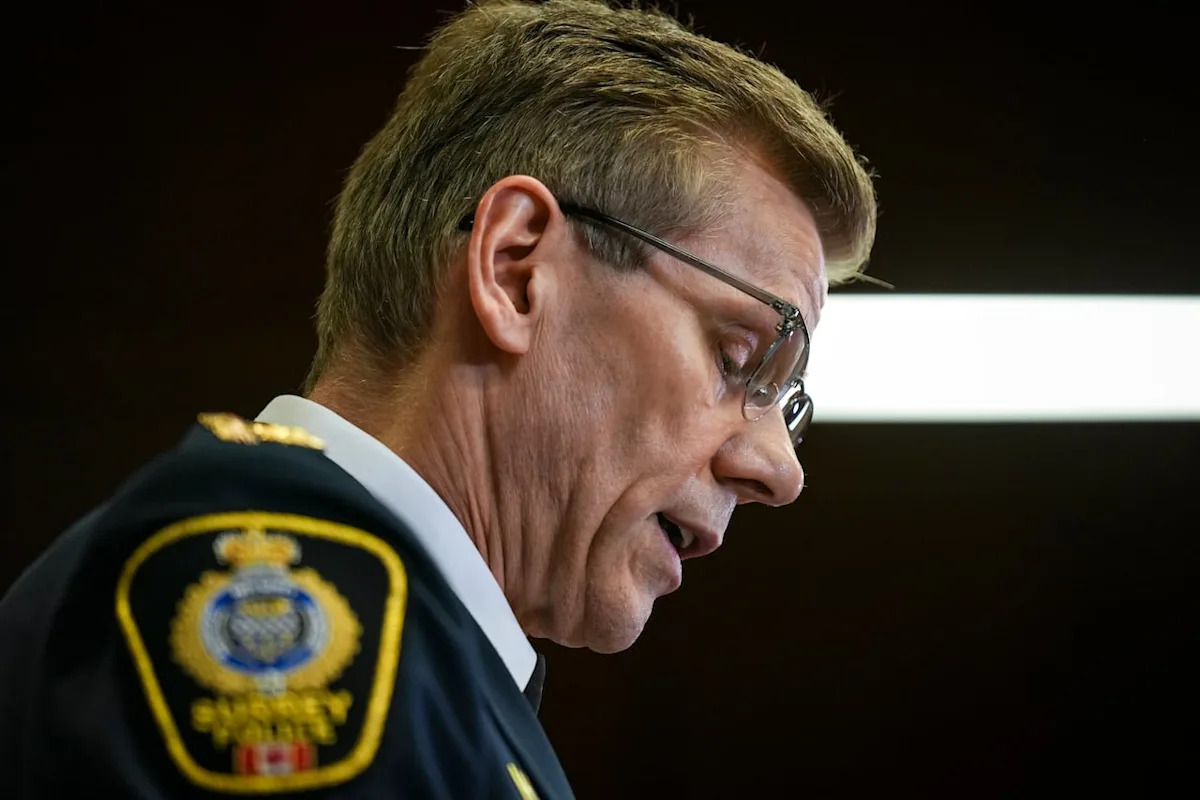
What led to the departure of Surrey’s top cop?
The Surrey Police Board announced Tuesday that Chief Const. Norm Lipinski had left the service.
Now-former police board chair Harley Chappell said the board made the decision to remove Lipinski at a special meeting that Chappell did not attend, leading him to resign in protest.
It all happened at a time when B.C.’s second most populous city is in the middle of a fraught transition from the RCMP to a municipal force that the mayor didn’t want, and has faced a rash of extortion cases and gang-related shootings.
Here’s what we know and what we don’t know about the departure of the chief of the Surrey Police Service.
Whose call was it to oust Lipinski?
That’s the biggest question that’s yet unanswered.
It’s no secret that Mayor Brenda Locke and Lipinski had clashed.
Locke launched a legal battle to fight the move to ditch the RCMP in favour of a municipal force, a bid she lost when a judicial review in 2024 sided with the province. Lipinski often contradicted Locke in public statements about the transition cost, pushing back on Locke’s financial projections and calling them “inflated and mischaracterized.”
Linda Annis, a Surrey city councillor and mayoral candidate, was quick to point the finger at Locke, accusing the mayor of “political interference” that is making the city unsafe.
In a statement, Locke thanked Lipinski for his service but did not respond to the allegations laid out by Annis.
CBC News has not been able to ask Locke about Lipinski’s departure. The mayor cancelled a pre-arranged interview with CBC News on Tuesday, minutes before it was scheduled to begin.
Deputy Chief Const. Todd Matsumoto has been appointed interim chief.
What role did the police board play?
Harley Chappell, who quit Tuesday as board chair, said the decision regarding Lipinski happened at a meeting on Friday that he couldn’t attend. He said he was given no indication Lipinski’s leadership would be on the agenda and he was left “completely in the dark” about the decision on Monday morning.
“I had no inkling that all of, any of the directors wanted Norm removed from his position,” Chappell said.
CBC News has repeatedly tried to contact every Surrey Police Board member who was at the Friday meeting. No one has responded to interview requests.
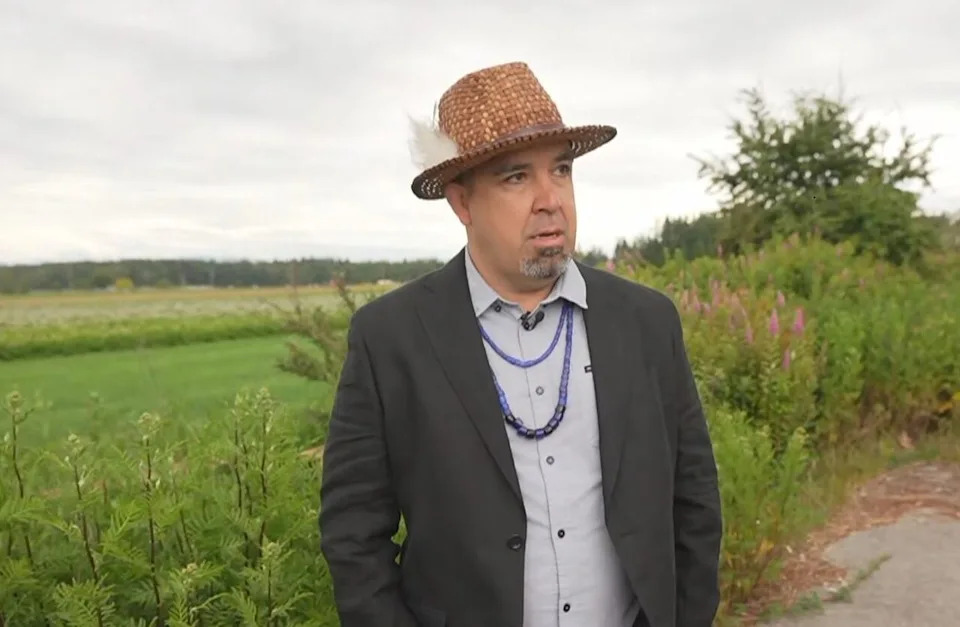
Harley Chappell resigned as board chair after Lipinski’s departure. (CBC News)
Chappell was among a handful of board members who survived a shakeup in February.
Locke had been asking the province for more control over the municipal force.
In February, there was a shakeup with the police board, with new members agreed upon by Locke and the province. Premier David Eby said at the time there was a potential that the whole board would be replaced.
How will this impact Surrey Police Service’s transition?
The road to handing over policing duties from the RCMP to the Surrey Police Service has been a rocky one.
It’s been marred by jurisdictional squabbles, staffing issues, all while the SPS and the RCMP battle ongoing gang violence and an extortion crisis that has primarily targeted the South Asian community.
On May 11, Locke and Lipinski put out duelling press releases addressing a spate of gang-related shootings that left three people dead and two others in critical condition.
Locke wrote to the board chair calling for an “immediate review” of the decision to redeploy officers from the SPS gang unit to the Cloverdale district.
Lipinski’s press release explained that SPS “temporarily repurposed the eight-person gang crime unit to support a citywide response to an unprecedented extortion crisis and, later, to meet accelerated transition timelines.”
That redeployment happened as Lipinski was under pressure to fully take over the Cloverdale district from the RCMP by July.
Earlier this year, he had asked the province for a four-month extension, saying the department was swamped with extortion cases. The province said no.
Chappell said this leadership shakeup won’t help the transition process.
“You don’t change riders in the middle of a stream.”
What’s the province’s role in all this?
On Tuesday, Premier David Eby tried to distance himself from the controversy, saying he hadn’t been fully briefed on what happened. Eby said he told Locke months ago that “the province of B.C. has been too involved in policing in Surrey for too long.”
“It’s time for the local community to take responsibility for their own police force.”
Chappell said it’s a bit rich now for the province to suddenly say it’s taking a hands-off approach.
He told CBC News that Lipinski was feeling the “political pressure from the province to finish this transition and get it done quickly and get it done now.” He said Lipinski wasn’t afraid to push back when he thought public safety might be at risk.
(Mike McArthur/CBC)
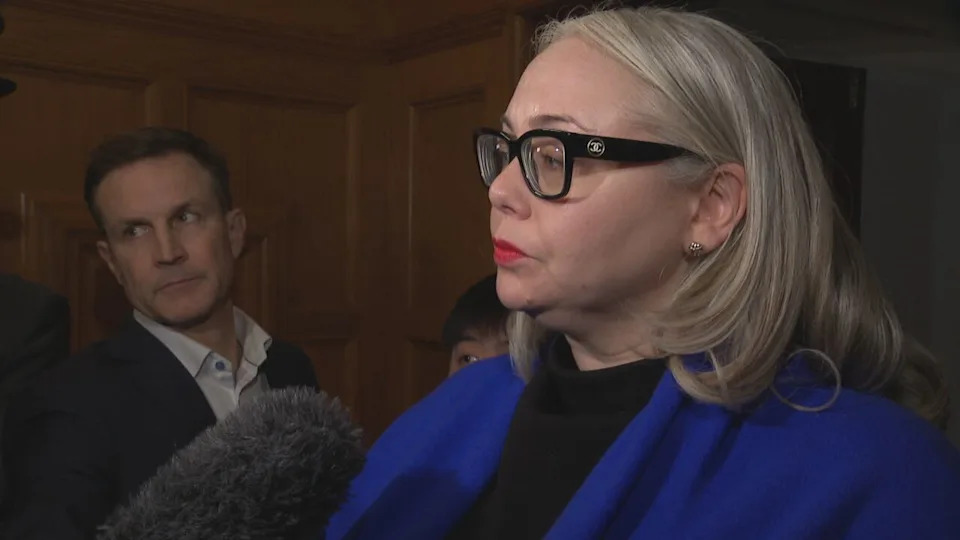
Surrey-Cloverdale MLA Elenore Sturko said the province is the “caretaker of this transition” and Public Safety Minister Nina Krieger owes an explanation to Surrey residents.
CBC News has requested an interview with Krieger.
How much will this cost taxpayers?
Another question hanging over this whole saga is whether Lipinski received a severance package, and if he was made to sign a non-disclosure agreement as a condition of that package. CBC News has reached out repeatedly to every single sitting board member. No one would agree to an interview.
Here’s what we do know. Lipinski’s base salary was $285,000.
His severance would have been negotiated in his contract. High-ranking public sector employees and police chiefs have previously received one to two years’ severance. At the high end, that could mean a bill of a half-million dollars to Surrey taxpayers.